Most recent blog

Final Fantasy XIII Review

Showing posts with label Deus Ex. Show all posts

Sunday, 18 February 2024

Deus Dead

We didn't ask for this

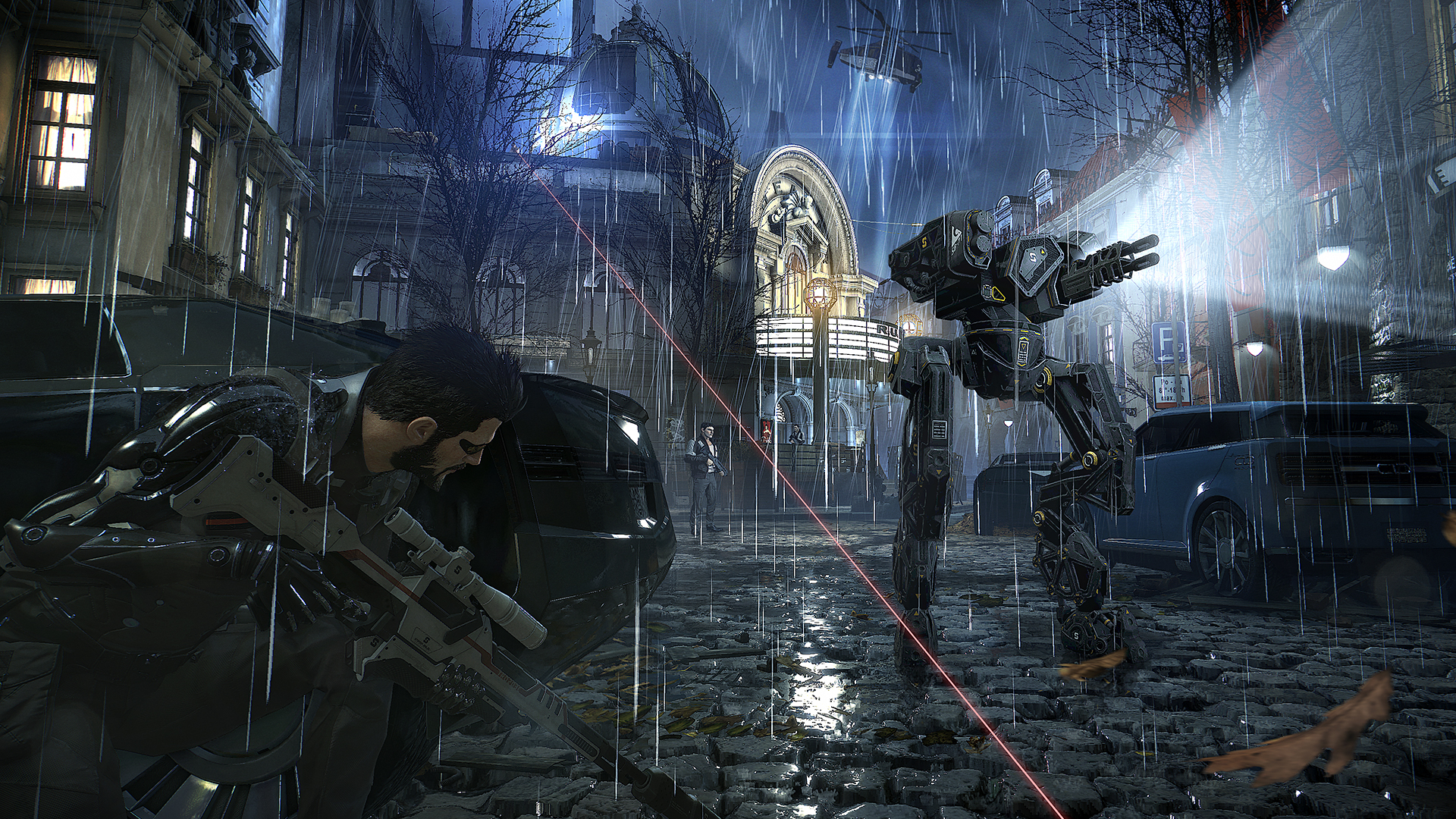
I love Deus Ex. No, not the original classic that is heralded as both one of the most influential and one of the flat best PC games of all time, because I'm not that based. I liked the original, I'd probably play it again someday- but it's Human Revolution that tickles my turnips. That rugged old pointed goateed GOAT cyberninja who Didn't Ask For This(tm) has haunted my lofty expectations for entertainment for years now. How a video game can tell a great multi-layered narrative with explorative story beats, how multi-faceted playstyle design can work at an impeccable level, and how one can style themselves to unreachable levels of rizz through the use of some quality beard oil and sub-dermal indoor shades- Human Revolution taught it all and did it with that subtle over-the-shoulder wink and smile that said "Yeah, I can do this all day. You'd like that, wouldn't you?" But they did not end up doing it all day.

Because you see, Deus Ex is a dead franchise. It is no more. Caput. Donezo. Or at least, the Deus Ex that we were getting to know over the past decade and a bit is. I suppose the very concept of Deus Ex will never and can ever die, probably being cooked up into some sort of ill-fated mobile management game at some point soon- but the Adam Jensen saga- as started by Human Revolutions and royally cocked up in Mankind Divided? The story that was going to give us a direct line into the formation of the Illumanti from the first game: presumably whilst giving us a direct tie to some of the core members to make them all that more interesting come next playthrough? Yeah, he's gone. And we've got confirmation from none other than the man himself.

Elias Toufexis is one of those well beloved actors largely for that one iconic role that is probably now so small a part of his resume that he has to remind himself why people still remind him of it on the street. But we can provide that context for free whenever such a query is raised. It's because of that innate lure that the weathered and beaten crusader who doggedly pursues an unassailable foe with enviable passion and a smooth-as-rocks attitude beneath it all. That an Elias has one of those voices you can just picture. Throw him behind the highly detailed and angularly stylised model of Adam Jensen or the considerable more potato-y face of Cole from Starfield and you can picture their entire person from the moment those characters open their mouth. His has a voice for character, that man does. Which is why when a talent like that is so intrinsically linked to a character, their bad news is the communities bad news. 

Bad news such as the fact that Elias seems to be the sole member of the original team publicly talking about Deus Ex, to such a point that a while back Eidos had to reach out to ask him to stop so that they could perhaps whittle down some of the Deus Ex begging all of their newer products get hounded by. And Elias? Well, he can't live off hope and fan expectation forever. The man himself seems to have thrown in the towel and publicly urged people to put out their candles- their strapping goateed macho man is never coming home and even if there is a future for the Deus Ex brand, it most likely will not continue the story which fascinated me and so many newer Deus Ex fans all those years ago. That timeline is lost to the ethos.

And that has become more apparent from the fact that Eidos is currently owned by the absolute grinder of potential video games known as, wouldn't you know it, the Embracer Group! Oh, what do you know! The company I've been saying for months sound like the proto-religious gated commune accepting all the lost and weary that, in the third act, turns out to be a people-trafficking organ farm run by a governmental shadow cabal in a Dan Brown novel- turns out they're not the safe haven of wayward developers that everyone else was building them up to be all these years! Turns out they're something of a convalescence house within which development studios struggle under an unyielding producer as they slowly stagnate. Turns out- Nominative determinism is a thing!

For Eidos specifically? Embracer has been the foot stamping out the embers of every possible Deus Ex project before it can be born. In fact, Embracer have been reported as cancelling somewhere close to 15 projects before announcement from all over the place- and personally I've yet to see their logo printed in the producer credits of any video game. Looking at a list of their biggest franchises, the only one's I can say I know is Destroy All Humans- for which they produced remakes, not the originals- and Homefront. Which was one of the worst shooter franchises ever made. So not exactly what I'd call a shining beacon of success. But Embracer have been embracing across the industry gobbling up every studio under the sun- almost like a Megacorporation might- wait... has Deus Ex been killed by a company who would look bad under the messaging? (Food for thought.)

Right now let's be honest with one another- you'd have to be an actual moron not to see the market for a Deus Ex game. After Cyberpunk 2077 managed to redeem itself with one final big content update, the genre is wide open for something to fill the gap whilst CDPR fumble about with The Witcher 4 and Project Orion at the same time- and Deus Ex could have ridden that expectation to glory. They could have revived another go around as that 'Deus Ex Universe' thing they wanted to do. They could have dusted off the old angular trench-coat and got us grumbly cyber-daddy back in his airvents. And instead- during the best opportunity window- we have silence. And if Deus Ex isn't in the cards now- they'll never be a better time to make one. So until Eidos can wiggle free from under the amorphous mass of the love-craftian abomination sitting on their back- Deus is Ex-communicado.

Friday, 2 February 2024

Deus Dead


So by now you're probably well aware of my many feelings about the horrific world destroying entity we all loving know as 'The Embracer Group'. A hellish concoction of primordial evils broiling and scheming before the first grass sprouted in the seraphim gardens and the dew of light first glinted some spark of creation. Now risen and collated into a tumorous leech clinging onto the edge of the ever-changing ocean of the corporate world, dangling flush green power with a gambler's wink, toppling empires and establishing dynasties with the flick of a wrist. Embracer's subtle reach snakes around our infrastructure enclosing about us like the ocean wall, embracing us all within the confines of their malignant machinations. Either that or they are a company well in over their heads that is just leaving the world scratching their noggins with every out-of-nowhere split decision!

Point in case being the recent reveal that Deus Ex- a storied video game franchise that holds two the greatest games ever made within the confines of it's entries (the original and Human Revolution) has been shelved despite the obvious potential the franchise has. It's not as though Deus Ex is an unloved franchise by any stretch of the imagination. 'Mankind Divided' may have not had the impact, or the sales, that the team or Square Enix wanted when they set it up as the spring board for their new universe of Deus Ex projects- (That's no exaggeration, by the way. Mankind Divided was literally marketed with a 'Deux Ex Universe' logo, which it retains within the producer credits- they invested hard into making that Square's next big franchise and it absolutely cratered.) But that was only because the game was not quite as spectacular as Human Revolution was. It was not from lack of interest, it was from expectant and unrelenting interest!

Deus Ex was the face of espionage sci-fi storytelling, combining robust roleplaying not just into the story and how you build the character's skills, but also the way in which you choose to move about the tight and multi-pathed levels. It birthed an entire sub-genre of games known as the 'Immersive sim', which I still retain is the worst name for a genre of games ever for how uninformative it is. Without Deus Ex we wouldn't have had the famed Dishonoured series. No Bioshock. No Vampire the Masquerade Bloodlines. And for the record- no Cyberpunk 2077! That's right- a lot of it's design is built squarely around the core tenets of immersive sim philosophy! We're talking about a grandfather of the medium here, getting shafted for no reason!

And it's not as though you can throw up your hands and declare the industry has simply moved on from games like Deus Ex- as though they no longer matter! This past year just saw the revival of belief in CDPR following the disappointment of Cyberpunk 2077. Years in the trenches, patching together smoking pieces of a solid but haphazard game resulted in the spectacular 2.0 update and Phantom Liberty DLC proving that you can stick lipstick on a pig. You know- providing that pig is one of those starlets in a Rom-Com that is a conventionally attractive model that the studio specifically made up to look 'conventionally ugly' specifically for the stereotypical makeover scene. In that ultra specific instance, that pig can rock the makeup.

It was this legacy that Embracer group snatched out of Square Enix's hands when they purchased practically all of Square's western properties in a firesale of undervaluation- and given the seven hundred other companies under Embracer's wing, one would think this was something of a safe space within which to work. Well, others might think that. Again, I've been suspicious of Embracer ever since I heard their name and went yep- that's the name of the bad guys in a 2010's YA novel. But it's becoming increasingly, and depressingly, clear that Embracer apparently have no clue what they're doing juggling all of these properties under their belt and it's starting to show dividends. Negative dividends, that is.

Eidos Montreal were reported to have been working on this Deus Ex game for two years now, and although it wasn't another Adam Jensen story according to the voice actor for that character- (Which is annoying- the final act of his narrative is begging to be told) it would have been a Cyberpunk sci-fi game riding off the success of Phantom Liberty back into a place of prominence. So long as Eidos maintained it's quality spirit, and given the recent Guardians of the Galaxy game they have, Deus Ex would sooth that ache we've had for a new entry. But for some reason, and it was Embracer's decision we are told, the project has been canned and upwards of 100 employees are on the chopping block for removal.

This is, of course, after Embracer brought Volition, squeezed one mediocre Saints Row game out of them and then shut the developer down. And how am I only just hearing that Free Radical Design was shut down by them in December last year? Those are the Timesplitter people, who had been holding on by the seat of their pants for nigh on a decade at this point- but all it took was a little exposure to chemical 'Embracer' to kill them stone dead. Starting to see what I'm saying about this company and how utterly, unforgivably, toxic they are? At this point they're inheriting the old EA reputation for hovering up companies, squeezing out the IPs and then firing all the employees- but at least EA has stopped that heinous act in recent years. (And at least they used their IPs every now and then!)

So Deus Ex after all time has become a dead franchise once again, and now Eidos Montreal has been severely kneecapped if it ever wants to try and pick the game back up again. Just another genius decision by the 'experts' over at Embracer. Seriously, I can't help but wonder if what they're really doing there is just trying to hog as many IPs as possible in order to licence them out to other studios for a payday without any financial expectation on their end- that's the only thing which aligns with they way Embracer have run their nightmare company up until now. At least Eidos is still alive, for now- we can hope for the future in some abstract fashion. You know, until Embracer rises up and swallows the sun to plunge us into an eternal darkness from within which Embracer can flog us all little remembrances of photons for a vastly exaggerated price. The Embracer demons- everybody! 

Thursday, 18 August 2022

"Lets do what Cyberpunk couldn't!"

Let's not.

We are looking at a new dawn for Eidos Montreal now that they've escaped the clutches of the big bad Square Enix, and though I have my considerable misgivings about where they currently reside, big names from Eidos antiquity seem to be adamant that the company is in better hands right now and that the mismanagement of Square is what led them to rough shores initially. Now I don't know about all that, I just know that 'The Embracer Group' sounds like a paramilitary group of post-apocalyptic nut jobs who prescribe the virtues of togetherness by a very literal and violent take on their adopted mantra: "Kill 'em with kindness". But choosing to believe against my gut I guess we can turn our minds off and look at this coming dawn as a new potential start for Dues Ex. And Legacy of Kain. I've never played Legacy of Kain, but so people seem to be excited about that too so I guess I'll be excited for them. Woo.

But this isn't just idle speculation on the many avenues that a free Eidos could go down without Square's boot on their neck, crushing their tracheas. In fact, the only man with a clue in the game's journalism sphere, Paul Tassi, seems to believe there's enough water in this well to parrot what was otherwise idle talk during a podcast about the early days of a new Deus Ex project. Now I know how that sounds, some guy reports on a rumour that some other guy said on a podcast; but Tassi ain't no chump, he does his homework. I trust his reporting a who lot more than I trust anyone else's. So when I see his name in a byline of an article talking about the ambition of a new blossoming Deus Ex game, I'm in the mood take that with a grain of salt and a celebratory cheer. Which I will because my god; it's been far too long since the last Deus Ex game graced us.

Deus Ex is often referred to as one of the greatest PC games ever made, and having played it myself more than two decades after it's release I can attest to the robustness it exhibits even in the modern day. Personally, however, it was Eidos Montreal's 'Human Revolution' that sold me over to the franchise. An incredible Stealth Immersive Sim with huge branching levels, an engaging globe-trotting conspiracy narrative that unfolded across a futuristic-but-grounded sci-fi setting, great script great cast, fun gameplay, timeless set pieces; it was everything to me at the time. It quickly became one of my favourite games of all time. Mankind Divided did so much right, but got so much wrong in the same breath as a sequel. By pure merit of the design direction it felt like a distinctly smaller game so that even though it's length was actually decently comparable to Revolution, it felt like the first act of a three part narrative. (Which is what it was supposed to be.)

Square Enix screwed over the game by assuming it would be enough of a success, whilst defanged, to lure players into sticking around for a three part franchise, even when that style hurt the body of a story in a game series that always delivered fantastic stories. Adam Jensen's narrative was teased heavily to swoop into the original Deus Ex cannon in two huge ways, but we never got to see that play out because Mankind Divided didn't sell well and Square immediately shoved the planned sequels on ice. Another step on their road to throwing in the towel and just going "Welp, we don't know how to make money from these franchises. They must be broken." I don't exactly know where a new Deus Ex would go, but I would hope that Eidos don't abandon Adam Jensen's story in spite of how Square screwed them. (Even if I'm pretty sure I already knew where that narrative was going, who he was going to end up crippling as the final boss and who he maybe ended up being related to from the original game.)

As the apparent rumour goes, Deus Ex are currently looking at their next project to achieve what Cyberpunk couldn't. On it's own that's a pretty decent sentiment, as Paul Tassi himself says it's a pretty confidant goal to shoot for, emulating the runaway success of Cyberpunk only with a landing that doesn't cost the company 75% of it's stock price in the proceeding years; that seems like a win-win all round! But, of course, there's just as many raised eyebrows as there are raised expectations. Such as the question of: what exactly is it that Cyberpunk couldn't do? Except for 'release when it's done', which to be clear would have been no great achievement if it had, that's the bare minimum we hope for. Is it the failure to be the branching RPG epic that people wanted? The failure to create that open-world Cyberpunk immersion that the trailers teased? Failure to provide a meaningful character customisation process that had consequence down the line? Or maybe just failure to stay in people's heads for the right reasons. Because I have to be honest; Deus Ex isn't really primed to tackle a lot of those.

Deus Ex is a single player RPG series with great stories and some choice and consequence, it isn't typically open world or character customisation heavy. In fact, character customisation tipped games usually don't have very well fleshed out leading characters, which would be a stark contrast to Deus Ex's Adam Jensen who's shoes fans have quite enjoyed stepping into over the course of the past two entries, even if Mankind Divided felt more like we were doing side-steps rather than any proud strides in those loafers. There are no fully realised open cities with dynamic crime and punishment systems, both angles that Cyberpunk attempted and failed on (to differing degrees) nor are there tons of meaningful side missions, which Cyberpunk... actually they didn't utterly screw up that department; they just forgot to bring side content that was more than just 'do this fight'. But then, Deus Ex isn't known for it's engaging and encapsulating side content either. In a nutshell; a Deus Ex that does what Cyberpunk doesn't, wouldn't actually cover any of the expectations Deus Ex fans have for a game like that. It would be something totally new altogether. 

So now we've followed Eidos into their lofty dreams, let's confront the practicality because it is stark. A big issue with what CDPR's dreams were, was that they believed themselves to be creating the next tier of open world game in order to steal that throne from Rockstar. Despite the fact that Rockstar have decades of experience making games like that, and a curated team of developers who specialise in those fields. CDPR didn't have the numbers to challenge that. Eidos don't have the numbers to meet CDPR's numbers, let alone to take over from that dream; especially not after they were just sold to a megacorp. Dreaming big is a part of equation and I'm glad that the next generation of minds attacking the Deus Ex franchise aren't doing so without ambition in their step; but letting that ambition slip into blind optimism can be dangerous; and it seems like they're starting right slap bang in that danger zone if their reported planning sentiment holds any real merit.

At the end of the day, Deus Ex doesn't need to be Cyberpunk in order to make all of it's fans happy; that's not what we come back to that series for. Even in the heights of Cyberpunk 2077 hype, people were happy for this game to serve as a companion to the Deus Ex games, not a replacement; and trying to leap frog the trainwreck to start your own steam train seems like a recipe for disaster. I don't want the Cyberpunk genre to become a synonym for 'cursed genre' after two well known Sci-fi franchises live and die at it's door. As much as Kotaku articles want to kill it off; Cyberpunk is still an incredibly cool and fruitful aesthetic and I'd miss it if it were gone. Deus Ex is coming back, and that's the good news I want to take away from this and thus I am going to; all the while hoping that the hopped up lunatic talk dies down by the time development kicks up.

Wednesday, 11 May 2022

So... Is Deus Ex happening or what?

 I asked for this!

Portentous news, everyone! Square Enix have lost their damn minds and are going through a midlife meltdown, burning all of their hard won reputation in a bonfire, shaving their head into a Mohican, buying a Harley Davidson and becoming a biker bro for the summer. In their self sabotaging insanity, Square sold off a good chunk of their greatest studios and IPs to a decentralised Swedish holding company that has a name which sounds like the enigmatic faceless corporation funding the tyrannical corporate crony badguys in a futuristic dystopian novel. ('Embracer Group', huh? It's not what I would have called you but if that's your name, that's your name.) What this means is, for perhaps the first time in a dark moon, we might be getting to see a follow up to the long dead Deus Ex franchise now that Eidos aren't required to Weekend-at-Bernie's up the Avengers game alongside Crystal Dynamics anymore!

Of course this is a might, wrapped in a maybe, and garnished with a possibly. Unlike with the upcoming Next gen Tomb Raider game which is confirmed to not have been confirmed yet, no one seems to have word on any clandestine Dues Ex work in the background. (People are pretty certain a new Tomb Raider in the works. I thought 'Rise' was supposed to be the tying off for this new story thread but I guess maybe we are going to go the distance and just remake the original games. Atlantis here we come!) Thanks to the the Harlequins over in the joke-of-an-initiative know as the 'Deus Ex Universe' leaving us on part one of a supposed trilogy; 'Mankind Divided' has been the unexpected final note of the franchise since 2016, and I, for one, have been begging for some content.

In the place of Deus Ex, we got ourselves a pretender to the throne claiming to offer all the narrative complexity and campaign choice of that storied franchise but with open world exploration and hookers. (Actually, Human Revolution did have hookers in it if I remember right...) But Cyberpunk 2077 ended up having many more problems on it's plate than just trying to be a solid Deus Ex successor, and in hindsight the two series didn't really share much of a similarity to one another aside from the genre they operated in and the appropriate thematic visuals therein. I didn't get my 'Mankind Transcended'. And so the candle in the window has burnt ever onwards, hopeful that this would be the E3 where- oh, it didn't show up. Maybe this Game Awards woul- nope, not a whisper. How about this E3- nope the show was cancelled. Perhaps the Game Awards this year migh- Nope, no such luck. How much longer is a Deus Ex fan supposed to endure?

So yes; I glad that the augmented Jesus franchise has been emancipated from the mistreating swine over at Square Enix. I'd even call a toast were I the type to drink. Instead I'm one to dream, and today I'm dreaming that the Deus Ex franchise has just been offered an olive branch to come back at it once more, right back onto the saddle! Maybe the series may be a little long-toothed, and the sci-fi futuristic body-modding novelty might be slightly worn and patchy, but give her a chance and the world'll see that she still got some good miles on her; yes she does! Whatsmore, I consider it an actual crime for a franchise as narratively driven as Deus Ex to leave us hanging after part 1 of a major narrative thread! (I mean maybe they technically did it before with 'The Fall', but no one really played that apart from me anyway so it's not really a big loss.)

For those who don't remember, or who's memory has mercifully expunged all refence to the cliffhanger that lingers. 'Deus Ex: Mankind Divided' worked a significant distance to bridging together the Adam Jensen character who we fell in love with in 2011's 'Deus Ex: Human Revolutions' with the conspiracy ridden Nanobot hellscape that Deus Ex 1 portrays. You know, a world where there's a decent chance you actually team up with the illuminati in order to fell an even more secretive clandestine organisation called Majestic 12. (God, I miss how Deus Ex was just a smorgasbord of disparate conspiracy theories chucked into a narrative so haphazardly that you can literally run into a little grey alien and it won't even rank on the top 5 most crazy things you've bumped into that level. Also they aren't real aliens, but that's besides the point.)

Whereas 'Human Revolution' neatly breezed us through a globetrotting conspiracy through its runtime which concluded in a climatic showdown to shape the fabric of society. Mankind Divided took nearly the same amount of time (minus 8-10 hours) in order to tell a tiny story about an, admittedly important, legislative measure that could possibly have had an effect, but we wouldn't get to experience it until the next game. Oh, and we actually ended up becoming unwittingly close with a member of the Illuminati who's daughter JC Denton works with in Deus Ex 1; the very same Illuminati who Adam Jensen is supposed to be hunting down. (Wow, he's really bad at his job.) So the main plot was kind of lacklustre, sure, but what a juicy little cliff to perch us on. A great vista, plenty of scope, just make sure you come back around to pick us up in a timely fashion guys. Guys?

But this goes for more than just finishing the story which Eidos started. (Not to belittle how important finishing that story is. Because it is important) This is about bringing back one of the leaders in clever roleplay game design, intelligent script writing which is always at least a sliver more nuanced then you are lead to believe, and immersive sim mastery. In an age where genre niches are being granted more room than ever to find their audience and sometimes even crossover to the mainstream, it almost seems unfair that a leader in cyberpunk video games should be so utterly overshadowed by a replacement who made such a pig's ear of the core tenants of RPGs that people have forgotten how broad, branching and balanced Deus Ex really was at it's peak. (Human Revolution and Deus 1 are timeless masterpieces.)

Embracer Group could very well be collecting these studies and IPs to be trophies on their shelves, to dangle on a mantlepiece so that they look nice, and then never think about them again. I'm choosing to believe that's not the case, and some of the early snippets of excitement that Embracer have put out seems to imply there's room for franchise exploration. Heck, they celebrate being decentralised so much, which I think means they prefer to go hands off and just let these studios create, rather than try and twist them into supporting dead-end live services for the rest of their lives. So I'm hopeful, for the first time in a long time, that the story of Adam Jensen isn't quite over just yet. And god it feels great to say that!

Sunday, 5 September 2021

When Choices don't actually matter

 Your actions have consequences

I actually remember my first time booting up Telltale's The Walking Dead and seeing that ominous message fade onto the screen amid a wall of black. 'Your actions will have consequences' blinked into life and hung for a time, ensuring the message really squirmed into your gut and nestled in your psyche. I'll be honest, it unnerved me. I wasn't throwing my head up and shouting "Finally, a game where things matter!", instead I was glancing to-and-fro, trying to exactly pinpoint how I typically like to play games and what sort of mess that might land me in. Could I accidentally screw up the entire story by not taking it utterly serious from day one? Would the main character instantly explode if I failed to select the perfect rhythm of choices? How serious are the 'consequences' we're talking about? I saw it as a threat directly against the laid back, see how things go, way I used to play narrative based video games, and maybe that was a jolt I needed in order to pay more attention and care about these games.

Obviously it didn't take long for a bit of experience with these types of games, all of whom started with that exact same plodding flash card, for me to realise that my 'actions' would only actually have a very limited set of 'consequences' and usually at highly specific moments where the actions are blindingly obvious. "Will you help the annoying guy or the useless woman in the middle of the zombie attack? Bare in mind, the other probably ain't gonna make it." Titles like these talk a big game about how branching the plot is, or how every single butterfly trod on will cause a cataclysm one world over, but in truth they're limited by the plot and the writers. You can't make every choice lead to some unforeseen consequence, else people will be too terrified to make any choices for fear that they'll screw everything up! (Not to mention the sheer vast range of options and story twists that would take in order to nail down to the wall perfectly.) But some fans can find this to be a bit of a betrayal in that they very much expected for their every choice to become a new plot point. So I wanted to explore some games who flounder or succeed on that very promise.

Take Cyberpunk for instance, being a game that very much sold itself on being a heavily choice-driven experience, but which famously didn't live up to that nearly as much as fans wanted. One of the most commonly quoted points of contention is the 'origin' system, wherein players would get the chance to choose who their character was before the storyline and that would influence the way they would interact with the story. Similar to how a lot of the more hardcore RPGs function. However, that origin ended up influencing only the very beginning of the story and as the plot went on, people found themselves only really being given an influencing part in the main plot at very sparring moments. Most annoying for some, being the fact that some conversations would give you a chance to offer an alternative option (even requiring a skill check to be passed in order to raise the point to begin with) only for your opinion to be overturned in favour of where the game wants you to go. Presumably the option is just there for characterisation in showing how smart or capable the player is then? It mostly just frustrated instead.

Pillars of Eternity is a game that doesn't suffer nearly the same amount of narrative hatred, even though it does actually handle it's origin choices very similarly. In that when you select where you came from, what your species is, and what you do; oftentimes that comes up very rarely in conversation, and when it does it comes as mere flavour text that is then contributes nothing tangible to the actual scene or interaction. The sequel does a much better job of this, but in the first game the only point I can recall where something tangible can be done depending on what your character is, was in the very beginning of the game where you find some braziers which can only be lit if your character is a fire god-like. But even that doesn't make any sense because you actually find torches littered all over the place, why can't they light the braziers? Of course, the rest of the game has a lot of choices and branching quests independent of your character creation choices, so this is more a 'drop in the bucket' problem for Pillars, but Obsidian did take steps to rectify it for the next game so it was definitely a recognisable problem.

On the other side of the spectrum we have games like Deus Ex, where we are presented with a world where choices do matter. Now by it's very nature, Deus Ex is a series where player choice shapes the experience, as this is a stealth-based immersive sim, and so building your character to be better at hacking defences and turning them against the enemy is going to change how you approach pretty much every area of the game. But choices effect the story too in that you're given chances to effect the progression or ending of practically every single encounter and mission in these games. A lot of these are self contained instances, wherein the matter is opened and closed within this quest alone and the wider narrative carries on unabated, but the effect still rings true in that the player feels like an active architect in their own fate.  On the otherside of the adventure, this means all these games have huge branching finales that can mean drastically different things for the future of the world and the people who live therein, encouraging replayability as these sorts of systems are designed to do.

So we've seen examples of both successes and failures in this field, but what of a successful failure? Mass Effect and Fallout 4 both have shades of everything we've already talked about in them, however when it comes to choices and consequence there is a shared criticism that these games illicit more than any other; the misleading dialogue option. With the very nature of how dialogue is handled in these games, a preview for the player followed by a full response from their avatar, there comes a few situations where the player will pick an option only for the response to veer in tone drastically from what they expected. This isn't necessarily an example of the writing lacking the scope to change the story, but can still feel like choice being invalidated due to the game interpreting your choices in a way that you didn't intend for. My example for this would be during Mass Effect Andromeda, where if you're too friendly with a swashbuckling smuggler side character the game will automatically assume you are pursuing a serious scandalous relationship there, which leads to some very awkward 'surprise intimacy' moments down the line. (I didn't know it was that easy to lead a guy on...)

I've touched upon a bunch of different types of promised consequence met by disappointing payoff, and what I've landed on is that mostly successful payoff (like Deus Ex) relies heavily on choice that has a distinct effect rather than choice that merely adds flavour; but does that automatically mean flavour options are bad? Whenever I was playing the Pillars games and an option would pop up to indicate that the experiences I'd had or the options I'd selected in character creation, would give me a unique option, I'd pick it. Personally, I saw these not as new paths to through the narrative that needed to branch into new questlines, but just an expansion of who I was, providing a unique perspective that I wouldn't have otherwise gotten to experience. But I think the key is balance. Don't promise your game will be a choice-important romp if the majority of your choices merely add context that the other person would have shared anyway.

There are a lot more examples of choice versus consequence in the interactive story games out there, but I found a lot of those example to be much more situational and specific than what I was talking about here. Although I bet it would be fun to pick out some of those games and really go to town on the key choices of certain episodes, maybe I'll do that sometime. My view on things is that choices and consequences shouldn't ever really be the key selling point of your game, but merely some spice thrown in there to mix up the pot, provide some replay value. Because when you put the weight of the game on it, then you open yourself up to criticism about "But what about this moment where I couldn't choose?" or "Why didn't this choice mean as much as that one?" At the end of the day the tag is performative more than anything else, no one really wants to make a story where every element of it can be pulled apart my some scrappy player who thinks they know the best solution to every problem. It's the writer's story at the end of the day and is limited by the shades that they want to explore, maybe that's a reality that game's marketers need to be more cognizant to in the future if they want to avoid unnecessary disappointment. 

Thursday, 17 December 2020

Mankind Divided and the Deus Exit.

Come back to us, Eidos, I promise we won't be mad.


So now that Cyberpunk is out it's got me thinking about the other Cyberpunk-type games that walked so that this one could run. Or rather, I've found myself postulating on the one series that deep sixed itself conveniently just so that Cyberpunk could swoop an enjoy an entirely clean playing field; that series being the Deus Ex franchise. Deus Ex is often considered to be one of the best PC games ever made, and the legacy it spawned can often be just as lauded in their own unique little ways. (I'm even told that some could stand Invisible war long enough to finish the first level. Amazing what some folk are capable of!) In fact, until this 2020, Deus Ex was really the only game in which you could take a conspiratorial look at the dark future as well as address the ethical and philosophical quandaries around the role of transhumanism in evolution. Deus Ex was that higher tier game which was mature enough to ask the bigger questions and be of consequence in it's narrative. Until Mankind Divided, that is.

Something about that game just seemed to drive everything of course in a manner that no one could of foreseen. What was designed to be the springboard for a whole Deus Ex Universe backfired wildly and ended up banishing the entire franchise to a limbo realm in which it still resides to this day. Now we've got former Deus Ex devs putting together trash like Square's Avengers, and there comes a moment to lean back and ask "Where in the heck did it all go wrong?" I remember back when Human Revolution launched and it was hailed as the true successor to Deus Ex original, and I remember how I fell in love with it's bleak view of the future from day one. There was just something so tangible and believable about what we saw, something that was lacking from the unfounded optimism of Star Trek and the unabashed whimsy of Star Wars or Mass Effect. This was a harsh futuristic reality that echoed so much of the world around us, and yet was still fun enough to be a game worth devoting free time to. So why couldn't Mankind Divided capture that same spirit?

I think that in order to quite isolate the things that Mankind Divided did wrong, we need to highlight where Human Revolution got things right, so let's start there. Firstly, Human Revolution, despite being a prequel to the original Deus Ex, set itself far enough apart from the original for it's story to be entirely unique and yet still of consequence. This allowed for newcomers to the franchise, like me, to play without feeling that we were missing out on huge chunks of the larger narrative. Indeed, the story was pretty much entirely self contained too! The story also followed this huge globetrotting adventure as Adam Jensen followed the trail of a conspiracy across to the other side of the world and back again. I cannot understate how diverse the locations are that you travel to in Human Revolution are, it really invokes the sense of an epic and wild adventure through this corporate-ruled world. The characters were all well written, with arks that neatly fit within the story; quirky features such as the interrogation mode were used sparingly enough to be special but often enough to be justified; progression was balanced out perfectly across the game; level design allowed for unique playstyles; the artistic direction was almost always arresting; the presentation of narrative-central information felt dynamic and interesting; side quests felt fleshed out- Basically there's a list the size of my arm for all the reasons why Human Revolution is one of the best games of it's decade. But how much of that did Mankind Divided replicate?

Honestly, quite a fair bit by my reckoning. And that's what makes everything so darn infuriating when it comes to the state of the Deus Ex franchise. The gameplay in particular saw a huge glow-up for Mankind Divided, with cybernetic abilities becoming more encouraged then ever before due to a user-friendly recharge system. The Gunplay felt a lot better, side quests felt a little touched up; and, dare I say it, the level design really stepped up it's game. But in a strange twist of events, I think the improvements to the game design was where the problems started. You see, for the Human Revolution the levels were designed to be open ended, but they really had three main routes to them in most situations; sneaking, fighting or taking some sort of shortcut that was enabled through a skill check. This way the team could work on making things feel dynamic and yet still be functional. I think the same basic philosophy was applied towards Mankind Divided, but somewhere along the line there was a shift which tipped things out of balance a bit.


The levels in Mankind Divided quite frankly dwarf Human Revolution; but that increase in size and options means more development time put in each level to the point where, honestly, some locations became ungainly and overwhelming. I know, it's a strange thing to admonish in a Stealth RPG immersive sim, but it's genuinely where I landed on the matter. Rather than handle new locations like I would in Human Revolution, by observing the whole picture and then picking my path through it, I would end up just going with whatever worked and taking any route which opened up to me. Now this is both a positive, because it means that new playthroughs still surprise me, and a negative, because it made me feels constantly out of control of my surroundings. Now you may look upon all that and think I'm ranting like a mad person and how you don't agree with me at all; but even if that's the case listen up, because the issue I just described, though mostly subjective, is just the tip of the iceberg.


You see, I think that because of the added effort which went into designing each individual area it led to a severe lack of making new areas, because there just wasn't the time for that. Point in case, the Hubs. These are locations wherein the player is meant to travel to between missions and mosey around, sometimes outside of the breadth of the main narrative. You can get know the world around you, take on side quests, explore this snippet of society and start to immerse yourself in the calmer moments of the narrative. It' just, Mankind Divided only has one Hub, whilst Human Revolution had two. This may seem insignificant, as Prague is a beautifully detailed and realised environment which easily surpasses the last games' in scale and realised potential; (A lot of great key moments happen there) but oddly enough the problems come back down to the storytelling. Remember how I congratulated Human Revolution for being globe trotting? Mankind Divided does the opposite to that by setting all the locations in roughly the same part of the world and brining us back to the same city inbetween each mission, robbing a lot of the romance of adventure from the story. This is especially off putting for a Deus Ex game, because it's a franchise that bases itself on global conspiracies and worldwide corruptions, and yet you never get to actually travel worldwide; once again imparting the feeling of a insignificant snail in a bigger world. In any other Cyberpunk game I would say that this is exactly what you want, a world that's bigger than the scope of the story, but Deus Ex is a special case wherein the story is about coming to terms with that wider world and analysing it; something which Mankind Divided only ever scratches at in it's final moments.

Which brings us to our final, and most damning, point against Mankind Divided; The storyline. Human Revolution's storyline throws it's players into a world on the peripheral of a huge leap forward in technology and the way it'll influence our lives, rewriting the very way we look at human capabilities, and alongside that trails the warring opinions about how such a monumental evolution should be treated. What starts as a very personal tale to uncover the truth behind a terrorist attack that cost your protagonist dearly balloons into an epic and far-reaching mission to, eventually, save the very world itself. It's in this way that Deus Ex differentiates itself from similar games in its genre and becomes something more akin to a Science Fantasy in narrative, but that just lends to the unique feeling of what a Deus Ex game is. Mankind Divided, on the otherhand, immediately undermines the events and multiple endings of Human Revolution and, in the effort of serving as the beginning of a series of games, trucks along at a snails pace wherein the entire breadth of the game is spent trying to solve the initial presented problem. The narrative never significantly evolves, 'the world' never enters the stakes in a significant manner and the endings are left murky, with the true implications of each choice promising to be subtle changes to the world state going forward. Now again, that's not inherently bad by any stretch of the imagination, but it's not Deus Ex. It's not what the series was built on. As a result, by the end of Mankind Divided you feel like you've just finished the first act of a story when the credits start rolling and probably aren't looking forward to waiting another 3 years for the next entry. (That's '3 years' if the franchise hadn't frozen. Now we're sitting at 5.)

You wanna know the funny thing? Mankind Divided isn't even that much shorter than Human Revolution in terms of content. Myself I only noticed a 4-5 hour difference. (Although I was playing HR as a veteran and MD for the first time ever) It just goes to show how a misjudgement in narrative can really shake up how full a game feels, making one experience feel like a shallow pit compared to the other. And when it's all said and done, I don't even really know who to blame for all this. Is it Eidos Montreal for leaning too hard into making a universe over just the one story? Square Enix for mandating that change with monetary intentions? Both for biting off more than they could chew? Whatever the case, the result is that Mankind Divided wasn't as well received as previous entries and now everything hangs in the balance whilst Eidos is dragged through the dog house and us fans lose hope. But let me be the first to say it, even with Cyberpunk here, I haven't lost hope in you, Deus Ex, and there'll always be room at the table for another Cyber-fuelled dark-future epic, as far as I'm concerned at least.

Sunday, 1 December 2019

How RPG's can bring out a personality

You can't defeat evil with RPG's!

I am an open book. Truly. That book may be little more than a dime-store novella, but it's clear and open none-the-less. I know exactly who I am and the metaphorical lines that I will draw in the sand when presented with ethical quandaries. I know the point to which I am willing and able to stand my ground and to which degree my innate, and overbearing, cowardice takes over. (Hint: it doesn't take much.) How do I know all this about myself? A combination of life-long candidness, too much time on my hands, and a love for that most illuminating of video game genre's; RPGs. (Two of those factors may feed into the other.)

What exactly do I mean by that? Well, me, I'm merely expressing my belief that games which shape themselves around player choice and consequence are ideal for introspective self-analysis. (Arguably in a very 'surface level' manner but y'all gotta start somewhere, right?) I credit this to the way in which many of the most popular RPG games of the age have endeavoured to stick players in scenarios which encourage difficult choices and labour them with little to no baggage, allowing for players to really immerse themselves into their characters in a practical and/or emotional manner. This is the concept that I intend to explore today. (With examples!)

The art of developing a difficult choice in a player driven narrative is both deeply taxing and rewarding. It demands the developer to explore multiple very appealing solutions to a huge problem, exploration that must be exhaustive in every regard. (Which is difficult for the standard person to achieve with their very biased minds.) And it is rewarding in that, when you go beyond the standard 'good' and 'bad' of a decision, you are left with a decision that branches into the personal politics of the player, with the potential to cut very deep from an emotional angle. Such a decision is not only just heavily revealing for an individual, but has the potential to haunt them for long after they put the controller down. (One of highest praises that a storyteller can achieve.) One such choice for me stemmed from a series known for it's difficult choices; TellTale's The Walking Dead Season 1 (spoilers impending).

 Although, as I hinted, there are many head-scratcher decisions that divided fan bases, there is one in particular that resonated on a deeply visceral level with me. Namely the scene near the midpoint of the series when players are left deciding what to do with Duck. Duck is the annoying son of your closest friend in the game, Kenny, who's dumb kid antics has already led to one guy getting the chomp and almost endangered the whole party at one point. Despite that, he is still Kenny's Son, and when that kid ends up bitten it is becomes a difficult pill for the old lug to swallow. Even more difficult for his wife, who would rather shoot herself then have to harm her son (which she does.) leaving Kenny in an even more heartbroken state that hinders his ability to do what must be done. At this point the player is given the choice to encourage Kenny into mercy killing his own son or do it for him. I found that this choice in particular always wrestled with me as I struggled with the merciful decision and the concept of stealing away Kenny's last moment with his son. In one way, that is scenario that no father should have to go through, and yet it is also something that only a father has the right to do. Whichever direction that the player eventually falls on the issue, they are left with an insight into how they view such an abnormal situation which they, hopefully, would never have experienced otherwise.

Of course, situations like that work much better when paired with the 'blank slate' character archetype, which comes with it's own difficulties and rewards to bring to life. As puppeteers of the main show, it is fitting for games to put players in the shoes of the protagonist by depriving that leading character of all their back story and previous driving forces, allowing for the person to stick themselves into that blank space. The problem with this is that most great narratives tie story progression to character development, which can be difficult to achieve when your character pointedly possess no personality. Therefore balances must be struck in order to put players in the perfect place wherein they have empty shoes to fill and an emotional journey that promises to twist and jive in the future.

One such example of a game which famously did this to great success was 'Star Wars: Knights of the Old Republic'. That story kicked off with players being shoved into the passenger quarters of a starship under siege by the Sith with no memory of how they got there or who they are. Whilst the 'suprise amensia' trope is painfully overdone in media, here it has a functional purpose (giving the players a blank soul to inhabit) and has a genuine reason for happening with a solid payoff down the line. (Which I will not be spoiling.) Other great RPG's have followed suit too, with 'Fallout: New Vegas' starting with the protagonist getting shot in the head, justifying that amnesia; and all the Elder Scrolls games starts with a nobody who's never achieved anything noteworthy in the lives, allowing for the audience to jump right in and change all that.

Finally, the most important ingredient in this recipe is 'immersion'. This is the way in which the game developers attempt to ground the player and contextualize them within this fictional world in order to encourage players to believe in this world and care what happens to it. This is the best way in which a game can accurately bring out an individual's personality as it can lightly trick them into believing the world in which they inhabit. There is no handbook to creating great immersion, but there are a few notable examples of some games and genre's that pull it off to great gusto.

The 'Immersive sim' genre is full of games that pull off great settings that tend to be, go figure, immersive. These are examples wherein the game is a narrative driven experience for which the player is along for every step of the way, including during the 'in-between' moments at home. Oftentimes these games involve players getting the chance to learn their neighbourhood and become familiar with their environment for an inevitable third act surprise attack. Dishonored had players trek around the Hounds Pit pub, Dues Ex had players regularly visiting futuristic New York and 'Vampire the Masquerade Bloodlines' lets you stalk the LA shadows. That little touch of letting players familiarize themselves with their world is a subtle but handy immersive tool, as it gets them invested when their actions begin to change their little slice of that world.

All of these factors come together in the best RPG's in a manner which can, in the right circumstance, help tease out the particulars of one's personality. I say this as an individual who is, and has been, very shy throughout my life. I've always had trouble interacting with others for that initial leap, but once a conversation is started I can rattle off forever. My time with video games is partially responsible for that because they have made me more confidant in my personality and the cocksure arse that I can sometimes be. Which makes for a measurable change in my person from when I was a kid and entirely unable to sustain conversation altogether.

It might seem tenuous and pedantic to attribute such a growth in character to the subtle actions of video game developers and storytellers, but I have learnt never to underestimate the power of fiction to teach us things about ourselves. (Else I would never have discovered my own passion for storytelling.) Even as we play characters up on the screen or on a digital stage, we are playing shadows of ourselves with more shades of truth to them than fiction. That's not to say that, just because you have a habit of going on murder sprees in your RPG games, that such violent tendencies reflects your readiness to do the same in real life (we're not about to 'Jack Thompson' this up); but it does go to show your willingness to exploit an environment with little to no consequence, or explore a antithetical morality to your own. There's always something to learn about yourself in these kinds of games, you only need to pay attention and see.

Wednesday, 20 November 2019

Prosthetic Limbs

We can rebuild him!

Limbs are very important to human beings. (Judging by Spore's economy I can personally attest to how much DNA they cost to unlock in the first place.) As such it can be devastating to lose a limb and be forced to readjust to simple life. Luckily, in this enlightened age of ours, there exist handy prosthetic replacements for our lost limbs which can sometimes be as sturdy and versatile as the real thing. 'As good as' isn't enough for video games, however, and for that reason whenever prosthetics make it to the video game world, they often come with so many bells and whistles that one might wonder if it's worth keeping our flabby weak human bodies when we can have some of these incredible creations.

Whether we have a story exploring the limits of humanity in transhumanist philosophies, or simply a game in which an Anime-esque hunk uses his robot arm as a baton; Video games are full of examples of this kind of body modification. I suppose developers can see it as a 'proof of struggle' to lose one's limb, as it can be one of the hardest injuries to overcome. However such developers also realize that few people want to play a game wherein they are subject to a disfigurement, and so out come the robot replacements. That might be a simplification but I'd wager that train of thought legitimately paid some role in the absolute deluge of prosthetic limbs we've seen in games.

One could not start a subject like this without starting with the grandfather of it all; Metal Gear Solid Peacewalker. (Huh, that's two mentions in one week. I might be having another relapse...) Fans might remember a very distinctive prosthetic arm in that game belonging to one- hold on- Vladimir Aleksandrovich Zadornov. (Phew, that's a mouthful.) When first introduced he appears to be a humble college professor travelling with his innocent schoolgirl accomplice who's name is literally 'Paz', which is Spanish for 'peace'. (There's a secret cover story that's trying too hard.) There's only one problem, the man has a bright metal robot hand that doubles as a cigarette lighter. (You get that from grading papers professor?) By the time this incredibly suspicious man, who just happens to hire you to investigate an extra-legal CIA occupation, reveals himself to be a Soviet spy, no one in the audience can manage so much as a pity gasp. Unfortunately this particular prosthetic doesn't prove very useful for Zadornov. Once he gets shot by Big Boss, after attempting an incredibly ill-advised quick draw against 'the world's greatest soldier', he makes a last ditch go for Snake by launching his robot arm with it's built in rocket function (What? Your prosthetic doesn't have one?) only to completely whiff his target and hit the wall. A sad way to go for the world's most conspicuous infiltration operative.

The arm, however, lived on. In the prequel to MGS V, 'Metal Gear Solid: Ground Zeroes', Snake is caught in a helicopter crash that costs him his arm and rugged beauty. (Those scars might have some charm to them but the giant horn-shaped debris sticking out of his forehead will definitely cost him some Tinder matches.) But opportunity arises from tragedy as in 'Metal Gear Solid: the Phantom Pain' his old rival, Shalashaska, (colloquially known as Revolver Ocelot) gives him a replacement arm that is known as 'The Bionic arm'. (Probably because 'The Phantom Limb' made too much sense.) This arm is modelled directly off of Zadornov's, for some reason, all the way down to the red paint job. Player's can even unlock the ability to launch it from their arm down the line, just like the 'professor', except Snake's comes with remote control. (That's how you avoid looking like an idiot, Zardornov, by firing your forearm at your combatants instead of your very functional firearms.)

Okay, so I've never played Devil May Cry 4 (I own it, I'm just a lazy piece of poop) but as far I understand it, there is a point wherein the adorable little cherub Nero has his arm sawn off through means that have never been explicitly discussed. (Bummer.) Rather then settle down and live off his impending disability benefits, Nero lived up to his name-sake and decided to secure a demonic replacement known as Devil Bringer. (Maybe not officially a prosthetic but I'm counting it!) In DMC 5, the platinum haired Nero loses this demonic gift and is forced to replace it with a robotic arm called Devil Breaker. This one has the ability fire unearthly demon beams at enemies, pull them over Scorpion-style in order to prolong a combo, and make it explode. (As you do.) However, Nero is in luck because some charitable soul decided to scatter levels with replacement arms, for some reason. (I guess the NHS are over funded in the DMC universe.)

Of course, there is one classic video game character who's prosthetic is so iconic that most forget he even has it, despite the fact it's really hard to ignore a huge black man with a Vulcan minigun for an arm. As I remember it is never explicitly explained why Barret has his minigun arm, nor why his former friend entrusted him with the raising of his daughter in spite of that aforementioned child-unfriendly implement. Whatever the reason, it means that Barret Wallace if often a stable of any team makeup for FF7 due to his useful ranged attacks and his tankiness. (Primarily for the tankiness.) It sure is encouraging that the Shinra of Midgard allow a man who should be classified as a weapon to walk the streets unhindered. (I bet he doesn't even get stop searched.)

On a more philosophical note 'Deus Ex Human Revolutions' proposed an interesting question; if your body was damaged to such a degree that you required a body worth of robotics in order to live, are you still human? (The ol' 'Ship of Thesus' question. ) Every part of Adam Jensen's body is redesigned by David Sarif into tools for hunting down those that kidnapped legendary scientist Megan Reed. Adam is forced to confront a body he doesn't recognize in a world torn by prejudice against the mechanically enhanced as he unravels the world's deepest cabal. (God, I sound like a movie announcer.) Honestly, this is one of my favourite examples of transhumanism in gaming and I sure hope that Jensen's story gets a third game to round out the story. (For the love of god, Square, I'm begging you!)

Tactical revolution, 'Xcom: Enemy Unknown', encountered some controversy regarding prosthetics when it came to envisioning their expansion/new release: 'Enemy Within'. This arose because the new 'mech units', who were designed to balance against the powerful Alien robotics from the late game, had to be piloted by individuals without arms or legs. (So that the mech suit could act as a replacement.) This meant that those who wanted to turn their soldiers into mech units would have to opt them into a procedure to have their limbs removed and replaced with metallic supplements. At the time there was some hubub by those who thought this was 'glorifying body mutilation', but then there were people who claimed that Xcom 2's badass Alien-head wall was 'unhygenic' so I don't but much stock in the word of outrage warriors.

Hold on. Another Metal Gear mention? I've gone mad with power! As it turns out, there is yet another example of prosthetics in Metal Gear, although this one did go a little overboard. Anime schoolboy stand-in, Raiden, was far-in-large the least cool member of the Metal Gear cast after his debut in Metal Gear Solid 2. Especially in the way that they replaced series icon Snake with a guy who is such a pathetic spy that his girlfriend is on the support line and repeatedly calls him by his real name several times over the airwaves. ("Jack, do you know what day it is?") Hideo Kojima amended this by replacing most of Raiden's body with cybernetics in Metal Gear Solid 4 and having him literally wield a samurai sword into battle. (I'm fairly sure this counts as overcompensation.) In Metal Gear Rising Revengence, Raiden has even more bodyparts replaced and essentially becomes a murder fueled robot of death and destruction. (Without all the philosophical hints that Deus Ex implemented.) Throw in a line where cyborg Raiden utters that infamous line; "The Memes!" and Kojima may have created the ultimate life form.

Bizarrely this is such a common trend across video games that I had to leave out a few of the ideas that I had come up with. (The Sekiro arm is too similar to Devil Breaker anyway.) Personally, I do enjoy the hints of imagination that this particular cliche invokes, not just in gaming, but for story telling in general. That 'body horror' angle mixed with typical badass-ery is just the right blend of surreal cool to make me smile every time; and I look forward to see if future games with this idea, like Cyberpunk 2077, go the whole hog and show all angles, the cool and the weird, all in one package.

Thursday, 7 November 2019

In defence of: linearity

Down the only road I've ever been down.

Every now and then there develops a trend in the world of gaming. Usually it spawns from something good and imaginative, just like any cliche, only to become repetitive and overused in no-time flat. In the early 2010's this was the fabled 'Multiple ending'. For a good few years it was genuinely considered lazy not to shoehorn some sort of branching ending into your game, even when such was completely superfluous to the main story. If you don't believe me on that, do you remember how Call of Duty Black Ops 2 had multiple endings? That's right even the big boy in the playground, Mr "Too big to fail", succumbed to the trend of passionless multiple endings for fear of looking silly amongst his peers.

It was all pretty ridiculous when you think about it, as imbuing a story with multiple endings doesn't automatically give that story depth. (Just look at Black Ops 2.) Usually, all this amounted to was the player having a slight choice thrown towards them near the end that'll slightly changed the ending cinematic. (Ohhh, how branching!) It never should have caught on in the first place, but there were so many big games successfully pulling it off that creatively bankrupt publishers felt it their civic duty to conscript developers into manning low effort rip offs. Games like GTA V, 'Deus Ex: Human Revolutions' and Dishonored, all featured multi-choice endings and all enjoyed some sort of critical and/or commercial success. However, in my opinion the one which really sold the concept to the world was Mass Effect 3. Say what you will about that ending, the main game was nothing short of a gaming cultural phenomenon. Everybody knew that Mass Effect was wrapping up in a grand way and people were just buzzing about the 'every choice matters' promise that many convinced themselves had been made. Replicating that would take effort, most publishers realized, but multiple endings could achieve the same effect simply and with gusto.

During this whirlwind of a fad, there was one obvious casualty amidst the gaming archetypes of the age. Namely, those games that choose to go for a single ending. This was the age in which such a direction in design was considered a crime towards creativity, and all those that were guilty of such would be labelled with that most damning of brands; 'Linear!' I'm being serious, look back on games of the early 2010's and check reviews from all the trusted critics. Almost all of them would bring up the phrase 'Linear' and use it as a pejorative to throw at the game. Afterall, games are all about empowering the player, so if you don't account for that one time they punched a jellyfish in the face and bring it up in the ending, you're stifling the player's freedoms! (Or at least, that's what I assume the logic was.)

The thing which always got to me was the fact that there is nothing inherently wrong with being 'Linear' with your story. In fact, usually that isn't a sign that you lack the creativity to expand out your story, but more that you posses the focus to fully realize your intended story. Many great games from around this time were all out attacked for their linearity despite handling it incredibly deftly. Sure, there's some overly noir moments in 'Max Payne 3', but the linear story was a blast. (I still maintain that game was the closet we ever came to a good Die Hard game). Assassin's Creed Brotherhood met with some grumblings in this regard despite being arguably the best written (and in-arguably the best paced) entry in the series. And even 'Bioshock: Infinite' only managed to get people to say that the story was 'good, for a linear title'.

Everytime I saw a review like that I would just grimace and bear it, confused by this mass hysteria that I fundamentally didn't understand. Even back then I could see how multiple endings for video games rarely lived up to the promise they made, if not now then in the future. Who remembers the GTA V ending? (Spoilers) That ended with Franklin being given the choice to off Trevor or Micheal in order to save himself. (And, of course, there was the option to rally against the man handing this ultimatum and risk everyone. Guess which ending everyone choose.) Whilst this initially looked interesting, in hindsight it was really rather shallow as the only ending which makes any remote sense is the one in which they kill off Trevor. You know, the guy who's insane antics got them in this position to begin with. The other two endings felt nigh-on nonsensical (Like the one in which Micheal opts to kill himself rather than be saved by Franklin.) or a bit too cleanly wrapped for a tale about 3 murderous bankrobbers. (It's a setup.)

That isn't even the worst of it. Just look at those games that were praised for offering those genuinely distinct endings which inexplicably granted real power behind the player's decision; Like 'Deus Ex: Human Revolution'. That was a game which placed itself in a precarious situation by being a prequel, in that it came from a franchise renowned for it's branching endings and yet would have to adhere to the state of the world in the original Deus Ex. To solve this, the writers ended up focusing on a supremely important but underexplored portion of the original game's lore, The Illuminati, and focused that final decision around them. This allowed for a final choice that gave the player the power to change the world in significant ways without retconning anything. (Supremely clever!) So what was the problem? Well, 'Human Revolution' was a huge success and warranted a sequel. So what did Square Enix do? Simple, they invalidated their own endings and choose one for the player in order to facilitate a franchise. (One which they then bundled with the narratively underwhelming 'Mankind Divided') So that shows you how much those 'multiple choice endings' are worth when it comes up against making money.

At the height of all this nonsense, there was one legendary linear narrative driven game that proved how one could follow a single storyline and still be caught up in the moment. (Something that shouldn't have needed to be proven, but here we are.) This of course being the story of Neil Druckmann's The Last of Us and way it used the setting of a post apocalypse to tell... well, the kind of story that the post apocalyptic genre was created to tell. (It's actually surprising how many zombie stories mistakenly make it about the zombies.) This absolutely shot through the gaming award shows of the age and won award after award for storytelling, all without giving us a red, green, blue scenario at the end. In fact, the game even has the guts to have the protagonist enact a highly controversial action at the end of the story that players have no recourse to prevent. Allowing for a powerful moment to remain powerful instead of doing what Rockstar did with GTA V. (That finale would have actually been somewhat poignant without the choices.

Obviously I disagree with the labelling of 'Linear' as a pejorative and feel that more modern games shouldn't be afraid to tell one story that they know how to tell. Nowadays the problem isn't quite as widespread as it used to be, it's almost a novelty to get multiple endings in a triple A game today; but Horror games are still very much beholden to it. (Even 'Fnaf: Help Wanted' had multiple endings. That was just a VR game, for god's sake!) I'll always maintain that it is stupid and contrived to artificial force any storytelling element into a narrative that doesn't require it, and the sooner that lesson takes hold in the industry the sooner we can start improving the net quality of video game storytelling.

Thursday, 25 July 2019

In Defense of: In-game lore books

Read all about it.

This subject is a weird one. It's one of those 'Blogs I'd didn't think I'd ever have to write' kind of situations. Let me explain. I like lore. A consequence of being such an ardent fan of high fantasy role playing games, I suppose. (I became use to reading hours worth of text in order to flesh out the story behind the peculiar shape of that pond over there.) Lore gives me the opportunity to immerse myself in the fictional world's I play in and come to believe in the people who live there. I've likely said this before but immersion is the make-or-break for fantasy, if I'm going to invest one iota of caring into your narrative you better be sure to immerse me first. This is achieved by establishing a solid main story and expanded through the use of expository lore books scattered about the place to answer those questions that you never thought to ask.

So maybe someone can explain to me why it is that people seem intent on abolishing the practise of in-game lore books altogether. Every now and then, I come across another one these baffling articles where critics tear into in-universe written works. 'It's lazy' some say 'It takes too much time to read' conclude others. For some reason there are people who seem to think the act of reading should be relegated only to the medium of books and nothing else. These are the same kinds of people who gawk at the fact that cut scenes still exist, claiming that they are the product of indolent storytellers. (I'll touch more on that subject at a later date. Can't get too worked up now.)

Let me start by making one thing abundantly clear; there is nothing wrong with the basic concept of in-game lore books. I'm not going to claim that they are all high-art or the pinnacle of story telling, but I will say that some lore books fit perfectly into their world. As for the complaint that taking the time to sit back and read some lore, 'detracts from the action', I would have to refute that maybe RPG's just aren't your game. If you are so bloodthirsty that you cannot stomach a peaceful moment of reading, perhaps DOOM might be more your cup of tea. Although 2016's DOOM does have lore entries in it as well, Egads!

I'm being a little bit unfair. I realise that some people object to being forced to sit down and read, and to be honest, I do to. I would prefer to read when I want to and stick my sword in someone's guts when I'm more in the mood for that. But the important thing to remember when it comes to lore books, (Or at least for those that are implemented properly) is that they are entirely supplementary to the core narrative. Rarely do game developers seriously expect their audience to sit down with a pen and paper and study their texts. Lore books are meant to be flavour material for the world just like world clutter and artwork. That's why these large RPG makers employ studios dedicated to managing all of this lore work, because it doesn't need to be handle by the core Dev team. So unless they've encountered a game that has literally held them hostage on the page, I find their arguments a little bit silly.
To demonstrate what I mean, let's focus on game series that is just dripping in excess lore; The Elder Scrolls. Ever since 'The Elder Scrolls 3: Morrowind', Bethesda have been dedicated to making the land of Tamriel seem as real as possible by fleshing out the world with lore books. These lore books have increased in number in every entry to the point where there is enough reading material in these games to fill a library. (That library would be full of 6 page long books but it would still be full.) Bethesda even had to form a lore department to make sense of it all and, crucially, to be capable of pronouncing the names of Dwarven ruins.

The Elder Scrolls' lore is undeniably expansive, but do you know what else it is? Entirely optional. The Elder Scrolls games are all open world RPG's that are developed with the core idea of player freedom. You are allowed to go practically anywhere and forge whatever story you so choose. Because of this, it is impossible to localise your lore writing efforts into crafting exposition that is relevant to the player and their situation, because they could be doing literally anything. As such, the lore team just try to flesh out as much as they can about the world around you through a variety of different lore books. You have history books, play scripts, nature books, written notes, journals, theology books and, my favourite, story books. This approach also allows the lore writers to focus in on the specific region in which that game is set, helping to establish cultural themes in the works. 'The people of Skyrim are considered brutish dullards so lets make some books that riff on that idea'. 'Dark Elves are considered irritable so lets try to capture that in this letter'. It's just another way the team at Bethesda make their world feel unique, diverse and lived in.

On the other end of the spectrum to that 'write about everything' approach is much more targeted and specific use of lore books in games like Deus Ex. The world of Deus Ex is a very complicated one, despite very much resembling our own. The transhumanist dystopia that we see presented in 2000's Deus Ex did not spring out of our world overnight, there is a lot of history explaining every step of the way. Not all of this history would make sense to include in the main character's dialogue. Imagine how clunky it would be if Joseph Manderly just said "Hey Denton, did I ever tell about the history of augmentations?" (Sheev would have to file a lawsuit.) Instead Eidos utilises little datapads that offer snippets of insight into the wider the world.

This is different from Bethesda's approach because Eidos takes advantage of their relatively linear narrative progression. As the player gets further into Deus Ex, they might start to notice the clever way in which datapads they find will elucidate matters that are about to become very relevant in the main story. Like the introductory pamphlet on UNATCO you receive briefly before you go to speak with UNATCO's director, a.k.a your boss. Or that strange datapad that brings up the topic of 'Grey Goo' before you are tasked with deciding the technological path of humanity's future, for which it would be prudent to take the 'Grey Goo' theory into account. By hooking the expository lore into the wider narrative, Eidos provides the player with the opportunity to dive into the complex issues around them with some understanding about the matters at hand. That goes a long way to making that player care about the stakes of the story.

Those were examples of games that utilised lore to great effect. But that doesn't automatically mean that all properties know exactly how to use it, just look at Destiny. Whenever anyone has a complaint about lore entries in gaming it feel inevitable for Destiny to come up. And for good reason. Destiny is set in a science-fantasy future wherein resurrected human beings known as Guardians protect the remnants of humanity from hoards of alien pirates, space wizards, and a dark entity so abstract that the writers dropped it for the sequel. Destiny is a game with narrative problems. Huge, gaping, narrative problems. Despite being originally marketed as a high-concept Halo successor, Destiny ended up as a shallow, feature light, time waster that has consequently negatively tainted the moniker of 'Looter shooter'. And the way Bungie handled the lore is a big reason for this.

The main purpose of lore in gaming is to create the illusion of substance in your fictional world, thus aiding the act of immersion. As such, the method the player uses to acquire and read that lore is a little detail that is incredibly important for the final effect. The Elder Scrolls gives you lore in the form of books and parchment, like one would expect from a medieval fantasy world. Deus Ex uses holographic datalogs, just like I expect we'll all be using in our sci-fi transhumanist future. Destiny used an app. On your real life smartphone. That means in order to take a look at the lore that you unlocked, lore that we just established exists to immerse the player, Bungie expected players to stop playing the game and bring up their smartphone app. That is literally genius levels of misguided. I'm not even mad.

Unfortunately, that isn't even the worst of it. I know that this particular part of the blog will piss-off hardcore Destiny fans but I have to be honest, the actual content of the lore is pretty weak too. Now I've already bought up how I appreciate it when exposition is conferred onto the player in way that doesn't feel clunky or ham-fisted. I like it when we learn about the world through in-game stories, history books and datalogs. But one thing that all lore needs to be, despite the format on which it is presented, is coherent. (And ideally not pretentious.) I want to have some idea about what you're telling me without feeling the need to pull out a pen and paper and start analyzing the text. Yet that's exactly how I felt whenever I looked at the lore logs on the Destiny companion app. Aimless digressions, obscure fables and stories that seem to exist for the sole purpose of playing the pronoun game. Lore like this doesn't make me care about the world anymore. Lore like this makes me want to stop playing video games.

All of this culminates up to Destiny's biggest issue. Bungie seems adamant to smother the game in lore to avoid maintaining a story. All the cleverly placed, targeted datalogs in the world isn't going help if your world isn't interesting to start with, and Destiny's world is dull. The problem isn't that the concept itself is weak, I actually think there is huge potential in an epic science-fantasy series. Star Wars managed to turn their epic science-fantasy into a ludicrously successful franchise. But they didn't do that by bringing out the extended universe books before they established a solid story with likeable characters. Destiny has no likeable characters. And if you're about to say 'What about Cayde-6?', I'll remind you that I said 'characters' not 'sarcasm recepticles'. (We've got enough of those in Britain already.) What remains is a hollow world without a heart that no one really cares about beyond 'How can I improve my DPS.' And that does not make a solid foundation for a series. Unless your 'Borderlands', in which case it absolutely does.

Lore isn't a concept that is either butchered or mastered, by-the-by, there are some games who pull it off to a merely satisfactory degree. Just look at Bioware darlings; Mass Effect and Dragon Age. I know right, "Are you about to diss the narrative prowess of one of video gaming's premier storytellers?" Yes I am, but only when it comes to lore. The original 3 Mass Effect's and the Dragon Age series are both exemplary examples of their respective thematic genres. Both boast gripping narratives and complex characters that develop in surprising and meaningful ways. The level of comradeship and rapport that you establish with your team in both franchises is the closet some us will ever get to having actual friends. And yet both games have problems when it comes to lore.

First is their presentation. Neither series makes the error of relegating lore to a companion app, (Still can't believe they did that.) but they do shuffle away lore pages into the game menus, requiring players to pause the action in order to read about the world. It is a little bit immersion shattering for the casual player. Heck, I love the games and even I sigh everytime I have to scrolls through menus and tabs to read that book I just picked up. Then comes the content. Again, not pretentious drivel like Destiny, but just bad enough. Mass Effect's lore is the better of the two, full of the technical details that lend some credibility to the technological foundations of their sci-fi world. But just read what I wrote again; The lore features 'Technical details'. This means that there are those times when you'll find yourself struggling to keep your eyes open as you read the opening sentence to the 'Biotic barrier' entry for the eighth time, somehow understanding it less with each re-read.
Then there is Dragon Age's lore logs, >Sigh<. I love Dragon Age, I really do. And there is a lot of really good, interesting lore pieces in these games. The entries about the fundamental laws of magic are essential for anyone interested in that part of the Dragon Age universe. (Even when the games themselves do proceed to break those laws. Especially the one about teleportation.) My problem isn't with these interesting entries. My problem is with the lore entries that are poetry. You read that right. Poetry. And song lyrics. Arguably the same thing, definitely as bad as each other. It is such a shame for a game that features so many exciting storytelling elements, diverse characters and believable world building, to include this kind of lore too. It's as though Tolkien came back to write a brand new epic fantasy but he insisted on inferring the worst parts of Lord of the Rings in there as well, for posterities sake.

I shouldn't have to explain why 'poetry' and 'song lyrics' make for bad addendums onto your lore, but here we are. Firstly, songs are fine for lore. Actually, songs are great, They are a fantastic way to confer the culture of the world to your audience whilst telling them a story. You learn so much from songs. How do these people sing? What kind of instruments do they use? What would these people sing about? It add a layer of mystery whilst simultaneously unfurling that enigma for you to hear. It's effect on world building is... indescribable. That is just the magic of music, I guess. Song lyrics are just words. Fancy rhyming words, but words all the same. I have no idea how the tune goes, what the rhythm is or what the tempo should be. When the player is given song lyrics they've basic just been given a confusingly parsed story, and as I've said, cohesion is important. Poems are much the same, only the morale is usually even more obscure. I'll admit I'm saying this as someone with a very muted love for poetry but I still doubt I'd like this practice even if I was a poetry aficionado. Actually, I might like it even less if I was also judging the quality of those poems. Ultimately, the lore suffers due to an inherent lack of cohesion, like I keep writing. All that said: 'Sera was never' is still a jam.

At the end of the day, there is nothing wrong with the core concept of in-game lore books. In fact, I would argue that it is one of strengths of the gaming medium that we can dive into and explore non-essential aspects of the surrounding world without derailing the plot. You couldn't go into the history surrounding the formation of S.H.I.E.L.D in the middle of 'Captain America: Winter Soilder', even if that could be helpful for understanding some of the finer details of the story. But you can take the time to read about the swordsmanship of Serkonos in Dishonored 2, because Video Games can be as long as you need them to be.

Accepting the wider fictional world of you story doesn't exactly delineate the plot, but it does go a long way to help enrich it. Immersion is a game of give and take; the audience give their trust into the world that the writers have envisioned and in return those writers give little reasons why that trust is well placed. That is all plot is, the creators side of the transaction. If lore books are a useful tool for conducting that transaction then I think that they should be championed not ridiculed. So if you're one of those people who scoff at the idea of reading in games, I would urge you to take a look at the material again and see if the narrative value those words contain outweigh the time cost of a couple minutes. You may just change your tune.