Most recent blog

Final Fantasy XIII Review

Showing posts with label Mankind Divided. Show all posts

Thursday, 17 December 2020

Mankind Divided and the Deus Exit.

Come back to us, Eidos, I promise we won't be mad.


So now that Cyberpunk is out it's got me thinking about the other Cyberpunk-type games that walked so that this one could run. Or rather, I've found myself postulating on the one series that deep sixed itself conveniently just so that Cyberpunk could swoop an enjoy an entirely clean playing field; that series being the Deus Ex franchise. Deus Ex is often considered to be one of the best PC games ever made, and the legacy it spawned can often be just as lauded in their own unique little ways. (I'm even told that some could stand Invisible war long enough to finish the first level. Amazing what some folk are capable of!) In fact, until this 2020, Deus Ex was really the only game in which you could take a conspiratorial look at the dark future as well as address the ethical and philosophical quandaries around the role of transhumanism in evolution. Deus Ex was that higher tier game which was mature enough to ask the bigger questions and be of consequence in it's narrative. Until Mankind Divided, that is.

Something about that game just seemed to drive everything of course in a manner that no one could of foreseen. What was designed to be the springboard for a whole Deus Ex Universe backfired wildly and ended up banishing the entire franchise to a limbo realm in which it still resides to this day. Now we've got former Deus Ex devs putting together trash like Square's Avengers, and there comes a moment to lean back and ask "Where in the heck did it all go wrong?" I remember back when Human Revolution launched and it was hailed as the true successor to Deus Ex original, and I remember how I fell in love with it's bleak view of the future from day one. There was just something so tangible and believable about what we saw, something that was lacking from the unfounded optimism of Star Trek and the unabashed whimsy of Star Wars or Mass Effect. This was a harsh futuristic reality that echoed so much of the world around us, and yet was still fun enough to be a game worth devoting free time to. So why couldn't Mankind Divided capture that same spirit?

I think that in order to quite isolate the things that Mankind Divided did wrong, we need to highlight where Human Revolution got things right, so let's start there. Firstly, Human Revolution, despite being a prequel to the original Deus Ex, set itself far enough apart from the original for it's story to be entirely unique and yet still of consequence. This allowed for newcomers to the franchise, like me, to play without feeling that we were missing out on huge chunks of the larger narrative. Indeed, the story was pretty much entirely self contained too! The story also followed this huge globetrotting adventure as Adam Jensen followed the trail of a conspiracy across to the other side of the world and back again. I cannot understate how diverse the locations are that you travel to in Human Revolution are, it really invokes the sense of an epic and wild adventure through this corporate-ruled world. The characters were all well written, with arks that neatly fit within the story; quirky features such as the interrogation mode were used sparingly enough to be special but often enough to be justified; progression was balanced out perfectly across the game; level design allowed for unique playstyles; the artistic direction was almost always arresting; the presentation of narrative-central information felt dynamic and interesting; side quests felt fleshed out- Basically there's a list the size of my arm for all the reasons why Human Revolution is one of the best games of it's decade. But how much of that did Mankind Divided replicate?

Honestly, quite a fair bit by my reckoning. And that's what makes everything so darn infuriating when it comes to the state of the Deus Ex franchise. The gameplay in particular saw a huge glow-up for Mankind Divided, with cybernetic abilities becoming more encouraged then ever before due to a user-friendly recharge system. The Gunplay felt a lot better, side quests felt a little touched up; and, dare I say it, the level design really stepped up it's game. But in a strange twist of events, I think the improvements to the game design was where the problems started. You see, for the Human Revolution the levels were designed to be open ended, but they really had three main routes to them in most situations; sneaking, fighting or taking some sort of shortcut that was enabled through a skill check. This way the team could work on making things feel dynamic and yet still be functional. I think the same basic philosophy was applied towards Mankind Divided, but somewhere along the line there was a shift which tipped things out of balance a bit.


The levels in Mankind Divided quite frankly dwarf Human Revolution; but that increase in size and options means more development time put in each level to the point where, honestly, some locations became ungainly and overwhelming. I know, it's a strange thing to admonish in a Stealth RPG immersive sim, but it's genuinely where I landed on the matter. Rather than handle new locations like I would in Human Revolution, by observing the whole picture and then picking my path through it, I would end up just going with whatever worked and taking any route which opened up to me. Now this is both a positive, because it means that new playthroughs still surprise me, and a negative, because it made me feels constantly out of control of my surroundings. Now you may look upon all that and think I'm ranting like a mad person and how you don't agree with me at all; but even if that's the case listen up, because the issue I just described, though mostly subjective, is just the tip of the iceberg.


You see, I think that because of the added effort which went into designing each individual area it led to a severe lack of making new areas, because there just wasn't the time for that. Point in case, the Hubs. These are locations wherein the player is meant to travel to between missions and mosey around, sometimes outside of the breadth of the main narrative. You can get know the world around you, take on side quests, explore this snippet of society and start to immerse yourself in the calmer moments of the narrative. It' just, Mankind Divided only has one Hub, whilst Human Revolution had two. This may seem insignificant, as Prague is a beautifully detailed and realised environment which easily surpasses the last games' in scale and realised potential; (A lot of great key moments happen there) but oddly enough the problems come back down to the storytelling. Remember how I congratulated Human Revolution for being globe trotting? Mankind Divided does the opposite to that by setting all the locations in roughly the same part of the world and brining us back to the same city inbetween each mission, robbing a lot of the romance of adventure from the story. This is especially off putting for a Deus Ex game, because it's a franchise that bases itself on global conspiracies and worldwide corruptions, and yet you never get to actually travel worldwide; once again imparting the feeling of a insignificant snail in a bigger world. In any other Cyberpunk game I would say that this is exactly what you want, a world that's bigger than the scope of the story, but Deus Ex is a special case wherein the story is about coming to terms with that wider world and analysing it; something which Mankind Divided only ever scratches at in it's final moments.
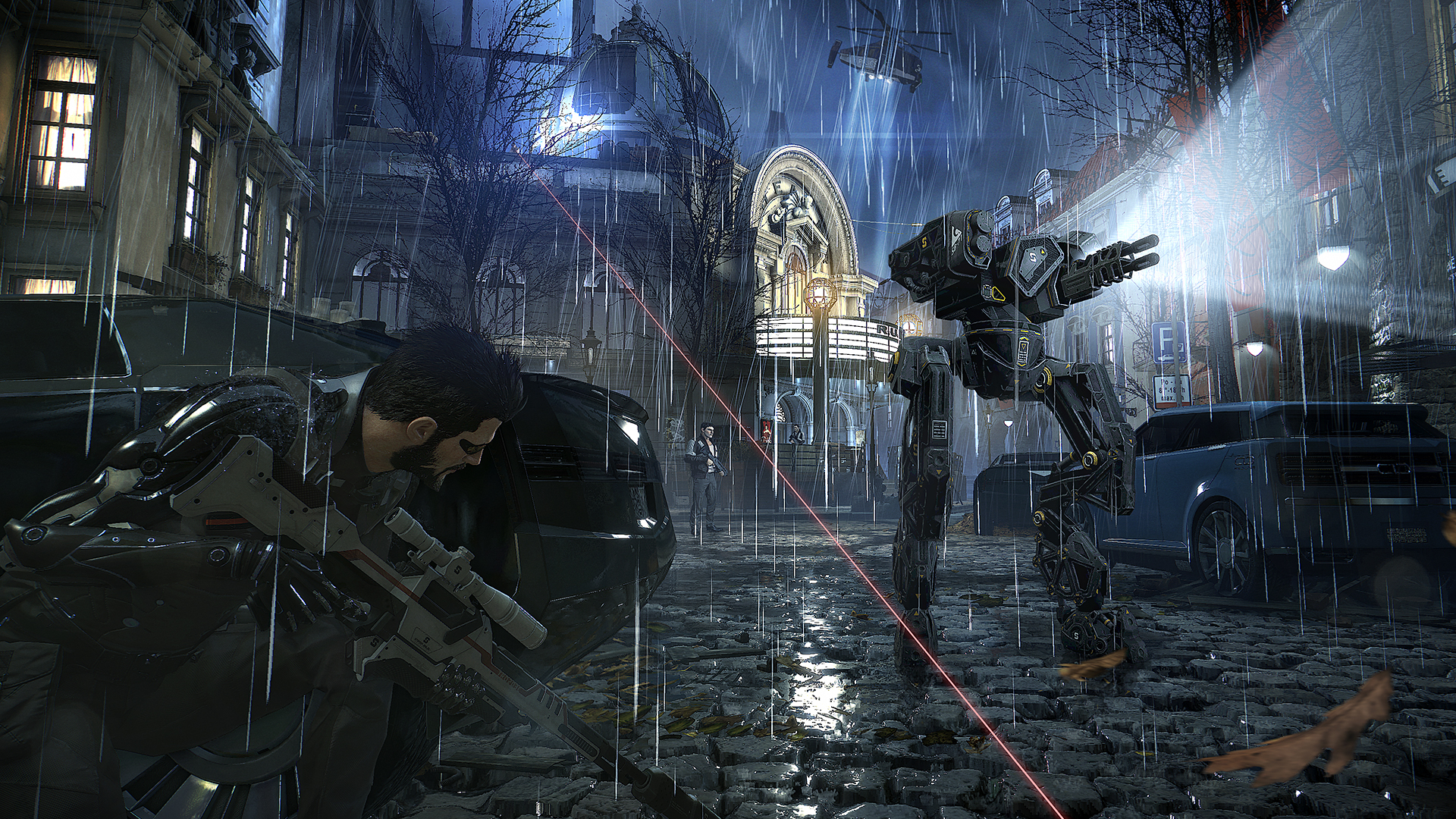
Which brings us to our final, and most damning, point against Mankind Divided; The storyline. Human Revolution's storyline throws it's players into a world on the peripheral of a huge leap forward in technology and the way it'll influence our lives, rewriting the very way we look at human capabilities, and alongside that trails the warring opinions about how such a monumental evolution should be treated. What starts as a very personal tale to uncover the truth behind a terrorist attack that cost your protagonist dearly balloons into an epic and far-reaching mission to, eventually, save the very world itself. It's in this way that Deus Ex differentiates itself from similar games in its genre and becomes something more akin to a Science Fantasy in narrative, but that just lends to the unique feeling of what a Deus Ex game is. Mankind Divided, on the otherhand, immediately undermines the events and multiple endings of Human Revolution and, in the effort of serving as the beginning of a series of games, trucks along at a snails pace wherein the entire breadth of the game is spent trying to solve the initial presented problem. The narrative never significantly evolves, 'the world' never enters the stakes in a significant manner and the endings are left murky, with the true implications of each choice promising to be subtle changes to the world state going forward. Now again, that's not inherently bad by any stretch of the imagination, but it's not Deus Ex. It's not what the series was built on. As a result, by the end of Mankind Divided you feel like you've just finished the first act of a story when the credits start rolling and probably aren't looking forward to waiting another 3 years for the next entry. (That's '3 years' if the franchise hadn't frozen. Now we're sitting at 5.)

You wanna know the funny thing? Mankind Divided isn't even that much shorter than Human Revolution in terms of content. Myself I only noticed a 4-5 hour difference. (Although I was playing HR as a veteran and MD for the first time ever) It just goes to show how a misjudgement in narrative can really shake up how full a game feels, making one experience feel like a shallow pit compared to the other. And when it's all said and done, I don't even really know who to blame for all this. Is it Eidos Montreal for leaning too hard into making a universe over just the one story? Square Enix for mandating that change with monetary intentions? Both for biting off more than they could chew? Whatever the case, the result is that Mankind Divided wasn't as well received as previous entries and now everything hangs in the balance whilst Eidos is dragged through the dog house and us fans lose hope. But let me be the first to say it, even with Cyberpunk here, I haven't lost hope in you, Deus Ex, and there'll always be room at the table for another Cyber-fuelled dark-future epic, as far as I'm concerned at least.

Thursday, 7 November 2019

In defence of: linearity

Down the only road I've ever been down.

Every now and then there develops a trend in the world of gaming. Usually it spawns from something good and imaginative, just like any cliche, only to become repetitive and overused in no-time flat. In the early 2010's this was the fabled 'Multiple ending'. For a good few years it was genuinely considered lazy not to shoehorn some sort of branching ending into your game, even when such was completely superfluous to the main story. If you don't believe me on that, do you remember how Call of Duty Black Ops 2 had multiple endings? That's right even the big boy in the playground, Mr "Too big to fail", succumbed to the trend of passionless multiple endings for fear of looking silly amongst his peers.

It was all pretty ridiculous when you think about it, as imbuing a story with multiple endings doesn't automatically give that story depth. (Just look at Black Ops 2.) Usually, all this amounted to was the player having a slight choice thrown towards them near the end that'll slightly changed the ending cinematic. (Ohhh, how branching!) It never should have caught on in the first place, but there were so many big games successfully pulling it off that creatively bankrupt publishers felt it their civic duty to conscript developers into manning low effort rip offs. Games like GTA V, 'Deus Ex: Human Revolutions' and Dishonored, all featured multi-choice endings and all enjoyed some sort of critical and/or commercial success. However, in my opinion the one which really sold the concept to the world was Mass Effect 3. Say what you will about that ending, the main game was nothing short of a gaming cultural phenomenon. Everybody knew that Mass Effect was wrapping up in a grand way and people were just buzzing about the 'every choice matters' promise that many convinced themselves had been made. Replicating that would take effort, most publishers realized, but multiple endings could achieve the same effect simply and with gusto.

During this whirlwind of a fad, there was one obvious casualty amidst the gaming archetypes of the age. Namely, those games that choose to go for a single ending. This was the age in which such a direction in design was considered a crime towards creativity, and all those that were guilty of such would be labelled with that most damning of brands; 'Linear!' I'm being serious, look back on games of the early 2010's and check reviews from all the trusted critics. Almost all of them would bring up the phrase 'Linear' and use it as a pejorative to throw at the game. Afterall, games are all about empowering the player, so if you don't account for that one time they punched a jellyfish in the face and bring it up in the ending, you're stifling the player's freedoms! (Or at least, that's what I assume the logic was.)

The thing which always got to me was the fact that there is nothing inherently wrong with being 'Linear' with your story. In fact, usually that isn't a sign that you lack the creativity to expand out your story, but more that you posses the focus to fully realize your intended story. Many great games from around this time were all out attacked for their linearity despite handling it incredibly deftly. Sure, there's some overly noir moments in 'Max Payne 3', but the linear story was a blast. (I still maintain that game was the closet we ever came to a good Die Hard game). Assassin's Creed Brotherhood met with some grumblings in this regard despite being arguably the best written (and in-arguably the best paced) entry in the series. And even 'Bioshock: Infinite' only managed to get people to say that the story was 'good, for a linear title'.

Everytime I saw a review like that I would just grimace and bear it, confused by this mass hysteria that I fundamentally didn't understand. Even back then I could see how multiple endings for video games rarely lived up to the promise they made, if not now then in the future. Who remembers the GTA V ending? (Spoilers) That ended with Franklin being given the choice to off Trevor or Micheal in order to save himself. (And, of course, there was the option to rally against the man handing this ultimatum and risk everyone. Guess which ending everyone choose.) Whilst this initially looked interesting, in hindsight it was really rather shallow as the only ending which makes any remote sense is the one in which they kill off Trevor. You know, the guy who's insane antics got them in this position to begin with. The other two endings felt nigh-on nonsensical (Like the one in which Micheal opts to kill himself rather than be saved by Franklin.) or a bit too cleanly wrapped for a tale about 3 murderous bankrobbers. (It's a setup.)

That isn't even the worst of it. Just look at those games that were praised for offering those genuinely distinct endings which inexplicably granted real power behind the player's decision; Like 'Deus Ex: Human Revolution'. That was a game which placed itself in a precarious situation by being a prequel, in that it came from a franchise renowned for it's branching endings and yet would have to adhere to the state of the world in the original Deus Ex. To solve this, the writers ended up focusing on a supremely important but underexplored portion of the original game's lore, The Illuminati, and focused that final decision around them. This allowed for a final choice that gave the player the power to change the world in significant ways without retconning anything. (Supremely clever!) So what was the problem? Well, 'Human Revolution' was a huge success and warranted a sequel. So what did Square Enix do? Simple, they invalidated their own endings and choose one for the player in order to facilitate a franchise. (One which they then bundled with the narratively underwhelming 'Mankind Divided') So that shows you how much those 'multiple choice endings' are worth when it comes up against making money.

At the height of all this nonsense, there was one legendary linear narrative driven game that proved how one could follow a single storyline and still be caught up in the moment. (Something that shouldn't have needed to be proven, but here we are.) This of course being the story of Neil Druckmann's The Last of Us and way it used the setting of a post apocalypse to tell... well, the kind of story that the post apocalyptic genre was created to tell. (It's actually surprising how many zombie stories mistakenly make it about the zombies.) This absolutely shot through the gaming award shows of the age and won award after award for storytelling, all without giving us a red, green, blue scenario at the end. In fact, the game even has the guts to have the protagonist enact a highly controversial action at the end of the story that players have no recourse to prevent. Allowing for a powerful moment to remain powerful instead of doing what Rockstar did with GTA V. (That finale would have actually been somewhat poignant without the choices.

Obviously I disagree with the labelling of 'Linear' as a pejorative and feel that more modern games shouldn't be afraid to tell one story that they know how to tell. Nowadays the problem isn't quite as widespread as it used to be, it's almost a novelty to get multiple endings in a triple A game today; but Horror games are still very much beholden to it. (Even 'Fnaf: Help Wanted' had multiple endings. That was just a VR game, for god's sake!) I'll always maintain that it is stupid and contrived to artificial force any storytelling element into a narrative that doesn't require it, and the sooner that lesson takes hold in the industry the sooner we can start improving the net quality of video game storytelling.