Most recent blog

Final Fantasy XIII Review

Showing posts with label Yakuza. Show all posts

Wednesday, 21 February 2024

Why is Yakuza so much better than Assassin's Creed?


With the release, and critical success, of Like a Dragon: Infinite Wealth the disparity between the western content farm franchises and the eastern content farm franchises is reaching a point of frank parody. How can it possibly be that the ludicrously over saturated Like a Dragon games are somehow increasing in quality despite being shot quicker than your average 100 Meter sprinter? In an industry filthy with production hang-ups and bloat, resulting in ever longer slogs between major releases that disappoint more and more often- to such a point where some superstar developers are having to weigh up the time they have left on this planet with what they want to work on next. (I'm pretty sure Kojima's next stealth-game after Death Stranding 2 is probably going to be his last, or penultimate, game. As sad as that is to say.) In this industry, what right does a AAA franchise like 'Like a Dragon' have to go on gallivanting like it's still the 2010's?

Especially when you compare this franchise to likes of the biggest perpetrator of 'diminishing returns' such as (Give me a second to riffle through my catalogue of dead horses real quick...) Ubisoft! Can you believe that Assassin's Creed is actually two years younger than the Yakuza franchise? That's right, the first Yakuza launched back in 2005! And do you know what? I think Assassin's Creed's first outing actually holds up better! It's still dated and clunky, but the core of what the franchise would become is spelled out there, whereas Yakuza was just kind of messy in execution at it's start- there's a reason why Yakuza took so long to get it's footing. But Assassin's Creed is increasingly becoming a symbol of everything wrong with modern game design, whilst Like a Dragon is becoming a paragon of all that can go right- so where's the disconnect?

First off I think the mistake that the production of Assassin's Creed makes is in their desperate search for 'relevancy'. What Assassin's Creed currently has in the modern age that is unique to it can only be it's history-jumping setting that promises to take players on a journey to new locations. I've always praised the Ubisoft asset designers because they've never not delivered the top-most possible content, even when recycling assets they never deliver a low-effort outing. However what else does Assassin's Creed offer as a USP? It's unique blend of visually appealing power-fantasy combat? Stealth based stalking mechanics? Robust metagames? All gone. They used to have a place in this franchise, and were probably brought together at their best in Brotherhood, but since then they've fallen for the Ubisoft plague of trying what everyone else is doing in hopes of leaching off of their success.

Yakuza (or 'Like a Dragon'), on the otherhand, knows exactly what it's niches are. Like a Dragon is a franchise that celebrates Japanese culture, leans on romanticised mobster-movie aesthetics and cliches and provides ever-improving combo-based combat schemes. The difference between knowing your strengths and fruitlessly searching for them is clear- RGG can hone on what they're good at and improve rapidly with each outing, whereas Assassin's Creed is stuck dipping their toes into different fields praying one pops off for them enough to warrant sticking around. Origin's slightly positive reception doomed the next two games (at least) to pathetically undercooked RPG-light gameplay which has bloated each entry worse and worse. They're not sharping their toolset, they're blunting their instruments and perfecting their flaws.

Assassin's Creed also suffers narratively thanks to the conceit of their own concept. Hopping to new time periods and characters with each games makes this something of a anthology franchise with only the modern day story to connect elements. Unfortunately, Ubisoft have absolutely no interest in championing narrative in their core franchise to such a degree that the audience often feels disrespected or ignored. Modern Assassin's Creed narratives consist of a couple of set-pieces that are built up to by comics and books released between games read only by die hard fans. Let me remind you that I used to replay the entire franchise before every release like a madman, and I still am not diehard enough to put up with Ubisoft's slop writing for the most basic amount of context. Which means I don't ever get character motivations or relationships presented appropriately to me, which means I end up either not caring or actively hating the cast. (Layla deservers that hate, to be fair. She's awful.)

And what about the assassin's themselves? Well, despite having 100 hour long games now, remember that Ubisoft have turned these into RPGs which translates to- character writing is too hard now. Seriously, their last two major protagonists after Bayek have a grand total of one motive at the beginning of the story and a couple of character traits that usually add up to variations of 'sarcastic' and 'begrudgingly virtuous'. These traits and motivations so rarely come into play that they don't really feel like building blocks of a character but rather bullet points that the script writers need to keep reminding themselves. Most of the time events just kind of happen around them and these characters react, usually by killing the people in front of them, and then they're shuffled off towards the next task. Sure, RPG options means we get to make a choice every now and then- but consequences for said choices are typically either immediate or ephemeral- essentially making them meaningless choices to being with.

Like a Dragon, on the otherhand, never fails to tell character/action hybrid narratives, introduce vibrant fore and background characters, moves the needle in some significant fashion and wows with substantive growth and spectacle by the end. Who could forget the four way duel at the end of Yakuza 4? And who can remember what the finale of Assassin's Creed Origins was? (It couldn't have just been the Caesar assassination, could it? The one that low-key broke the lore of the franchise because we didn't get to see Brutus in the assassin gear we know he owned from Brotherhood.) It's hard to tell stories with characters iconic and static like Kiryu, and RGG have been doing that for nearly 20 years at this point. They're just better at telling stories, to be honest.

All that Assassin's Creed has at this point is legacy. No one sticks to those games for their quality, but because they're comfort food. But the problem with comfort food is that it does start to bore after a while, and all it takes it for anything with a bit of flavour to waft across your way and you drop the comfort food in an instant. Yakuza is like a plate of Pasta al Nero di Seppia. Your brain tells you that is a weird dish of inky noodles your going to be spitting out in a couple of hours, but then you've finished 6 plates, stuck into your seventh with another ahead of you and the spin-off plates piled around that. (Think that analogy got away a bit, but you see where I'm going with this.) The moral of the story is- I'm hungry.

Sunday, 3 December 2023

The value of Minigames

 
Making games is hard and taxing work. Coming up with interesting systems, seamlessly implementing them into the core product and then polishing them up to retail standard- it's a trip. So much work goes into getting that central product working, balanced, shining to a brilliant standard, that very rarely is there time then to think about 'minigames' that go attached with the project. Who has the time? The Capacity? And even then, what exactly is a minigame within the context of the development process? What makes it mini, but the containment program macro? And why bother with the development and implementation of a product that does not directly reinforce the central ethos of the delivered product? Isn't that, by and large, a betrayal of the tenants of design and storytelling? Clutter is the death of poignancy, afterall. And if not, why not? Questions and queries that could sink and drown for all most care, but I am the kind who ponders the pointless.

First off, we should acknowledge the truth that game design, or rather interactive design as a whole, has fundamentally different aims than most other forms of media, in general. Books, movies and TV shows- by their very nature, need to rely on the backbone of focus to be effective. Focus on the themes, the message, the environment- there needs to be some element that brings together all the aspects of development coherently otherwise the final product can feel meandering and disorganised, and the message becomes lost and muddy. This expectation of focus does start to drift, however, with the length of the product in question. TV shows are usually permitted more time to faff about with non-essential side narrative than a movie would be. Books can get away with twisted alternative plots that weave around the central plot when they want to. And games, arguably the longest form of media in their most bloated forms, can tug at the very boundaries of cohesion without rubbing up against it's audience's patience.

In this way the precedent for the implementation of minigames seems feasible, but let us further define the topic just to be safe. Minigames are self contained units of a game separate to but contained within the core game. A world within a world, so to speak. A minigame is perhaps best defined by it's complete distinction from the core game in that the effect that the player has in manipulating it's world bears no significant effect on the wider world. For example, winning a game of Virtu-Fighter in a Yakuza game might help you succeed at a side quest, but the fight within the minigame of Virtu-Fighter does not resolve any narrative situations within the game, it was merely a vehicle through which the side-game was played. Whereas the 'side game' of micro-managing purchasing various businesses around town in order to save the locals from greedy venture capitalists, would be considered a 'meta game'- because it takes a consequential world event and gamifies it. There's your distinction, Meta versus Minigames.

So Minigames are by design side content. Which makes them inconsequential then, right? Perhaps, but I'd argue it really comes down to the scope of what you are trying to make. Solidly narrative experiences that prioritise the delivery and presentation of every single square second of their game can probably safely steer clear of the very idea of Minigames- but those titles that want to instead simulate the feeling of being in another world, like many games do, would be better served by paying attention to exactly how minigames might aid that pursuit. A well designed and well placed minigame can, in the best scenario, better flesh out the fiction of the world you are trying to build. How better can you create the feeling of a world that people live in than by letting players engage with unwinding within the context of that world? A metatext under the core text.

Perhaps the biggest poster child for the supremacy of Minigames would be the Yakuza franchise, a series of games built around the premise of capturing the spirit of various Japanese districts in order to tell a dramatic gangster story around them. Yakuza prides itself on dozens of minigames all framed around the sorts of pastimes one would find in these sorts of areas. Hostess clubs, Pool bars, street Shogi players, Sauna's with Table Tennis attached, Batting parks, Karaoke, Bikini Wrestling betting circuits, gaming halls, bowling lanes, arcade stores that feature actual complete Sega games in them- You can essentially get lost playing a dozen other styles of game whilst playing your Yakuza game on top. And the effect builds a unbreakable image of Japanese culture so robust it makes these the ultimate tourist games, and that's not even the genre this franchise was built to cater to. All of that without sacrificing the quality of the main narrative- truly magical what they built.

Final Fantasy 7's Remake is also doing a solid job leaning into the world of Minigames in order to buff out it's gameplay loop, but here they serve a slightly different purpose. Building up the world of Midgar is important, but in the structure of an adventure game portraying a vast journey of character and distance, brief little Hub areas packed with different styles of minigames serve as opportunities for the gameplay to sprinkle a little variety for the player's benefit before things get too stale. Final Fantasy VII Remake's gameplay is solid, cinematic and punchy supplemented by a fantastic soundtrack to boot- but that doesn't mean the player won't start to find cracks if you leave them with it for too long. Maybe character switching feels a bit redundant when Cloud is the best damage dealer, maybe there's not quite as much responsiveness as one would like from the 'hold down to combo' gameplay style- but now I'm doing a pull-up competition as Tifa, or playing a quick mini-tactics game of Fort Condor as Yuffie- and now I can't remember what it was I had complaints about. 

Not every game marries itself to the idea of Minigames quite so staunchly, but you'll find their like popping up here and there. The Witcher 3: Wild Hunt was well know for it's own unique minigame in the form of the competitive card-game Gwent- which proved to be such a worthwhile distraction to the whole 'world wide Witchering' scene that it eventually evolved into it's own game. Fallout New Vegas featured a whole bunch of minigames featured around the gambling life-style that Vegas Champions including the infamous Caravan which is so ludicrously simple it's almost a joke that most people write it off as painfully complicated and beyond possible comprehension. And even the most recent iteration of Mount and Blade featured it's own set of boardgames, one for each culture, each based off of medieval boardgames of the era. 

Minigames are often discarded as extra fluff atop the core package of a smoothed and finished game, but in my mind the level of understanding and forethought it takes to intelligently conceive of, and then implement, a worthwhile gameplay ecosystem within the grand structure of the full product demonstrates a degree of design synthesis worth building a soul around. I'm not saying that any game with a minigame automatically has a soul that makes it worth playing, but any game that does have a soul, probably could sustain a minigame or two. Very few games are made worse by a little deviation off the beaten path- and beyond that who doesn't love the twisting implications of choosing to unwind within an unwinding activity? You'll start feeling like Ryker in that mind prison if you think about it too long. Dreams in dreams.

Friday, 24 February 2023

Western Versus Eastern Product Placement

Devil in the background details.

'Product Placement' is the term we give to a very specific type of advertisement as it exists within entertainment. What we see as the breaking of the sanctity fictional world to introduce real world brands and logos, usually in the pursuit of subliminally advertising related products to the audience. Sure, you can hire the current James Bond actor to star in commercials driving your cars and wearing your watches so that movie fans will equate the suave and cool Bond with those products and thus seek them out in emulation, or you can literally show James riding an Aston Martin in the movie and let the prestige rub off from there. It's a very pervasive and well acknowledged branch of the advertising tree, if somewhat controversial depending on where you hail from and the marketing morals you grew up with. 

But what if I told you that somewhere out there, under the spectrum of differing cultures, some people don't just accept product placement but actually really love the idea of the real world infecting their virtual and fictional spaces? It's seems such a wild perspective in the West, where many of us are taught at a young age not just to recognise what we're being sold but to be actively weary of the idea of aggressive and subversive salesmanship. Remember how in the time before regulations were introduced, kids cartoons used to try to blend seamlessly with adverts in order to fool the child audience into the agency of the ad. Tell a kid that a toy version of the Transformer they were watching is in mortal peril unless they buy that very figure from the store, and the parents will have to endure endless nattering for the next few weeks. Nowadays we are sharpened to be more weary. Not only should I recognise the advertisers attempts to represent themselves and mentally separate it out of the contained story, but I should be aggrieved about the placement to begin with. I cannot speak for everyone, but that was a precedent I remembering being introduced and imbued into me during school; English Class. And yet I see that same sort of perception towards product placement all across America too.

And I think you know where I'm going with this, don't you? Over in the East, perception towards product placement tends to trend in the exact opposite fashion. Product placement isn't just accepted in films and games over there, but actually encouraged and preferred. In some small part due to the way that it works to ground fictional worlds that are supposed to be set within the recognisable and observable world we inhabit. Because afterall, if you're supposed to be watching a fictional story set within modern day Tokyo, wouldn't it make sense to see the same shops and brands that anyone would normally see when walking across Akihabara? That mindset doesn't just stop in places where it's fitting, however; as I'm sure most bewildered Western gamers came to see when they were confronted with Hideo Kojima's Death Stranding.

Now Death Stranding is a very emotionally intelligent game about forming connections across a bizarre post apocalyptic space seemingly purpose-built to encourage isolation. The America of that world couldn't be more conceptually distinct from the America of the real world in all manners except basic Insitutional fundamental values aped by the Bridges organisation. As such, there really is no reason on earth why Sam should have a replenishable stock of Monster Energy drinks at all of his bases. Nor is there any real reason why Sam should comment on 'Riding with Norman Reedus' when mounting certain bikes designed for tie-in promotion. They're both blatant slaps out of the immersion of the world which Western media consumers are taught to hate, but in inspection might actually serve some sort of artistic purpose. Really confronting the world of Death Stranding for what it is, and how it reflects the emotional state of a world drifting slowly apart, the fictional game world can actually seem dramatically heavy as it weighs on the soul with topics like extinction, repression and abject hope-crushing loneliness. Those small stabs of the outside world, shaking you out of magic box conceptual, can be seen as little lifelines by the designers, bringing us out of the world where everything seems so utterly insurmountable back to the real world, where things don't seem quite as bad in comparison. 
  
Of course, that is by no means the only style with which Japanese developers approach product placement. In Metal Gear Solid 3 you'll find many allusions to real brands among the tools you pick up, not least of which being Snake's favoured rations, his munch bars of Calorie Mate; a chronologically appropriate food item related to the role and world that character, as an American Green Beret, would have been part of. The Yakuza franchise too, smothers itself with brands and brand iconography in their wonderous depictions of various analogous Japanese districts. You'll find Sega Sammy branches, Don Quijote retail markets and innumerable in-print magazines and news rags stored in their isles. Yakuza even tends to feature real-life Japanese celebrities either in cameo roles or playing characters within or around their core stories, all just to sell the illusion that this is a Japan recognisable to the people who play. All in tune with a franchise quietly about celebrating modern Japanese culture.

Of course the Western world is no stranger to their own games seeped in a modern culture, but their approach to product placement is distinctly different. Look at Grand Theft Auto, a sardonic fun-house mirror thrown up across various aspects of America. Though the shape of the cities and people those games are set mimicking always bear some recognisable similarity to the real inspiration, you'll never find a real brand that has made the journey into the visual depiction unmolested. Instead you'll find parody after parody, brands depicted in a manner that is recognisable but slightly skewered to either fit a pun or just be legally distinct enough. 'Mustang' becomes 'Stallion', 'Ikea' becomes 'Krapea' (creative), 'Kawasaki' becomes 'Nagasaki', 'Sprite' becomes 'Sprunk'. (And there goes my appetite for lemonade.) And yet we don't see the world of GTA as an inferior depiction of a real-life location, to our sensibilities this all just makes sense.

It's so bizarrely common for Western games to conjure their own universe of similar sounding but crucially distinct corporate entities that I even see small scale indie games do it and I don't even think they know why. The amount of contemporary-setting indie games with their own version of Twitter and Instagram is so mind numbing that at this stage I'm actually more happy when the devs don't even bother and just reason neither company has the free time to sue their small studio over a literal nothing burger. And you can't tell me some part of you doesn't recoil everytime you watch a movie where a character has to look something up on the Internet and they scroll through a site that is the splitting image of Google but has a name like 'Goggle' or something equally as stupid. In some ways that sort of stuff knocks me out of the immersion more than the intentional product placement did.

At the end of the day I guess it all really comes down to the intention of the placement, which in turn informs the purpose of the set-up. If you go out to try and subconsciously get the audience to buy a Coke by placing that can in a scene with the logo conveniently turned in the direction of the camera, the contrived nature of that shot will shatter the otherwise carefully built moment. Litter the world with a sense of reality, using real brands as simply another means by which to convey that truth, and you'll have yourself a much more receptive audience to the brands present. Perhaps that is the key distinction between why the West intrinsically hates product placement and the East seems to love it. Of course, then I'm brought back to the Monster Energy in Death Stranding situation and it knocks me back out of understanding leaving me just asking 'why'. (I'd rather headbutt a Beached Thing than drink a Monster Energy myself...)

Wednesday, 4 January 2023

Yakuza 4 Remastered Review

Everybody, pick an ass to kick.

Yakuza and me left on something on a sore note when last we were entwined; the third Yakuza game failed to stand out to me in narrative or gameplay and not just for it's obvious age but for heavy lingering design flaws too. But it was with some genuine hope that I put the woes of Yakuza past behind me and moved onto 4, because I had become somewhat familiar with the reputation which Yakuza 4 holds as the apparent 'best of the franchise' before 0. Some even make the very bold claim that this game is even better than Yakuza 0! I was ready for quite a lot when I slapped up the download for Yakuza 4 Remastered, but most of all I was just looking for an excuse to fall in love with the Yakuza franchise again after the last game whittled that love down to an indiscernible painful throbbing lump of diseased flesh.

As such I'm going to slightly go ahead of myself and ask that most important of questions: is the combat of the Yakuza games fixed? It is. Yakuza 4 opens up NPC movesets more so that they don't block incessantly which allows for the player to actually make use of all those increadibly fun combos and heat actions that are collected up throughout the game and it is an absolute breath of fresh air for anyone who was forced endure the torture of Yakuza 3. Whereas before it often felt like your were trying to fight with both your hands tied behind your back, Yakuza 4 starts with a breadth of initial options alongside a vast array of diverse combat opportunitues courtesy of this game's flagship narrative and gameplay feature; the four playable protagonists!


Now anyone who has been playing through these game chronologically will be familiar with the idea of playing as one of many heroes who stories become increasingly intertwined over the course of a sprawling narrative. Yakuza 0 did it beautifully with Majima and Kiryu, and I'm pleased to say that we have a decently good go of it here with Yakuza 4. Only, for reasons I will get into more later; this is more like a story built by the separate stories of three protagonists, with an ending cameo by Kiryu only because this is his franchise. His whole role could have been cut out of this game and nothing of the core narrative of the game would be lost. That being said, I do quite like Kiryu and the place where this game leaves his character is a hell of a lot more interesting than where Yakuza 3 left the Dragon of Dojima. Which is a little funny, isn't it? Yakuza 4's quarter of a game with the man moves the Kiryu character along more interestingly than the entire breadth of Yakuza 3. (God, I'm glad that game is behind me.) Going through the story of Yakuza 4 involves entering the shoes and lives of each individual one by one and discovering the city and everything it has to offer through their eyes. Which is why I'm going to be doing just that through the blog, touching on the various elements of this game as I do, and how I feel about each character. The only real point that doesn't fit into such a structure would be a chat about Kamurocho itself, which is why I'll lead with that first.

Kamurocho has evolved so much over each one of the games, especially if you started with Yakuza 0 and so can get that special tingle up your spine when you pass a couple reminiscing about an 'Empty lot' that used to sit where the Millennium Tower now stands. ('There sure was an empty lot there, and it caused chaos.') But for the Yakuza franchise as it existed before 0, I think 4 might take the cake for the most transformed version of Kamurocho that the games had seen to date. Just as the streets were becoming a little stale and well-trodden, Yakuza 4 opens up several new routes across the city and encourages the player to explore them. You have the new interconnected rooftop system, the various underground tunnels and rooms that connect to the sewers and an extra little under-the-street market with some new stores. It introduces a whole new vertical slice to the landscape of Kamurocho and opens up routes of traversal where before only one or two would have existed, allowing otherwise repetitive journeys from one side of the map to the other just that bit more interesting.

Unfortunately Yakuza 4 is a quite old game, being run on a pretty old engine, and as such most of these new traversal angles are split up into separate game cells that require a loading screen to move between. The loading isn't painfully long or anything, but even that small inconvenience is enough to disincentivise creative traversal unless you have an absolute reason to take to the rooftops or sewers instead. (Which, in fairness, one character definitely does have a reason.) The Sky Finance stairway has to be the worst off for these loading screens; being located in the same back alley as Serena; walking up from the street level to the rooftops using those back-access stairs requires 2 loading screens! One to load the tiny cell featuring the Sky Finance office, and another to load the rooftops. It's seams as garish as that which show the clunkiness of aging tech. But again, we're talking a remaster of an old game; there's going to be technological shortcomings.

Now that's out of the way, let's talk about our first protagonist. Akiyama, the charming suave boy this franchise has been missing for so very long. I feel like Akiyama is the puzzle block for an archetype that has been sorely absent from the Yakuza franchise formula, the effortlessly charming, seemingly aloof, character who is secretly more intuitive and moralistic than he let's on. In fact, every new character of Yakuza 4 is themed around characters besieged with negative perceptions and allusions who are quietly more forthright and honest people than any of their detractor's combined. And Akiyama certainly pulls his weight in establishing this precedent with his reputation as the odd-ball money lender who offers funds without typical loan shark trappings in exchange for the completion of bizarre personalised little tasks that only seem to make sense to Akiyama and his assistant, Hana. (And some of the times, not even to her.)

Akiyama oozes affable charisma and causal style in practically every scene he stars in, which makes him an easy scene stealer even in the late game where he's no longer the focal point but a background reactor. His character is painted, as are all of the protagonists, with a very unique moralistic brush that defines the angle he views the world from succinctly. His world has been seeped in and defined by money, and he respects and reveres it's power and purpose, but he uses it quite curiously as a way of getting close to the ordinary struggling people of Kamurocho. We really get some insight into who he is and why he runs his off-kilter loan sharking company when he shares his thoughts with Yasuko "Money changes people's lives. I just like to see it happen up close and personal."

His personal life of running Sky Finance is mostly touched upon through his Substories, which have to be some of my favourite side quests the franchise has had yet. You really get to enter into the eyes of Akiyama as he trials and tests aspirants for his limitless loans in order to ascertain, as slowly becomes clear, whether or not they have the potential to truly pick themselves up from the bottom. And as with any well written character, this moral compunction is born out of his own backstory which neatly and beautifully dances itself into the narrative of the first Yakuza and the wider story of this game. An important step because, without that connective tissue, there really is no apparent reason for this game to be a Yakuza entry throughout the whole of the first act. Those little hooks cleverly bring us back into the fold when the connection wanes wanes.

With our new protagonist, of course, comes a brand new style of fighting which translates into distinct feeling combat to play with. Akiyama uses, rather fittingly for his visual style, a largely kick-based fighting style that prioritises speed and picking on single targets to eviscerate enemies. It's animations are great and the speed feels so very fun to play about with once you start to get to grips with a character that doesn't quite have the flow-stopping knock-back of Kiryu. Sliding around enemies and soft-stun locking them in a barrage of successive kicks feels nifty and swift, inherently distinguishing itself for the somewhat too familiar feeling Kiryu moveset we've lugged around ever since Kiwami 1 at this point. And evolving this move set to develop new moves is made fun again thanks to the arrival of a list of skills you can pick to gain whenever you level up. A much more targeted and memorable system for skill improvements over the random dice throw that Yakuza 3 employed.

Curiously enough this distinct approach to gameplay also extends towards one of the franchise's key hallmarks, the flashy and powerful 'Heat Actions'. (Which actually do decent damage again in this entry, thank god!) All characters feature their own appropriate variations upon the basic set of heat actions, grabbled, on the floor and holding a weapon; but they also have a vast array of context specific unlockable heat actions that can define the way you choose to navigate battles depending on who you play as. Akiyama, for instance, has heat moves that work best around exploitable environment positions, such as with your back against a solid wall. You'll find the way you control each character start to merge and meld around these smart character specific heat actions.

Revelations are also back this time around, carrying over the only Yakuza 3 introduced system I thought was largely all good; allowing the player to eavesdrop on funny and bizarre happenings around Kamurocho in order to observe some chaotic and explosive event and gain the inspiration for a new heat action accordingly. The only disappointment with this system being that they all come with complete animated movies that took so much effort to create that the team decided to recycle a few between characters, robbing some of the charm of seeking them out to see what sort of new crazy interaction is going to inspire you today. Although that idea of 'evolving from experience' carries on to a brand new system that Yakuza 4 explores- evolving heat actions!

Certain heat actions, I believe it's only some of the character specific ones that need to be purchased, have a special red text under their description denoting a latent potential within them. If you perform that specific heat action over and over, eventually gears will pop in the character's head and you'll unlock the ability to spend a bit more heat to perform an additional powerful follow-up attack. It's a system that encourages and rewards experimenting and trying out new moves, opening up the playstyles of each character for the player. I only wish this specific little system was explained a bit more and fed so that the player can pick up on how it's working. For example, maybe if they added a bar that slowly fills each time you land that heat action, players would be able to track how many more times they need to practise before the final form of that move happens, instead of just guessing and hoping.

The main narrative as it touches Akiyama decides to take advantage of the soft franchise reset headlining new leads, pointedly by starting the focus of the story on small players of the Tojo Clan. Honing in on stakes and people we're personally invested with, and introducing the elements of an intriguing mystery that entices and seduces the player. Putting us on this level also allows the side cast to shine and be important on their own, which gells well when you have such an easily likeable side-cast with characters like the youthful and fiery Kido and the ever-frustrated scolding assistant Hana. Even if the narrative unfortunately reintroduces Yakuza 3's painful chasing minigame, albeit with a few tiny improvements that make it a bit more bearable this time around.

I also can't possibly go on without mentioning the music. Yakuza games always have solid soundtracks, but I struggled to find any game with music that really hit me in the same way that Yakuza 0 did; until I played this game. A couple of tracks really stood out to be for how interesting or appropriately badass they were, and for the Akiyama chapters the one I remembered is perhaps one of the most memorable in the entire game. It's called 'Rhapsody and Whiskey' and it's this utterly bizarre off-note jazz track that perfectly slides under your skin and unsettles your very bones. Never when playing a Yakuza game did I expect to be drawing comparisons to Hotline Miami; but that indie classic is exactly what screams to my mind everytime this weird, but great, little track started up.


The second character of the game is an actual legend I've been waiting quite a while to meet thanks to starting this franchise with Yakuza 0. Saejima, brother of Majima. (That's 'sworn brother' by the way, not blood brother.) Ever since Majima cryptically mused on his brother's own desires to have him killed, the mystery of who Saejima was bounced about in my head; and it's a mystery that Yakuza 4 spares no time in revealing for us in great detail. I think the prolonged introduction sequence to Saejima has to be one of the most iconic set of scenes in the franchise, what with the legendarily over-the-top sequence where Saejima guns down a dozen men with seven different guns in every pocket and one extra stuffed up in his mouth. Also, we get the scene of Majima's Kansai accent slippin'; perfect all around. (And yes, with context now I can deduce the double meaning of that sentiment; with Majima trying to appeal for Saejima to back down from the hit and think about the well being of his sister, only for Saejima to reply that his Kansai accent, the manner through which Majima plays up the role of being a Yakuza, is starting to slip up. Actually more clever than I would have expected for a famous meme line.)

Saejima's chapter is probably one of the most difficult single chapters I've experienced in a Yakuza game and not because the combat gameplay barely functioned. (As was the case with all of Y3's supposed 'difficulty'.) You're trapped in prison with no means of grinding the street or stocking up refreshments, being subjected to an absolute gauntlet of enemies and boss fights scrambling for whatever you can from the bodies of the fallen. I don't think I've sweated that much for a chapter finale since the first chapter finale of 0; and that was only because I didn't know the importance of being prepared. Still, I suppose it makes sense that as Saejima has to fight for his freedom, so too does the player need to fight in order to get access to the benefits of open world side activities. (Amen.) At least I came away knowing how to play as the lumbering brute.

Much the polar opposite to Akiyama, Saejima is a slow swinging tank who's signature gameplay style is charging up for these devastating slam attacks that carry enough power to literally launch bodies through the air when it connects. His skill tree also upgrades to make him resilient to knock-downs and proficient at grappling enemies; movement and traversal options are, predictably, rather limited. A lot of the tougher fights as Saejima mostly revolve around figuring out how to hit enemies who are faster than you by exploiting their moveset patterns or being unpredictable with your own swing pattern. Learn to master his skills and moves, and eventually you'll have a monster so unstoppable he can pretty much tank his way through an enemy heat-powered barrage with his own bear-like swipes.

To the surprise of no one, despite being on death row for thirty five years for mass murder, Saejima is somewhat empathetic and moralistic, even if he hides that under a show of apathy and reclusiveness in order to survive in the tough prison environments he's been subjected to. Throughout various substories and stretched across his playtime the real Saejima starts to bleed out and we can see that he is the symbol of the 'old school gangster' archetype who staunchly believes in concepts of 'honour', 'respect' and 'clan reverence' to the almost exaggerated decree of some sort of criminal Paladin. All of that he wears as armour to smother the torturous guilt of the many murders he believes he committed that night so very long ago. In many ways the character of Saejima is a very familiar archetype you've probably seen a dozen times before, but the execution of his character is well done so as to remain interesting. Although I do think the huge 'twist' in his backstory is simultaneously a cop-out and weak validation for a character path defined by the pursuit of atonement. I won't say it ruins his story outright, but it definitely kneecaps the effect it could have had to linger on the soul.

With Saejima we learn a few interesting things about the way that Yakuza 4 treats it's unique protagonists. Firstly, they all start from level 1 when you get them and thus all have to be made strong through hardship and struggle, which can be frustrating for some of the tougher intros (Like Saejima's) but becomes rewarding in the longterm. And secondly, each character is given their own sections of the city that only they can explore. For Akiyama it's the tiny area of his office, and for Saejima it's the sewer grates dotted about the place as only he is strong enough to be able to lift them. One huge downside to playing as Saejima, however; is that due to his breaking out of jail, the streets of Kamurocho are flooded with police who will give chase to him the moment they see him, making walking the streets and absolute nightmare. The various city shortcuts would alleviate this frustration somewhat, but again the loading screens just make that an annoyance. Again these different exploration tricks do work to breath character into exploration when you can take advantage of exploration methods that others can't, changing up how it feels to live as each individual.

These are also the chapters in which we're properly introduced one of the more unique and noteworthy minigames of Yakuza 4: the IF7. Cutting through the sloughs of lore explaining it and the 'Animus' reminiscent design- essentially the IF7 is a sort of boss revisit mode where you can fight against super powered variants of main story bosses you've defeated in a fighting-game presentation for the reward of unique skills and heat actions. It's a really cool idea with a few set-backs. Firstly, beyond the hefty fee it takes to rebuild the thing (In a game without a reliably quick way to get money) each match-up, win or lose, costs 10,000 yen; a stupidly expensive costs that incentivises me to just quit out and reload in the circumstance of a loss. Secondly, and more importantly, the 'fighting game' presentation slightly works against the gameplay. Squeezing the camera down into a side-to-side viewpoint restricts your ability to sidestep in the precise direction you want to thanks to the forced perspective shift, which is a huge problem for characters who rely on sidestepping in order to squeeze in their combos, (like Akiyama) or people who need to take advantage of positioning because they're too slow to crowd their bosses. (Like Saejima) Resulting in a minigame that's too expensive and too unnecessarily frustrating to really take off as the game's best new addition. (Which is a shame, it was a really creative idea too.)

Saejima refuses to go into Karaoke, which is an instant 50% loss of credit points by my estimation. "It's not my thing" he says, as if that alone explains his reticence to croon his worries away in a padded booth to himself. You know what, Saejima? With where their headspace was at, Yakuza 0's Majima and Kiryu weren't exactly perfect candidates for disco dancing and singing, but they partook anyway because they were just stronger men then that! Damn it, I just don't feel like I'm playing a Yakuza game when I can't unwind with a Karaoke song after every emotional scene. And it really puts a strain to the otherwise poignant and revealing moral Saejima imparts when trying to set a kid on the right path during his longest substory quest chain: "There's nothing bad in this world, 'cept turning your back on those in need." If that's true, Saejima, then get yourself inside of that booth and sing about it you big ungainly bear-man, you!

Finally, touching on music once again, Yakuza 4's Majima receives some very interesting new boons. Beyond his new 'Beyblade' spinning top attack which defies the laws of physics, Majima also has a brand new battle theme which, quite frankly, is a head banger. It's called 'Receive and Bite You' and for a year where a new Sonic game released it is telling that this is my favourite gaming rock track of 2022. Seriously it's as if Majima suddenly stood up and received the theme he's always deserved after all these years and I don't want to hear him paired with anything else but sub-variants of this track. Just like 'Pledge of Demon' was Kuze incarnate, this is the Mad-dog's spirit bottled up and distilled into pure ear candy. Effortlessly exciting and catchy, this is what Yakuza boss themes are about!


The third character we're introduced to is a face to which I was not familiar with at all, although his very stand-out and unexplained cameo in the Akiyama chapter did give-away his position as a main character somewhat. Masayoshi Tanimura is the young puppy of the group, although not a totally wide eyed idealist like one might expect from a character who slides into that role. You see, Tanimura is a cop and one with a reputation for being a leech and potentially even corrupt for the way that he extorts various businesses in return for police immunity. I actually applaud the game's solid effort in doubling down on this face-value version of Tanimura for a lot of the first chapter with him, making you seriously doubt the likability of this seemingly deeply morally scarred character for a decent stretch of time. Before, of course, pulling a one-eighty and revealing that Tanimura is in reality a 'take from the cruel to give to the weak' style protagonist who believes in his moral compunction of 'the ends justify the means if the end is the greater good' more than he does in the strict and stuffy rules of his granted station as law enforcement. Fitting for a franchise where the criminals are usually the heroes.

Tanimura is the smallest of the four, which is why his playstyle is based on exploiting the weakpoints of others with limb-isolating tackles and parry attacks which combine to make Tanimura perhaps the most technically proficient fighter in the franchise so far. His set of heat moves are largely tied to the end of each of his string combos, incentivising the player to try and land those, and largely focus around grabbing a limb and forcibly hyper-extending it in a painful display that debuts a new series visual effect to underline the pain. The inverted colour flash on the stretched joint is a nice touch for indicating the trained and precise manner through Tanimura defeats his foes, whilst highlighting his preference for disarming and incapacitating his enemies in a method fitting for an officer of the law, unlike his counterparts who prefer a 'beat them until they're unconscious, they'll probably survive' approach. Even if I find his very specific martial toolset comes at odds with Tanimura's own lore which seems to imply he never trained to fight any form of martial arts. I'm not sure how one learns a plethora of limb isolating grapples, throws and dislocations from street fighting alone, but then I've never grown up as an orphan foreigner in the heart of Tokyo, so what do I know?

With his position, Tanimura makes a great point from which to expand the complexity of the narrative and introduce the wider players, which Yakuza 4 leaps to take advantage of. Yakuza isn't at all a stranger to the idea of conspiracy and interweaved factions, although those plot-threads can tend to slip out of control and become gangly in previous games. By placing a character at a each nexus point of this conspiracy, Yakuza 4 allows us to get a firm picture of the players involved before they're smashed together at the end. The difference between learning the perpetrators here and having the concept of Black Monday haphazardly thrown our way at the end of Yakuza 3 is just an absolute world of narrative cohesion difference. I also quite like the personal relationship that each character has with at least one of the conspiracy vectors in this game, which makes the progression of the narrative feel personal and driven.

Unique to the Tanimura is the 'Police APB' system whereupon random crimes will come in over the radio that the young officer can respond to at their discretion. They're short lived encounters, but increadibly lucrative to complete and they tie into a larger substory specific to Tanimura involving Kamurocho's version of the 'Neighbourhood watch'. This gamemode even regularly makes use of that infuriating chase minigame, forcing you to come to terms with it's systems. (It's systems are not quite terrible anymore but they're also not the reason I come to play Yakuza either) As much as I suppose this does bring the character closer to their supposed role as a police officer, the way you get money off the victims for the service of solving their crime does make the whole situation feel a little bit like a protection/extortion racket.

One of my favourite moment of the Tanimura chapters was the action set-piece that felt right out of an Jackie Chan movie, which tasked you with an extended sequence during which you get exposed to everything the game has to offer. Close quarters combat with a suitcase shackled to your arm, a chase that leads up to the rooftops then a battle back down to street level, and waves of thugs to fight inbetween it all. It was one increadibly impressive sequence in spirit and design, slightly ruined by all the seams between loading different cells and slipping from the fighting gameplay to the chase minigame. But whilst it might have been a little clunky to actually sit down and play, my recollection of the event is seamless; and isn't that what it's all about at the end of the day?

Narratively, Tanimura is indispensable to the narrative, although on an individual character level he does kind of feel like the odd one out. Everyone else is a legend in their own right, either due to their fame or infamy, whereas Tanimura just feels like a young muckraker who stumbles himself into the middle of a conspiracy. As such it feels a little weird to have him stand shoulder-to-shoulder with the likes of Kiryu and Saejima and pretend they're all equals. Still, I quite liked Tanimura for what he offered, specifically highlighting the human elements for the ethnic Asian minority sub cultures in 'Little Asia', his personal navigation zone. These substories in particular really touch on the more bleeding heart side of the kid and explores a shade of the Kamurocho makeup that the other games seem to eagerly ignore. It nice to see the invisible people for once, beyond the homeless 'network' which is more of a comically interconnected spy system by the events of Yakuza 4. Do you think the Florist even pays his homeless interns? They're always dressed in rags so I can only assume he doesn't.

And finally, at the end of the game when I had just started to lose hope; we get the chance to play as the main man Kiryu Kazuma once again. Up until the final chapters of the game Kiryu's only service to the plot had been as a cameo role, and I was really starting to question why this man was on the front of the box for a good while there. But they made good on their promise, eventually, and Kiryu was slid into the ongoing narrative through a means that feels, honestly; supremely contrived. In Yakuza 3, Kiryu had to be dragged back into action and he was retired off at the end of the game, so thoroughly that it took two attempts to bring him back into the action in Yakuza 4. And even then, he still feels like a character who should be in the sidelines, instead jumping in and sucking all the air out of the room like a budget pink-faced Kirby.

To try and be fair to the game, I think the narrative does a decent job of giving Kiryu more of a potential for follow-up stories than 3 did. And winding in the 10 billion yen plotpoint from the original Yakuza is always fun, even if it reminds me of the fact that Kiryu's solid gold statue from Yakuza 0 also cost 10 billion yen. (How much would that have marked-up by now? Kiryu might be richer than Akiyama!) Speaking of stuff that Yakuza 4 did better; how about Hamazaki? He was almost hilariously one note and predictably rigid in the last game, but Yakuza 4 uses the very weak foundation of Yakuza 3's finale to change him around and make him actually sympathetic. Someone so generic you probably forgot he was even around until the epilogue of Yakuza 3, made into a proper anti-hero at last! What a world we live in... 

Kiryu plays how he has always played, as a versatile brawler with punishing single-target combos who becomes helplessly overpowered after a quick visit to Komaki. Actually, this is the first game where the Tiger Drop can actually be unlocked purely from the skill menu window, but visiting Komaki anyway is just polite etiquette. The old man gets lonely otherwise. It's actually somewhat gratifying to see Kiryu slowly become the demon killing engine he always becomes at the twilight act of every game, after playing through a whole game's worth of balanced and distinctly capable characters now we have Kiryu- who simply destroys everything. The game even throws him up against a literal army of Yakuza for one scene, because they know how broken his moveset always is. I love that self awareness.

Altogether this brings us a full set of four characters who each work to compliment each other well throughout Yakuza 4. Akiyama is the sort of character you keep in the back-pocket who has his fingers all over the place and carries endless utility with his ceaseless riches, Saejima is the lynch-pin character around which the events of everything revolve, Tanimura is the plucky idealist hero who stirs the nest and Kiryu is the immortal legend who smacks down all the bees that are shaken out of that nest. A perfect team to lead a great twisting adventure that spans so far that police officers actually roam the streets of Kamurocho to Kiryu's utmost shock. And I'm there right with him in that shock; especially considering there wasn't hide nor hair of the boys in blue the previous year when an army of Triad rolled up to the city and shot rocket launchers in the street. (I guess the Japanese gun-ban doesn't spread to rocket propelled grenades?)

Still this wouldn't be Yakuza without at least one totally boneheaded moment from Kiryu that just makes me slap my palm my face, wince and go "Why!". Namely it comes in that classic moment when the protagonists meet for the first time, Kiryu bumping into Akiyama and Tanimura. Now firstly, the fact that Kiryu isn't recognised by Tanimura is insane given that Kiryu is the most famous Yakuza who operates on Tanimura's beat; you'd think the police would know who their main 'subject to watch' is! But then think of Akiyama, a man who literally considers Kiryu as his hero in life. He doesn't recognise the object of his own adoration when he's staring the man in the face wearing the exact same grey suit he always wears? But what really seals the deal is the moment when the misunderstanding turns to a fight and Kiryu says "We'll have time to talk later, you don't like one of the bad guys." Then here's an idea; don't fight them Kiryu! This man has such a problem with basic communication and it absolutely kills me everytime!


Outside of the progression of the main narrative Yakuza 4 comes with a selection of totally complete metagames for each of the four protagonists that range from 'decent' to 'vastly too big'. Akiyama inherits the Hostess Maker from Yakuza 3; which is still a decent concept that doesn't have the quality of content to entertain for as long as it takes to finish. Tanimura has his investigation training with Nair, which is more like a large substory with training sections instead of traditional mission objectives. Kiryu has a ludicrously bloated 'Gang Encounters' metagame that would have worked better if it was stretched over the whole game for all protagonists instead of squeezed into the final four chapters just for Kiryu. And Saejima has the 'Fighter Maker' and let me tell you about the god-damn fighter maker...

I have never been so frustrated to deal with a Yakuza metagame as I had working with the Fighter Maker! And maybe that's because the whole concept is building an AI to win a fight with the spotty AI brain of a standard Yakuza enemy. 9 times out of 10 you're doing everything right and the AI is letting you down because you have next to no control over how the actual matches play out. Makoto is a scourge upon the earth for his godawful fighting animations that need to burn and Masataka brought the game to a literal dice roll. Everything in the later half of that minigame relies on the 70% chance to activate Moody trait, and even then it's a toss-up if your AI moron will remember how to attack. I don't even know if I can claim this game mode had a solid concept, because watching someone else screw up a fight sounds teeth grindingly awful even on paper. Dear god I hope this minigame doesn't make a return for Yakuza 5!

And then there's the Amon fight which I skipped in Yakuza 3 because... obviously. 4's fight brings us one Amon super-boss for all of the four protagonists and I'm happy to see that the developers decided not to give every individual super-boss 15 health bars this time around. (I'm very grateful for their mercy.) Still, making Saejima's explosive mallet wielding bad-guy regenerate his health is nigh-on unforgiveable. It's fitting that the final man is literally just all of his subordinates abilities melded into one with an extra 'insta-kill' move stitched on for good measure. Kiryu makes a solid match up for the crazy mash-up of abilities and I really had some fun really stretching the limits of the Dragon's god-like powers against a foe of equal footing instead of just stomping uppity street thugs like usual. Or perhaps I just love the sight of Kiryu eating the power of an exploding sledgehammer to the face through the sheer indomitable might of his Tiger Drop strike.

Summary

In conclusion, Yakuza 4 is often cited to be the very best of the franchise and I would have to defer to the consensus, to a point. I think there's a scope of ambition in telling a story from 4 sides that absolutely must be commended, and the distinct gameplay systems just sing of play diversity and evolving challenge so that this game almost never starts to feel stale. But the limitations of the game and the tropes of the narrative nearer the climax acts stop this from hitting me in the same places that Yakuza 0 did. I'm getting really tired of the old cliché where a defeated enemy leaps for their pistol and takes a fatal shot which gets blocked by a 'destined to die' character. It was hardly even a shock the first time, now it's just embarrassing. (I swear the last time it didn't even make sense because the guy's hands were literally handcuffed first!)

But I'm really cherry picking problems here, because as a whole the Yakuza 4 package encapsulated everything I want out of my Yakuza experience. Heavy drama punctuated with absurd and sometimes surreal humour and underlined with moments of genuine pathos. If only the emotions hit a bit harder, I might consider this game to be Yakuza 0's equal! Okay, actually the metagames of Yakuza 4 are largely mediocre in comparison to what 0 would do just a few years later as well, to be honest. Still, I absolutely loved my time with Yakuza 4 and can heartily recommend it to those who did themselves a favour and skipped Yakuza 3. All and all; there's really no other grade this game deserves aside from an -A on my arbitrary scale of game grading. Seriously, try this game, breathe it's greatness and relieve the glory of what makes Like a Dragon the series of a lifetime!

Thursday, 22 December 2022

The one good maketing idea

Okyakusama wa kamisama.

There's a rule whenever a property is being translated from the Eastern world to the western one; that someone with absolutely no clue what they're doing is going to rock up with their 'can do' attitude and totally cock-up the adaptation in some significantly horrible way. It is an inevitability of life. Typically a marketing executive. And you can understand why in a tortured and beaten way. When you're a western marketing executive who's thinking of the next way to sell a product to an audience you think you know, and someone throws a box on your desk that is written in another language; I can only imagine your brain totally haywires and shuts off. At least, that's the only excuse I can think of for why a living human being would conceive of replacing the gorgeous Japanese bot art for classic masterpiece 'Ico' with a 3D model picture from Blender's worst nightmares.

I don't know why it's so very hard, aside from rank incompetence, for marketing executives to really ask themselves the core questions "Why does this appeal to the Japanese audience" followed by "How can I translate that for a Western audience." Many would say "Just don't change a thing" and whilst in many cases that is absolutely the right question, that's not a permanent done deal. Some things just don't work as well in English as they do in Japanese and if your job is to match the success from the home country out in the wild west of America, then liberties have to be taken. But do not misconstrue my devil's advocate talk for an endorsement of the marketing profession. I am well aware that most marketing decisions made on a monthly basis are born solely out of some upstarts desperation to validate their own job to their superiors. The minimalist brand logo trend didn't start out of nothing!

Still, sometimes even the best intentions don't pan out quite as you'd like. I can't pretend to know the machinations of why the Biohazard franchise was renamed to 'Resident Evil' when it came to the western territories, but I certainly don't feel anything cynical or inherently superfluous there. I can see the thought-process: "Horror game set in a mansion, Biohazard sounds a bit too vague and bland on the store shelves" it makes sense to me. Still the series creator despises the Resident Evil name, and today it doesn't really reflect the franchise anymore, does it? The game abandoned it's 'residence' in the second entry to explore whole cities, other continents, a couple of European villages and pretty much the entirety of America in one entry. Overall, Biohazard stood the test of time better.

And then there's the odd marketing decision that, whilst not exactly an inspired idea, looks genius next to whatever the home team were thinking. 'Sonic Unleashed' is not a great name for a video game, it's pastiche and unoriginal with a central focus on a mechanic that inherently missed the point of what Sonic was about. It's a game about speed; why would you focus on the Werehog segments; they weren't even all that good anyway. Still, I have to admit that Sonic's American redone title sounds loads better than the original. 'Sonic World Adventure', are you serious? Not only does that shamelessly rip the naming convention from 'Sonic Adventure' despite sharing nothing in common with those games and their wide cast of playable characters, the box art tries to desperately balance the Werehog central figure infront of a mismatch of location screenshots below a cracked planet; it looks honestly amateurish. I feel like 'World Adventure' should be the bad American translation of Japan's 'Unleashed'. (That's a topsy turvy situation right there.)  

But there is one instance of an American re-mixing of a franchise that I not only whole-heartly agree with, I think it was the exact right choice to make. Even though it took some while to blossom, and the franchise is currently undergoing the process of totally reversing it; I think that for the time, whatever the marketing executive who made the decision was, it did the franchise a service for it's western discoverability. I whole-heartedly agree with the choice to rename the Ryu Ga Gotoku franchise to 'Yakuza' in the west. I think that someone that day had their head on straight, they read the room, and upon learning that the literal Japanese translation of Ryu Ga Gotoku was 'Like a Dragon' they made the wise move for the game's future prospects.

Not that I dislike the name 'Like a Dragon', at all. I think it's both a great title and better fits the breadth of a franchise that, whilst it surrounds the Yakuza, is more interested in the themes of that lifestyle than the criminality itself. Still, 'Yakuza' is a stark and straightforward title, isn't it? It's blunt and abrasive, confronting the audience with a recognisable name that carries it's own daunting connotations already. A western audience hearing the name 'Yakuza' for the first time thinks they know exactly what they're looking at, and for a market that was already in love with crime drama titles set all over America, the title of 'Yakuza' promised something fresh and new. A different face of a genre the western market was hopeless addicted to thanks to the sustained success of the Grand Theft Auto franchise. Even to this day, the glamorisation of criminal life is a piquant siren call to the game buyers market, if only anyone could make a title to match what Rockstar put out these days.

But what about 'Like a Dragon'? How would a franchise named 'Like a Dragon' fare in the western world? Well to be quite honest, I don't think it would have stood out in the pack. It sounds mythical and fantastical but unspecific, inherently. The title 'Like a Dragon' would draw the eye of fantasy fans, but the front cover of snappily-dressed men with short haircuts would confuse and likely lose a lot of the interested. 'Like a Dragon', on it's own, too easily melts into the deluge of other fantasy game titles that were booming in the early 2000's; and even Japanese game fans would end up subconsciously associating such a game with the dime-a-dozen JRPGs that littered game shelves all the world over. Chrono Trigger, Xenoblade, Dragon Quest, Final Fantasy, Grandia, Like a Dragon: it just slots in there doesn't it? But 'Yakuza'? No, that's a franchise which has no place among those others. A Japanese title that deserves to stand apart, and go it's own path. (That's what you call a 'pun' see; because the Japanese word for a Yakuza member, Gokudo; has been adopted to mean 'the extreme way' or 'going your own way'. That's a... that's how my pun worked...)

Nowadays the Yakuza franchise in the west is a few months away from it's period entry 'Like a Dragon: Ishin' marking the official point where this franchise will finally have a unified naming convention across the world, and I support it. I think 'Like a Dragon' sounds cool, and now that the franchise has fully cemented itself in pop culture thanks to the runaway success of 0 and the mainstream appeal of Yakuza 7; the franchise doesn't need to use tricks of naming to stand out from the crowd. The Yakuza name has served it's purpose well and fully, and now it's time for the franchise to retire it for good. Except, for prosperities sake I'd appreciate it if we didn't just drop the name from history. I think it would do us good to remember the franchise as it was named when it struggled and eventually rose in western markets; and wear that title, the only good marketing idea ever conceived, with pride. Besides, if we apply 'Like a Dragon' retroactively, then Yakuza 7 becomes "Like a Dragon 7: Like a Dragon" and I'm just not ready for that, let alone the world!

Tuesday, 13 December 2022

Yakuza 3: Remastered Review

 Beautiful Eyes.

Oh it has been a while, hasn't it? Several months, in fact, since my last review of Yakuza Kiwami 2. And how could that be? I already owned all of the Remastered collection when I finished Yakuza 2, and I already had 3 installed when I finished off the review for that game! Could it be that I was so enraptured by the intangible glory of Yakuza 3 that I felt the need to play it again and again for months on end? Well, considering my completion time was 30 hours, the shortest amount of time I've spent playing any Yakuza game, that can't be the case. So what could it be? Hmm... Perhaps because Yakuza 3 was, by the far, the most annoying, frustrating and inane experience that Yakuza has presented me so far and I am so very relieved to hear the good people of the fandom tell me that it's hands-down the worst one in the franchise, because I couldn't endure pain like that for a second time.

Obviously there was going to be some 'growing pains' going from the Kiwami franchise to the Remastered saga. That's more than ten years of video game design philosophy going straight out the window, afterall. But if you've been around this blog for a while then you'll probably know that I ain't one to dismiss a game merely because of it's age. My glowing reviews of the Baldur's Gate games should convey that well enough, I adored those games. What I can't abide, is a game so deeply and fundamentally broken that the very action combat system which is the cornerstone of this franchise (until we get to 'Like a Dragon') becomes imprisoned behind overzealous and painful combat necessities which turns every encounter into a mirror-image drag fest instead of the dynamic and free-flowing combat brawler I had come to love until this point. How did things get this bad? Let me start my explaining what makes Yakuza combat good.

At it's very heart the core gameplay of the Yakuza games is not inherently complicated. It's a very basic 'light attack', 'heavy attack' brawler system with grabs and special contextual super moves thrown ontop for a bit of variety. Progression slowly unlocks more specific abilities that can be employed, slowly opening up the depth of combat as the game trundles and becomes more complicated so that the general spread of combat possibilities never overwhelms the user when they aren't ready for it. Later Yakuza games threw in multiple combat styles with differing utilities, but even before those separate styles were bought in, the singular style approach of earlier games was functional and appropriate. What makes it so fun to play with is the increasing breadth of options that become available as you get more tooled up in the levelling. Different super moves, special attacks, new variation combos, utility move alterations; they all open up such an enthralling freedom for combat that the player constantly feels like they have direct control of a sprawling arsenal of attacks in every fight, which can make any old street brawl into a different experience. If every fight ended up playing out in the exact same way, then combat would get very old, very fast.

Which neatly brings us around to Yakuza 3, don't you know. For every previous game, playing on the hardest available difficulty mostly just effected the damage of attacks and the health of the enemy. Maybe some AI packages were made more ferocious as well, but for the most part you got exactly the experience as lower difficulties with an added punch. For Yakuza 3, however, higher difficulties were supplemented with a painfully asinine AI 'change up'. AI enemies were suddenly allowed to block, and they would; a lot. You really begin to understand the problem with this quickly during the very first fist fight with Majima, wherein what should have been a simple two minute tooth-and-nail brawl against the mad dog stretches into a seven minute+ nightmare once you realise that everytime you get the chance to pull a combo on him, he blocks the entire chain and takes no damage. Then you use a Heat Action, and it chips away one twelfth of a single one of his two healthbars. Safe to say: it is a miserable experience.

You see, you'll come to learn that Yakuza 3, unlike it's predecessors, doesn't want you to play with the freedoms of the toolset available to you however you want. Instead Yakuza 3 wants you to conduct fights in a very particular way. It wants you to sidestep enemies, dodge behind them and then sneak out a quick pitiful combo before rinsing and repeating. Heat actions do next to no damage, weapons can't break block, all you have is the sidestep and bait. This is how every fight will play out throughout the entire game and it is tedious, repetitive and creativity destroying. In the early game you'll probably end up trying to avoid random encounters with thugs. AVOIDING STEET THUGS: IN A YAKUZA GAME! Of course, fighting is what Yakuza is all about so you can only dodge the combat for so long before it's thrown at you screaming. Boss encounters become painful 'who can last the longest' slogs wherein you'll hit the boss upwards of a hundred times before they stop getting up again, group fights against swathes of enemies are a pain with the only consolation being the ability to switch targets mid-combo which seems to confuse the AI now and then, and almost every cool flashy heat action becomes functionally useless due to complete and total nerfing. It's a dire situation.

One further shackled system of this game's is the progression and levelling. You are granted EXP levels that can sink into one of four attributes which provide an ability, basic stuff. However, there's no way of knowing which attribute will unlock what skill, and though the game pretends you have free reign of which attribute you unlock, every level attribute level jumps the amount of EXP levels needed to raise it significantly, and the second you gain enough EXP to upgrade any attribute, the game will scream about it and plaster your upgrade opportunity all over the menu screen, begging you to upgrade every attribute at an even pace. Basically incentivising people not to try and pursue abilities and techniques specifically but to just take them as they come. A step down to what later Yakuza games leant towards. And largely moot on higher difficulties anyway since most of those abilities can't be used on anyone anyway.

As with any contrarian opinion, there is a special breed of deluded fan out there who not only swears by Yakuza 3's combat, but declares everyone else simple minded simpletons for coming to the logical conclusion that it just isn't fun. The excuses are always the same: "you don't like it because it's hard", erroneously equating frustration and tedium with 'difficulty' and "You just don't understand it's systems", that last one sounds intriguing, no? What systems could Yakuza be hiding, and pathetically explaining, so badly that it flies over people's heads? Well, lucky there's no end of videos on Youtube of people showing you how it's supposed to be done, and everytime it's the exact same routine. Counter an attack, knock the enemy into a wall until they glitch and bounce off the wall, and then stun-lock them to death. The same technique. Every fight. Yes, doesn't that sound exciting and diverse? Just as expansive and free as every other Yakuza game! Truly this is high level Yakuza 3 gameplay! (Yes, Yakuza 3 gameplay fans are deeply deluded just because they've found a way to squeak a cheese method out of a game the world rightly hates. That's what a hipster mindset does to you, folks!)
But a terrible combat isn't the only new system which Yakuza 3 lumps you with. There's also the 'chase' minigame which challenges Kiryu with chasing or escaping with more painful half-conceived ideas. For some reason there's a stamina management gauge which limits Kiryu's sprint time coupled with a 'shove' action which both drains that stamina and is the only way to whittle done escaping perps. Stamina reserves are typically just enough to beat your objective and require almost prescient reaction timing to account for dodging everyone in the crowd, jumping over every inexplicable obstacle and predicting every wild corner your annoyingly cowardly perp will run down. It is an attempt to bring something new to the gameplay slate, and I appreciate what the team were trying to do with these systems, but overall they fall flat in tandem, as you'd probably expect. There's also a hostess minigame which is, again, a total drag where you micromanage one girl based on keywords you need to look up a guide for to take advantage of because the game will not tell you what feedback equates to what taste. It's kind of like the precursor to the excellent hostess minigame of the 0 games onwards.

One of the new methods for gaining abilities involves Kiryu blogging, bizarrely enough. He is prompted to a random crazy event somewhere in the city, which he takes pictures of with his brand new phone, and then he blogs about it to an audience of, what I can only assume, are hardened Yakuza members who know of Kiryu and also double as his loyal fan boys who follow his every online post about random crap he spots on the street. Crap that involves, an old lady doing a full flip in her moped over a car and a child supplexing his father and dragging him into a sex toy shop because the kid's too stupid to know what 'adult toys' means. It's a fun and silly way to introduce Kiryu into new ways to dodge and throw enemies, and about as quirky as I'd expect from Yakuza. Making this throw away feature perhaps the only new addition to Yakuza 3 that I liked. Make of that what you will.

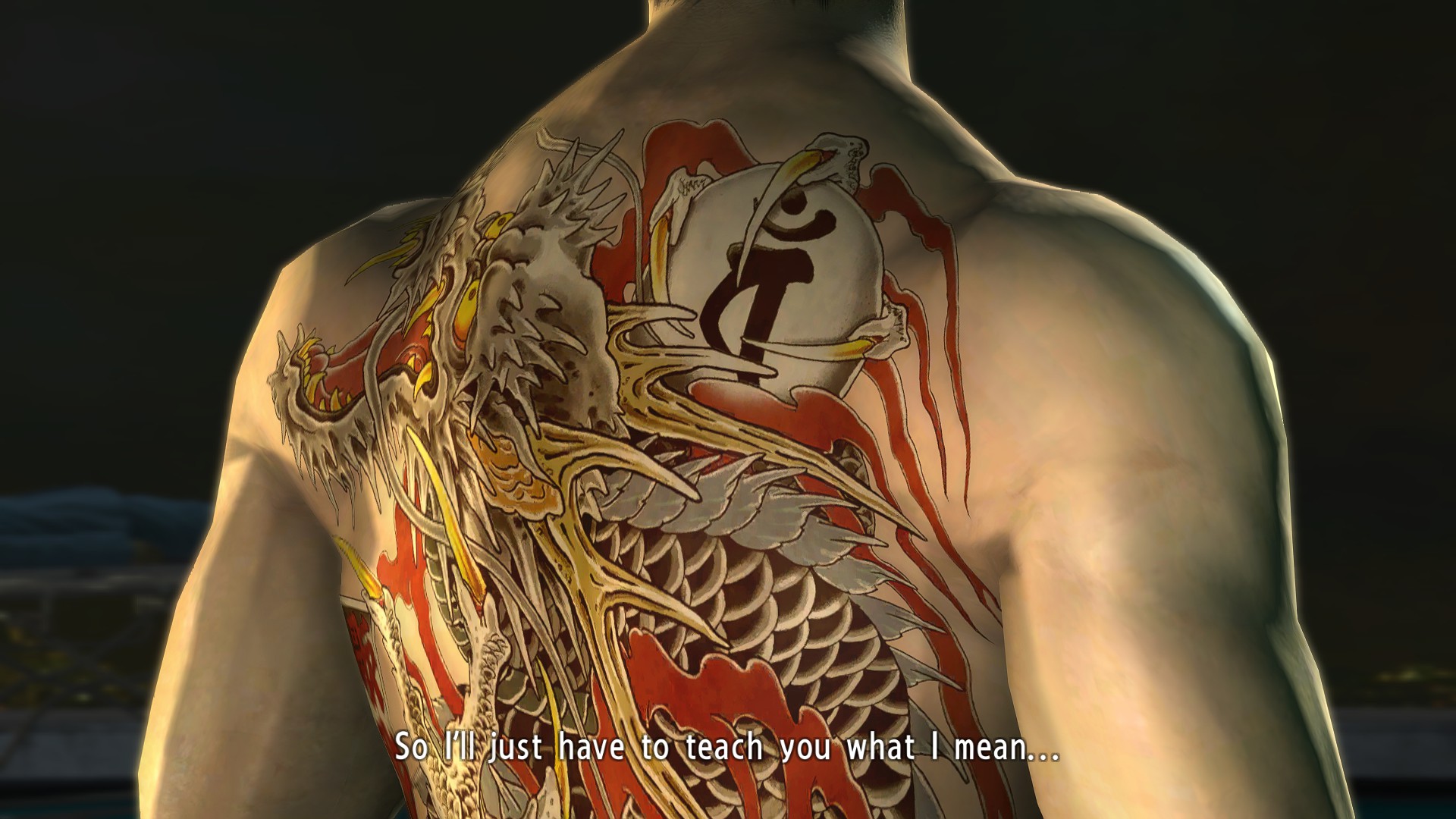
Before long I was avoiding all content from the non-essential routes of Yakuza 3 in favour of the main narrative, which at least was somewhat interesting and different to the previous stories. Kiryu Kazama is an early retiree, settling down in his Okinawa orphanage with a whole cast of new orphan kids and trying to live his life. The game spends a decent number of the chapters in Okinawa going through basic life lessons being taught to the kids, but done so in that typical RGG fashion which invites small scale drama and satisfying resolution. Largely these sections feel more wholesome than the Yakuza games are accustomed to being, what with their love of high drama, but these sections are no less well written and presented then the typical Yakuza fluff. During your stolen moments at the orphanage you'll really come to know the kids and maybe even like how varied and curious about the world they all are as you accept the role as their guardians. Of course, these quest chains can start to grate in the later chapters where the story quite literally brings it's own speedy pace to an utter standstill simply to try and rekindle some fatherly-devotion in the story, but overall it's a decent addition and a fine way to keep Haruka out of the events of the game. She can't be getting kidnapped when she's looking after kids in Okinawa, now can she?

Okinawa itself makes for a refreshing new location in the Yakuza pantheon of places, a less dense and packed group of city streets with a sunny tourist vibe to them. You feel less likely to get into trouble walking those streets, even if you are, technically, just as likely to run into street punks because that's just how the game's systems work. The narrative for these early chapters meanders a bit more in world building and stake placing, letting you somewhat naturally be introduced to the major players of the world without a huge exposition dump or 'third person introduction cutscene'. (Both those tropes are coming later in the story though, don't worry.) Okinawa neatly fits the slower pace which Yakuza 3 attempts to start with and makes for a neat atmospheric shift once the real plot kicks in.

Of course something has to eventually drag Kiryu out of the calm life and back into the Yakuza fold, and this time it's the attempted assassination of Daigo Dojima by a man who happens to perfectly resemble Kazama, Kiryu's adoptive father. This pulls Kiryu back to the busy streets of Kamurocho wherein he comes face to face with the new face of the Tojo clan and explores one of the more clandestine and politically active plots in the Yakuza franchise, which of course comes crashing into Kiryu's personal affairs in ways he cannot imagine from the outset. Date returns as a reporter, bizarrely, as well as a whole host of sub story characters who all largely felt like they were getting their final farewell in for this game. I wonder if Yakuza 3 was intended to once be the sign-off for the franchise, what with the rather startling allusions to 'finality' that the game starts to adopt in it's twilight hours. 

The plucky star-struck youngling of this game is Okinawan Yakuza member Rikiya, with his curly hair, viper tattoo and thug-with-a-golden-heart attitude. He reminds me of a more emotionally unrestrained young Kiryu in some ways, idealistic yet human. A far cry from the man Kiryu himself, who throughout the course of Yakuza 3 sheds the last vestiges of his human 'flaws' and pretty much ascends into a Christ-like figure. Kiryu is morally impeachable in general, but for Yakuza 3 he just becomes an almost eye-rolling paragon of virtue. He teaches orphan kids, remains the sole bastion of honour, and even when his most valued and treasured people in life are threatened and endangered, he never seems to act out of rage or grief. He's even so virtuous that the man insists on teaching life lessons to the big villains with fists for no reason other than a sporadic hunch that this is a guy he can get through to. All except for one supremely jarring scene where Kiryu, upon learning that Majima might be involved in the scheme against the Tojo, just blatantly announces that if Majima is playing dirty, then he'll have to kill him. Wait, what? Hasn't Kiryu avoided killing his entire career, but he's happy to kill a decades-old friend if they don't see eye to eye in that specific moment? (That's the tiniest bit wildly out-of-character, in my opinion.)

In many ways this does feel like the cap-off to Kiryu's arc. His rise to becoming accidental chairman and battling his sworn corrupted brother, to his struggles against his dark mirror Ryuji, his erstwhile counterpart, and now his evolution into a fulltime orphanage owner intercut with a battle against... honestly a final threat who feels a little like Nishki 2.0. By the end of the game there's a lot of seemingly undue talk about 'finality' and 'death' which seems to spurn out of nowhere and, considering the series is still alive and strong, goes nowhere. What the Kiryu of the next game might get up to in order to expand who he is could be anyone's guess, but I feel that from this point anything that drags him away from his life as an orphan rescuer can only really be more mild distractions that he is only barely  involved with, rather than actual involved character driven intrigue.

I found the cast to be largely likeably if somewhat underutilised. This narrative speeds through events as the game kills off pretty much every lose hanging thread these games have ever had related to Kiryu in an entry that feels like the most blood soaked. (At least in the moment.) The concept of 'Black Monday' is supremely under-explored and amounts to largely nothing, which I suppose lines it up neatly next to the surprise villains of Yakuza 3. And some key players, like the Minister, don't appear to have any significant role to play beyond 'exposition guy' for a single prolonged scene. Still, I think the story was fine for what it was, just lacking in a lot of the really engrossing character intrigue that really bought me into previous narratives. Maybe it was because I didn't like the gameplay, but I found the major story beats to be largely basic. 'There's a traitor; here's the list of suspects. Now you've whittled down them, I guess it was the last guy all along'. The only real rug-pull being the fact that there's a completely separate, more interesting sounding, plot that just happened to conveniently collide with yours? It didn't do it for me. 

I really wish Kiryu was more involved with the actual events going on for reasons other than sheer happenstance. Because a lot of Yakuza 3 can be summed up to sheer happenstance. Kiryu just happens to own an orphanage on land that just happens to become important. And not in the way that Yakuza 0 balances a similar plot, it just feels largely contrived to stir the Dragon. This story relies on it's emotional moments for dramatic tension, and they work just fine on the small level, when you're still dealing with nothing more than orphans, but when you start getting to the higher plot threads they are totally emotionless. When I think about the complex and developed cast of three that ruled Yakuza 0 and compare them with the caricature 'bad guys' of Yakuza 3's side cast, it doesn't even feel like the same franchise. And you can't tell me that good character writing was only developed in the last 10 years, because I won't buy that excuse! Also, Kaoru writes herself out of the story for no reason at the beginning of the game; because apparently Kiryu is the virgin mother and simply cannot keep a girlfriend for more than a few minutes. (That's the most relatable character trait left in the man!) 

Mine was a fine, if slightly confused, antagonist. His motivations seem to spur out of nowhere, which is waved away as a trait of his morally lost character, but then by that same merit he seems superbly morally judgemental for what essentially amounts to a money driven drifter. Someone who has that angry of a response to Kiryu simply because of what the Dragon of Dojima represents shouldn't also live his life by the moral compunctions of his bank account. And every thing he claimed to be, or was setup to be by the story, didn't really show on his face either. In many ways, Mine is like a more put-together Awano, only his apparent hedonism is only referenced, never represented. He seems like something of an paradoxical enigma that, quite honestly, should have been explored in later games; but to quote Chris Tucker: "He ain't gonna be in Rush Hour 3."

And I cannot wrap up without mentioning the way that this game attempts to leapfrog the cliffhanger ending of Yakuza 2 with another 'is Kiryu dead?' fakeout that borrows a cue from one of Yakuza 2's most iconic scenes. (Yes, the one with the Japanese reggae in the Kiwami version) It's pretty weak, mostly because I don't think anyone really would buy that Kiryu would be killed by a side-character in the story who was so brushed off that most people genuinely forgot he was even present in the game. Still, I appreciate the side villian trying his best to make one final attempt on our boy before he becomes fully immortal. I hear there's a scene of Kiryu strafing two rocketing missiles in the coming games; I can't wait to get to that level of absurdity.  

In summary, Yakuza 3 is a hugely disappointing game from a gameplay perspective, that muddles an occasionally heartfelt, but largely unimpressive main narrative. It's side content and quest were okay, but not particularly in depth, the new minigames felt weak and under-developed and the progression is a sad mistake that should never be repeated. Yakuza 3 is a game that, quite honestly, I think is probably worth skipping in the 'full saga playthrough'. I wouldn't recommend it at all, and it's grade on my arbitrary scale only come up to a C grade. That goodwill might just be left-over refuse from a franchise that I love, because if I had played this game first, I probably wouldn't have continued playing this franchise. But I did complete it, and the story wasn't terrible, so I think the game just about gets a passing grade. Also, the scene where Majima somehow sneaks an entire colosseum full of screaming spectators under our nose made me laugh, so it makes it out of a C- Grade for that. Poor show and a largely lacklustre entry. Luckily, I'm already eight hours into 4 and confirm that it's much better on all accounts so far. I can't wait to start reviewing that one!