The unspoken rule.
Showing posts with label Persona 4 Golden. Show all posts
Showing posts with label Persona 4 Golden. Show all posts
Saturday, 15 July 2023

Thursday, 27 April 2023
Persona 4 Golden Review
This shadow world!

Many years ago a very innocent and untainted version of me was browsing about the internet, gauging whatever it was that caught his interest and looking far afield to do it. That young boy browsed the foreign speaking corners of Youtube, the bizarre pseudo cultist communities of the tilted sector of the web and, as it inevitably always comes back to for me, game trailers. I'm always watching game trailers. The artistry of what they represent and how they do so has always enamoured me, I'm a marketing obsessive; you can probably tell as much from how often I write about it here on the blog. But that day, which couldn't have been too far into 2016, I found something unlike anything I'd ever seen before. It was a trailer for the latest entry in a franchise I had never even heard of in my entire life. It was colourful, animated and musically jazzy and some dormant switch flipped in my head. I was searching for something to capture my attention and I stumbled into a steel-tooth bear trap- I was instantly obsessed- with Persona 5.

Of course, as an Xbox owner I was doomed to disappointment, because ATLUS and Sony have a blood pact which cannot be forsaken and the Persona games were a Sony exclusive with no intention to ever go elsewhere. I waited patiently for any news to change on the Xbox front, then when I got a half decent gaming PC I waited patiently there too. Eventually I actually just gave up hope and jumped to play the game anyway that I could. I almost considered starting a Playstation account when I heard that Persona 5 was going to be streamable to PC through the Sony service for a limited time, and I actually did try to emulate it when that file did the rounds. (My PC wasn't nearly strong enough to run it, however.) Around about this time ATLUS had to issue a plea for people not to play the emulation, to which my refrain echoed the crowd's: "Let me pay money for it, and I absolutely will!"

So overwhelming was my hot obsession with Persona 5 that every E3 event that so much as teased at the Phantom Thieves and Joker got my heart pounding. When Joker snuck into a showcase, only to end up being the new Smash Bros. character, I pingponged about the five stages of grief in a rollercoaster to hell. And ATLUS kept doing those teases, year after year, event after event, with the only indication of their ever possibly being a port maybe being a much-hidden email survey they randomly spat out asking if PC ports of their old titles would be something anyone was interested in. A sentiment I, and many others, had been shouting from the rooftops (and Twitter) for years at that point! But at least it came to something eventually...

Because lo it did happen, that one lowly E3 a few years back, with the buildup of actually nothing, ATLUS announced a increadibly imminent port of their beloved Persona title... Persona 4 Golden. (And so the tumbleweeds passed.) This news certainly affected me. I sat there, stone faced, with an odd twitch in my left cheek, for a few minutes after the show finished. We had waited patiently for 5, and we were getting 4... wow. Now of course I had heard good things about 4 in the many months where I religiously stayed glued to every single piece of Persona news that I could, but that wasn't the game which won my heart in a single teaser. I held out all these years for 5! But... logic stirred. I figured... this is ATLUS testing the waters, right? Just like RGG did with Yakuza 0. If Persona 4 Golden's port does well... heck, why wouldn't they move onto 5? And that was literally my only reason for biting that bullet and picking up Persona 4 Golden Steam port the exact day it launched and playing the thing. It was my second choice friend-of-a-friend I was tolerating under the hope of getting closer to the real belle of the ball. Like a real sleaze ball, I was playing Persona 4 for it's younger sibling. It took me maybe 90 minutes to fall in love.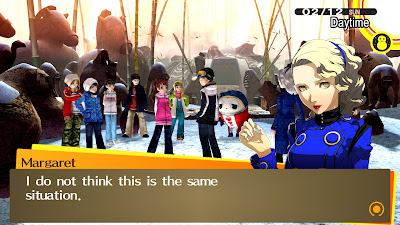

If we were ever to take the Japanese media's concept of 'Nichijou' and translate it into gaming; we'd probably get... well we'd get The Sims, wouldn't we? But if we were to try and mix in the actual aspects of a JRPG with the more tame concepts of the 'slice of life' genre, then we'd get a game like Persona; a title which mixes the mundane with the extraordinary thematic and logistic all under a practised precision that had made it's style of game almost a sub-genre in of itself. It is quite the unordinary style of game that even I, having followed Persona 5 extensively and hearing it's many features, didn't quite understand until I sat down and played 4 to see it in action. But I'll try anyway to explain how this game lays itself out to give you a solid grasp of why it makes for such a unique RPG experience.

Essentially how Persona works is like this: you are presented with a single calendar year in order to complete the game, solve whatever mystery is at the centre of the plot and wrap up all storylines you are involved with. And by that metric you are in charge of the day-to-day, week-to-week actions of the player character in that pursuit. Every Persona game starts with the main character signing a contract with the Velvet room to take responsibility for their actions, and that contract is more to the player than the avatar they play as. You are being told to take care of how you choose to spend each day in the two activity blocks you typically get- one for midday and one for evening. (As your mornings are typically taken up by attending school.)

This is the 'slice of life' aspect of the game, as your protagonist navigates the world, in the case of Persona 4: the sleepy small town of Inaba, and splits up their time between building relationships (or Social links) with their friends, earning some Yen and working on their own skills through part time jobs and side activities, working through side quests, conducting minigames, studying for upcoming tests. All the rigors of daily life like that. Oh, and finding the time to break off into the Shadow world in order to fight shadowy manifestations of the darkest aspects of the human psyche in order to save impending victims of a violent serial killer who is plaguing the town. Yeah, you really do be living that ordinary small-town life.
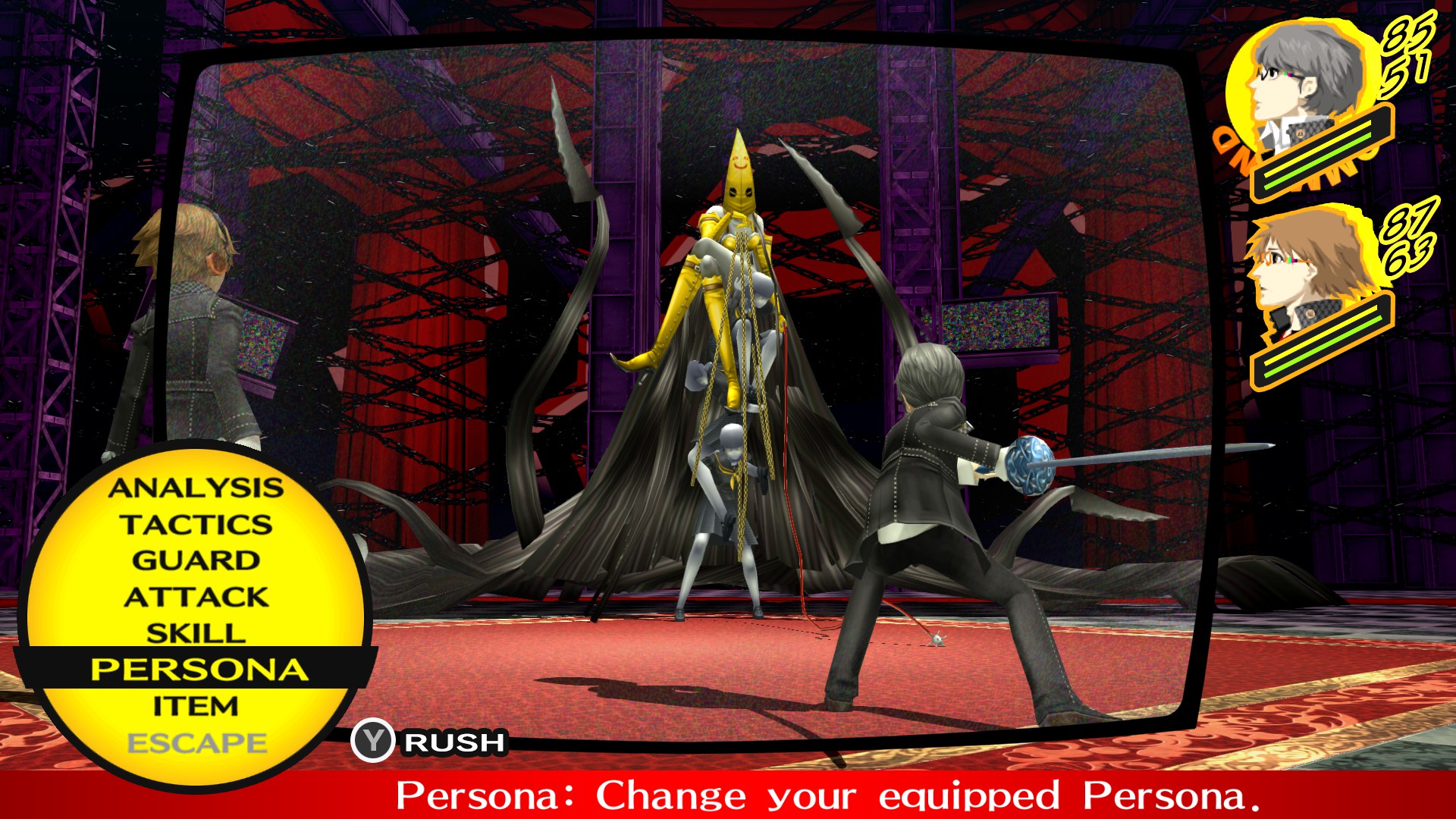
Persona is almost a balancing act between it's time management daily life portions and it's more traditional JRPG dungeon delving aspects which blossom out as the game progresses in kind. You have your typical RPG foils, elemental weaknesses, accessories and weapons, usable items, but mixed in deftly to work with the routine of the game world. At first it can seem like totally different worlds, planning out your week around people's schedules and then delving headfirst into a seemingly time-free dungeon delving adventure- but the more familiar you become the more it will become apparent that the JRPG side of this game is just the main side activity that you need to be making time for, whether to grind for items or to complete a new dungeon that opened up this month and needs to be conquered before a certain date or else someone's life is lost. Which is where the true beauty of the Persona formula is unlocked.

It comes down to the titular 'Persona's themselves, which are essentially spiritual manifestations of will, or ego, that act almost exactly like a Stand from Jojo's Bizarre Adventure. (Not unintentionally either. Jojo was an inspiration for Persona.) The player character and his party summon these Persona's to cast spells and are beholden to the elemental weakness and strengths of their respective Persona- with the protagonist being the only one capable of taking on multiple Personas and switching between them at will, making them the switch-up point-man party member organising the more static entities around them. You'll pick up new Persona's by winning fights or fusing weaker one's together to make a stronger one, and level them up by grinding to give them new skills or buff up their stats (which become your stats when you 'activate' them for your round) and change your role on the fly to suit the situation. Maybe you'll be the main damage dealer for one fight and the support wizard for another- this is pretty much where the higher strategy of the Persona gameplay lies.

And all that relationship building and time management you do outside of the RPG space- known as the 'Shadow World'? Well, that ties into the pursuit of improving your Personas. Every Persona has a certain Arcana (based on tarot symbology) which translates to a character with whom you can build a social link with in the physical world. The stronger that link is made and the deeper the connection you've established, the stronger the boost is whenever you fuse together a Persona of that corresponding Arcana- shooting their starting level and saving several hours of perspective grinding. And in turn, keeping a Persona of the corresponding Arcana in your 'mind bank' whilst interacting with that corresponding person in the physical world will rank up your social link with them faster. You an see how the cyclical relationship between game systems works already.

Now with how I've described the gameplay systems you'll have noticed my allusion to 'building relationships' and fighting 'manifestations of human darkness'; which has probably clued you in to some of the themes bubbling at the heart of Persona. Indeed, the concept of 'Personas' within psychology is central to the premise of Persona, such to the point where Golden features several side-content lessons on the teachings of Carl Jung to help familiarize the audience with what they're playing around with. One of the key most themes of the game that is brought up again and again is facing yourself and conquering your own darkness, instead of ignoring and rejecting it, thus making that part of your strength. As with any psychological plotpoint it's a very easy theme to make feel juvenile and condescending, but the intellectual maturity with which Persona is written, and the complexity of the characters who are tied into these plotpoints, makes the content poignant and worthy.

Persona 4 particularly had another obsession with the dual concepts of lies and mystery, and how they tie into personal psychology. Even when 'facing yourself' the question of the inner truth and the 'truth' constructed in the mind of others clashes in a manner that becomes increasingly relevant to the narrative as it progresses. In fact, in a turn of events that truly ascends past many fantasy worlds I've played through, the themes of Persona games take paramount importance in the formation of the plot such that practically every decision in design ties back to reinforcing their moralities and themes that the creator's intend to propagate- solidifying the importance of every aspect of the game design. I've rarely ever played a game so fiercely loyal to it's themes, and coming out of the game understanding why everything happened as well as what it all meant proved to be so much more satisfying to digest in those final moments.

And of course, the theme of love is a reoccurring aspect in Persona 4's character. Love for family and friends and love for yourself. Whether that be demonstrated in what people are willing to sacrifice for each other, or what they're willing to compromise on for themselves, as well as how characters are able to reach a point of acceptance with themselves. A more strong take on the way that theme exists in Part 4 of Jojo, funnily enough. Even the name of this rerelease, Persona 4 Golden, seems eerily remenisent to the name of the final arc in Part 4; and the title attributed to the heroes upon the conclusion of that Part, 'The Golden Heart of Morioh'. And that might just be because in many ways, Persona 4 is an unbranded video game adaptation of Jojo part 4. (But I'll touch more on that later.)

Music is another huge part of the Persona franchise and I'm so happy to say that Persona 4's is increadibly apt and intelligently conceived. Persona 4's suite focuses on J-pop with a sprinkle of Rock thrown in there, which reflects the bright and playful nature of the world of Inaba, as well as touching on the darkness and weirdness hiding under the surface of the innocent countryside town. That juxtaposition between the outside image and the inner truth blurs and blends in the genres and tracks to create a perfectly positioned OST that I could, and have, listen to for hours. And, of course, some particular tracks feature vocals that can make the heart swell and lyrics that spark the inner emotions of the situation and people around you. Quite simply, I adored Persona 4's soundtrack. Even more so for the decision to create a musical bookend with the song 'Nevermore', which is a lyrical reprise of the menu theme so players hear the same song at the beginning of their journey and the end.

The story depicts you, a big city teenage boy, through his transfer down to the sleepy countryside town of Inaba to live with your Uncle and cousin for a year whilst your parents are busy abroad for work. Once there the curiosities of small town life unravel, from the peaceable daytime streets to inexplicable supernatural myths that always seem to travel in tight knit communities like that. One such myth, known as the 'Midnight Channel', proclaims to present an image of one's true soulmate on the black glass screen of a turned off TV screen on days when it rains at midnight. Giving it a shot yourself shouldn't be too dangerous, right? Only that turns out to be the gateway into a world of metaphysical allegory wrapped in a game of cat and mouse against a serial killer and the forces of mistruth and disillusionment themselves.

As with any Persona game, the real heart of the game is set in the building of relationships with those residents of Inaba, each on their own journey's in life just waiting to be nudged along by getting to know you for a few months. Persona 4 presents an affable team of characters to serve as fellow investigators for the Inaba murders and budding close friends, and the narrative performs vast feats of storytelling to ensure that both factors are presented to be as important as the other. As you are, a team of teenagers trying to solve the mystery of a serial killer, it would have been easy for the story to lose that innocent simplicity of youthful life, or sacrifice the intense drama of a murder mystery, but with the length of a JRPG to take advantage and a working formulaic gameplay loop- the game simply excels. Though building individual relationships with each member of the main cast, and the various side characters around Inaba, is left entirely to the discretion (and time management skills) of the player, you'll feel the head of a close family by the end of the narrative whether you wish to or bitterly fight it every step of the way. You can't keep the love out forever!

That gameplay loop is based around the progression of the days, where every couple of months a new character will be introduced into the story during your daily school life, only to be captured and placed within the shadow world at some point. From there it's up to the player to prepare and mount a rescue in the days left before the next bout of rain, because the day after that rainfall is when the fog sets in...and the kidnapped person will be found dead through inexplicable means. Keeping to this fairly strict formula allows the player to settle into a rhythm of play where they know roughly where the story beats will be and plan out their routine for the month accordingly. Grind out stats in the days that a new character starts to enter the fray, build up those more abstract social links in the free days after saving someone, organise stat boosts with the right jobs to maximize gains. Eventually you enter into that kind of 'Stardew Valley' state, where the weekly plan is itself a satisfying loop to build, only with the backbone of a strong unfolding mystery dipped in poignant ruminations on the nature of growing up and discovering oneself.

Actually rescuing the endangered involves travelling into this 'Shadow World' I've been talking about, through sacrificing one of your evenings to enter through a magic TV screen, and conquering a dungeon thematically themed around the inner emotional turmoil of the prospective victim. Yes, this means level-design storytelling, ear-worm musical themes for each zone and revelatory confrontations once you grind through every randomly shifting floor to the top. Honestly, some of the most fun can be had just witnessing the allegorical design motifs of these boss designs and how they pertain to the psyche of the person they've been projected from. For example; the martial arts loving tomboy Chie, who shuns from her dark thoughts regarding her inferiority complex next to her more popular best friend Yukiko, sees her 'Shadow' manifest in a boss that is a leather-bound dominatrix perched cross-legged above a seat made out of stacked schoolmates struggling to keep her up. It's demented and abrasive, but oh so creative and fun! (For the record: 'Kusumi-no-Okami' is my absolute favourite. Such evocative and symbolic designs just makes my shrivelled little heart swoon.)

Near the later months of the game the story slips out of it's routine as the mystery unravels and events enter into a more traditional 'life threatening' stance for a typical JRPG narrative. However, Persona never falls for the pitfalls of your traditional fantasy narrative- the world is never just in peril because that sounds like a big stake to hold over the plot's neck. There's significance, narratively, behind every development, even if it's not obvious at first. In fact, it's quite easy to go right from the apparent climax of the game straight to the end and settle with the basic understanding of events that occurred and be relatively happy- but go that step further for the 'True Ending' (which thankfully is a really straightforward process of simply investigating a little bit more when everything feels almost wrapped up) and you'll find the true motivations blossom out beautifully. I seriously recommend everyone to experience the true ending- it's satisfaction personified.

Of course, we are talking about Persona 4 Golden here (stylised as 'Persona 4: The Golden' in Japan) which means there's another face to the story. Golden adds some new elements to the game, most notably a new character in Marie and a new unlockable ending- the bad end where you literally join forces with the game's initial villain. Marie is a girl without memory who exists in Persona 4's transitory nexus of activity which has a unique incarnation in every entry of Persona: The Velvet Room. (In this game it's the back seat of a moving limo travelling through the fog of the Shadow World searching for a destination- representing the protagonist's journey to travel through the fog of mystery and discover the truth.) When I first saw her, I presumed Marie to be this narrative's version of Reimi from Jojo, given the plethora of similarities between Persona 4 and Jojo Part 4. And sure, there are undeniable similarities, but I'm glad to confirm that Marie is so much more integral to the narrative.

Getting to know Marie, by maxing out her Social link, doesn't change the course of the narrative but rather deepens it with an extra layer of understanding, and presents an entire new chapter to the game that fits in right before the final chapter wherein lies the true ending, presenting an extremely unique dungeon with it's own mechanic, (Albeit, an intensely annoying mechanic) and a brilliant boss encounter that serves more as a playable narrative climax rather than a traditional slog fest battle, but is still engaging to beat. Ultimately, Marie exists to provide an extra bit of depth to the true ending, elucidating a bit more about motive and making that final dungeon just that little bit more personal to you. She fits in increadibly well to the already presented narrative, and though her story doesn't change the course of the game in anyway, I think her place is too perfect to cut out now that she's here. Golden is simply the way to experience this narrative, without doubt.

Of course, I've spoken so much about the cast of Persona, it's only fair I touch on them before wrapping up. No, I just really want to talk about this group of characters I came to really love and cherish across the course of Persona 4 and whom I know I'll be thinking back on fondly for years to come. Yosuke is perhaps the most typical, another big city transfer who fills the best friend role as anyone might expect, but with his own actual character depth thrown on top because ATLUS don't do anything by half measures. Chie and Yukiko make up the rest of the main crew, both girls who grew up together as friends despite their distinctions. Yukiko is like the gentle winter rose of the school, heiress to the iconic Inaba Inn, ladylike and meek- Chie is a tomboy, sporty yet clumsy, fiercely protective of her friends. Each of these characters get the chance to bear their souls out and grow throughout the narrative until they're totally different people by the end. There are others to meet, but labelling them out would be something of a spoiler because discovering your party is half the fun of any RPG.

And the main cast aren't the only people you'll come to really get to know if you take the time. There are dozens of citizens you brush past during your brief year in Inaba, and you can spend some afternoons building social links getting to know them as well. The troubled head Nurse working in the local hospital, the club actress who escapes further into her roles than anyone around her, the gruff police detective uncle and his mature but quietly-lonely daughter and maybe even the goofy partner of that police detective who feels like he deserves something more out of life than his lot. And of course, though I loathe to think of her as a 'side character' she isn't technically a member of the main party so she is, by definition, 'side': Marie. The tsundere fish-out-of-water hybrid, discovering Inaba just like you, only with a more alien perspective as she's also searching for her memories and purpose. Only odd seemingly involuntary poems penned by her hint at her inner truths. (As you can likely tell; Marie is my favourite of the side characters.)

In Conclusion
What can I really say except that 'Persona 4 Golden' was originally meant to be my consolation prize and ended up becoming one of my favourite video games of all time. I adored the characters, the world, the narrative, the themes, the music, the heart and the soul of this game. It didn't make me cry, but it did make me gasp and whimper and cheer- and it wormed it's way into the warmth of my heart's nostalgia already. I only beat it a week ago! 'Persona 4 Golden' feels like more than a game. It feels like a sensation crystallised into an interactive form. The sensation of sleepy summer holidays, scrapping your knees in the dirt at the park, breathing in that intoxicating irreverence of unblemished youth. I felt much the same way about 'Jojo's Bizarre Adventure: Dimond is Unbreakable', but whereas I think that part of the story captured a tincture of that world- Persona 4 encapsulated it. As a JRPG it's beautifully balanced and engaging. As a simulator it's sweet, poignant and moving. As a product it is a complete work of art, brilliant enough to be an example to others. I've given myself time to digest it, played another Persona game in the meantime to expand my horizons, (3 Portable) and though I've had my hang-ups here and there (particularly with the punishment of the hardest difficulty. But I brought that on myself anyway.) I struggle to think of any genuine flaws of this game. 'Persona 4 Golden' is a masterpiece, plain as day. As such I'm about duty bound to award it with my first ever 'S Grade', as a simple testament to it's genre. I came in expecting an idle fancy, and came away totally in love. Games like this make me happy to be obsessed with this industry of gaming- and stories like this make me just that little bit more hopeful to get up in the morning and face this Shadow World.
Monday, 27 March 2023
Risk versus Reward versus gaming
Dicey
Recently I got back into playing Persona, what with the recent reveal of the mobile Persona game rocketering our way, and in doing so I became intimately reacquainted with how heart-wrenchingly 'risk and reward' that game's set-up is. To be clear, on normal difficulties the game is nice and decently paced for your typical RPG player, but on my chosen difficulty (Risky) the game presents a heart pounding escalation of consequence that mounts on the player for every moment they choose to grind for experience by holding a gun to the head of the single most valuable resource in the known universe- time. Which got me really thinking once more about the impact of these sorts of systems outside the narrow scope of Souls-like games because we talk about them literally all the damn time on this blog. In fact, I technically just mentioned them again so time to take my 'bingo' shot, I guess.
So to explain the Persona situation, first I have to preface this by revealing that Persona 4 is one of those rare few titles in which your party based RPG demands the survival of the principal character. Not only is the main hero not allowed to die, they're not even allowed to fall unconsious in battle otherwise you are kicked roughly back to the title screen. Yes, Persona 4 doesn't even send you to the load screen, or a recent checkpoint. In normal difficulties this isn't the end of the world, because the game will autosave everytime you cross a floor meaning that the typical grinder can't expect to lose more than 10 or so battles worth or progress assuming they commit to totally wiping a floor clean before moving on. On Risky difficulty, however, that dynamic changes considerably. Because on Risky, there are no autosaves. Only manual saves. And when battling in Persona, the only place to manual save is at the nexus between dungeons outside of every battle space, which you can only reach by walking out the dungeon through the way you came (which would require passing through roughly 10-15 floors worth of respawning enemies) or to use a limited resource to teleport. (Thankfully the game allows you to pick back up the dungeon from the furthest floor you reached.)
What this system essentially does is place a premium price on how often you can rest and save between runs, beyond the general time limit of the ticking days for which certain story milestones must be met. (or else the game ends completely) Players on this level have to commit to a run in the dungeon and pay the price for not completing it fully, whether because their team are running low on precious resource or because a presented boss simply isn't feasibly killable at their current level. Persona doesn't pull it's punches when it comes to tough bosses, either; being unable to easily beat a presented boss because your level just can't withstand their hits is in no way an unlikely scenario. So grinding runs are a gamble, dedicating your time to wiping up trash mobs for XP all the while being nervous of how many times you can feasibly leave the dungeon to 'bank' that XP (by saving) and the mounting risk of all that grinding time being utterly wasted if you get one lucky mob who slams your MC with a 'god-fist' dealing 900 damage. (That would probably even one-shot someone with a physical resistance shield active- giving that move to trash mobs is just nasty.)
There's nothing more crushing for anyone in life than the feeling that the time you just put into something was wasted. In fact, it's a constant battle with modern game design to try and develop systems in such a way that players feel like they're constantly moving towards some sort of goal. Rougelites are a spectacular example of this, presenting an ostensibly 'one run/ one life' system wherein death resets everything, whilst at the same time typically presenting background systems that unlock new tools or variations for each run; alongside the general game knowledge that comes from mastering those sorts of games. For a title to straight up slap you in face for failure is actually shockingly hardcore for a game of the modern age. And Persona does not care to tell you that have wasted your time by playing poorly. (Thanks Teddy, I'll cry myself to sleep now.)
But when happens when we start turning the dial to the opposite extreme? What happens when the reward comes without the risk? Or, to put it another way, how do you pull off a situation where the amount of work put in by the player doesn't correspond to their reward in an appropriate fashion, because they are either under or over rewarded? World of Warcraft had a problem similar to this early on it it's life cycle, where one of the early game quest rewards gifted a supremely useful utility tool that granted a buff to general world movement speed. However this item was given at the end of a fairly innocuous starter quest, and as a 'choice reward' against a pretty useless alternative. With the lack of purpose put behind the reward, alongside the relative freshness of most players to the game at that point, several people ended up passing on the movement boost not realising it to be a pretty unique enchantment and passing it off as early game trash.
Another example I always like to think of would be Grand Theft Auto Online, which tied it's economy and it's microtransaction store to the same in-game reward money system. This meant that all new game content could be grinded with in-game money to access, all it took was the dedication and perseverance to sit down and do it. Of course, this also meant that there were a few quests that drew people in for how relatively quick it was to do versus how much potential payout it would dish. The high-paying 'Rooftop Rumble' could be finished in minutes if you knew what you were doing, and grinding it endlessly for hours at a time could net you virtual millions, all from blowing up the same parking lot full of bad guys over and over like a zombie. Yes, I was one of those zombies.
To combat this, Rockstar ended up fundamentally changing how GTA Online rewards it's missions, by instead of prioritising the actual mission, the onus would fall on the play time. The longer you spent in a mission, the closer to full payout you would earn, with fifteen minutes or more required to score the most amount of money. Of course, this had the knock on effect of killing momentum on every activity as being good at doing any sort of task ended up punishing you in the long run. Rockstar would make a similar mistake with Red Dead Redemption 2 Online, in which they punished people for completing more than one activity within an hour by heavily cutting each subsequent reward within that cooldown period. It's their bread and butter, so you know why they're trying to thin out grinders, but when you remove that element of reward, the investment of time and dedication to risk becomes utterly moot and momentum killing.
Higher concepts of game design aren't really the things that get discussed when making your bog standard game. A lot of the indistincts have already been figured out and those that want to make a genre title can merely follow those guidelines, but the trailblazers know that messing with these guts of design are what makes or breaks the gameplay formula. And as with everything in art and cooking there is no right cure all for everyone, I'm sure there's many who would find that Persona 4 situation I explained utterly hellish, and sometimes I'm right there with them, but when you know your audience and what they're typically willing to accept and be attracted to, you know exactly how to create the right feeling reward tapered by the exact measurements of risk.
Thursday, 23 December 2021
Persona 4 Arena Ultimax
Warning: This blog is 98% whining
Okay, which one of you lot cursed me? Out with it, I wanna hear it straight. Which one of you sick people thought it would be funny to imbue me with an unrequited love for a video game series that just seems to hate me for some insane reason? And while we're at it, who tasked ATLUS with porting out every bloody game in their back catalogue apart from Persona 5 Royals? Why does this Japanese company want to conspire against me and exactly me? What have I done to them? ATLUS have been toying around in what feels like a personal slap in the face competition against just me for actual years now and I can't wrap my head around it. No one can come up with a good explanation for why we're being strung along, only die hard Playstationites seem happy with the idea of Persona 5 being a console exclusive until the seven rings of Hell collapse and reality comes to an end, Persona 4 Golden actually sold pretty well on Steam, what could possibly be the hold-up next?
I know this is a story that I've told before, but it honestly bears repeating, because I was actually there when this new Persona game was announced. I was watching the game awards Pre-show, if you consider the act of 'watching' to consist of allowing it to play in the background whilst I was playing Hollow Knight. Thus I was hardly paying attention when the presenter claimed that the next reveal was one we 'didn't see coming', and just off-handily joked that it was Persona 5 Royals for PC. And then the ATLUS logo dropped. When I say you've never seen a controller dropped faster in your life I mean that the final ravens in the London Tower were finally scared off by the force of the impact. London is currently undergoing it's apocalypse consequentially. (Which is either a zombie invasion or an infestation of Edo Period Japanese spirits, depending on which historical document you prefer out of ZombiU or Nioh.) And the payoff? Persona 4 Arena Ultimax. Good god- the song that announcer was referencing 'Last Surprise' wasn't even in existence at that point, it was created specifically to be the title for Persona 5. Someone delights in jerking me around and I can't take it anymore!
So then what is this game that is coming our way if not a PC adaptation of one of the finest RPGs of all time? (Or at least that's what I'm told. I'd be able to back that up if I could actually play it.) Well, Persona is never the sort of series to keep things constrained to a single box when they can multitask and try to be every genre at once, or at least that's what I think the reasoning behind the spin-off games in the series is. Think the kind of stuff that Yakuza always sticks into their gameworld, just cut off the main game and fleshed out into their own fully fledged title. (Actually, I guess there's a lot of Japanese series' that do that, huh? Dead or Alive: Beach Volleyball comes to mind) This iteration is a fighting game in the traditionalist sense, with a flat 2D arena space, combo moves and summonable Persona's to make the Jojo comparisons simply unavoidable. (This port will make for a good place to store all those ripped Eyes of Heaven models that people seem to love so much, if nothing else.)
Now I'm not much of one for fighting games, the only one I've ever really given the time of day was Killer Instinct, and that's only because that game has a special mode which allowed me to do combos without having to move. (Seriously, someone explain to me how you're supposed to move and keep the target infront of you if that deviation instantly breaks the combo: it makes no sense!) Visually I will admit that what I'm seeing is actually pretty cool, characters seem to have an almost cellish look to them that faintly reminds me of the guilty gear games, so I already want to see more of the game at the very least. As for whether or not I'm going to like the controls, well that remains to be seen but these sorts of games tend to be decently well received by fighting games fans which bodes mildly well. (If they love it then it means the skill ceiling is too high and I'll never get into it.)
So I'll be honest then; as a fan of Golden, there's a little bit of cognitive dissonance when I glance upon this mere concept for a game. As you've likely picked up from the many thousand times I've droned on and on about Persona and what I love about it, the key is the laid back atmosphere and the juxtaposition between RPG death battles and figuring out what you want to do at school for that day. I find all of that super laid back depth to be relaxing yet somehow invigorating to balance, so a part of me feels like there's an essential missing piece of DNA in the Persona formula with a straight arena game, but then I suppose that's just what spin-off games are for, isn't it? Changing things up so drastically you find yourself wondering if this was a good idea at all. Also, the Boxart of the protagonist ripping his shirt off like a Yakuza protagonist is just weird, it has to be said.
At the very least is can be said that the Persona library is making it's way to the PC, albeit slowly. At this rate ATLUS will literally have no choice by to get to Persona 5. Except there's the dancing game inbetween. And then they'll probably go back to 3, first. Let's be honest, the only point at which they'll port 5 to PC is going to be the sameday that they announce Persona 6 to the world so that they can ride that hype. I've tired to convince myself that won't be the case, but it's basic logic. So that's, what, an entire year away probably? Is this fighting game really going to keep people satiated in the mean time, knowing that we're gnawing off limbs for an RPG? Hell, are fighting game fans even going to be satisfied considering the sheer amount of other fighting games out there in the world? Am I going to buy it anyway? Probably. But I'm a rube, of course I'll buy anything with Teddy on the box.

And you know at this point I don't even care about Persona 6. Seriously, I don't. They could announce the game tomorrow and my response would still be "Cool- where's my 5 port?" Because here's the thing, I've been kicking around this block long enough to know that in this industry, it doesn't matter how big you are, how many hits you've made, how stellar that game record is, one day you're going to take the biggest turd in your career and it'll stink worse than most of your successes. The way I see it, the more great games you make, the more you're just building up bulk and that almighty, world-ending, dump is somewhere along the way. That Doom Clock ticks ever closer to midnight. And the Persona games have had 3,4 and 5 be labelled as classics, so as far as I'm concerned 6 is radioactive material to me. Once more ATLUS, in as much energy as I can still generate in this flabby failing frame: just give us that port we want to pay you money for: Please.
Friday, 22 January 2021
Persona come back
Patience isn't my strong suit
Okay, so I inherently know that I'm going to sound a little whiney saying this; but when's the next game, ATLUS? I'm dying out here! Recently you may have remembered that long tradition broke when ATLUS, kings upon kings, decided to do the unthinkable and put a JPRG on computer. (What madness it this!) Yes, a game genre that typically demand hours of one's time pouring over incremental stat increases, strategizing over exact move orderings and combos, all whilst juggling packs worth of regenerative items. Why should that experience ever make it the PC? Of course, I'm being an ass; JRPGs were made for the PC audience and it's crazy to think how long it's taken things to actually catch on. When Persona 4 Golden finally made the jump, however, there was none of that early stigma of 'Will this work out', 'ain't this more of a Playstation thing', it was all just "Please god, let me have Persona I've waited for so very long." (Or at least that was me, I imagine others were a bit more muted.)
And it worked out! Heck, I couldn't have made Persona 4's PC launch a success on my lonesome, so that's proof there's an audience on PC that's dying to have more of this world! Just recently it was surmised that Persona 4 was one of the top games of the year to be played on Steam with a controller, which seems a little odd given that it is a turnbased game, but I was actually one of that number so I guess I can't really talk, can I? So we're talking about a game that smashed sales, challenged some records, and had folk literally begging for more. So are we actually getting that more? I feel like this is something that we need to know because... well... I hate this annoying limbo of never knowing enough! Capcom are kind enough to let us know what we can expect out of Yakuza's PC ports, and that's ten times more kind to us than letting fans longue around all year and wither. I remember several times seeing that glimmer of home in a trailer and jerking upright, only to see that it's just Persona Strikers, or an AFK arena crossover. (AFK Arena? Seriously!)

I suppose the reason this really digs at me goes back to the very first moment I heard of Persona, because I can actually pinpoint that. It was during the lead-up to 'Metal Gear Solid: The Phantom Pain', and I had been scouring Youtube for videos in any language that would tell me more about the game. Now I cannot say if watching all those Japanese videos had a hand in influencing my slice of the recommendation algorithm, but that certainly doesn't seem completely out the realms of possibility, does it? Either way, I found myself with the announcement trailer for Persona 5 in my feed and just ended up clicking on it. I kid you not, by the end of that trailer alone I was sold. It looked vibrant, exciting, kinda crazy, brimming with personality and just a hint of these great anime cutscenes; I was hooked. From that moment I've been constantly looking for a way to get my hands on the game, but it's always been just out of my reach. First it was because the game was destined to be a Playstation exclusive, and then because- no wait, every bit of my waiting has been because this game is a Playstation exclusive. Damn it Sony, why won't you share the love?
Now don't get me wrong, I understand why the Xbox hasn't exactly seen it's share of Japanese titles. Sony is a Japanese company with ties to all studios from that side of the world, so when it comes to exclusivity talks you can't really blame these devs for going with what they know. But what's the excuse for PC? Ya'll making these games on personal computers, are you not? Why can't they be for them? Yes, I'm getting to the point where my arguments are as simple as that, because do they really need to be any more complicated? How often is it necessary for a game to be made for consoles and then ported to PC; does that ever make more sense than the inverse? I doubt it. And if Sony are worried about losing market ground, that's fine, but what the heck do PC players have to do with that argument; we don't care about this whole 'company loyalty' nonsense, we just want to buy the games! Let us buy the games, Sony, you avaricious gold-hoarding flying lizards. (Yes, this rant is slightly inflamed by Final Fantasy XVI too, can you blame me?)

So why am I writing this blog? Because now that I've actually had the chance to sit down and play the heck out of Persona 4, I'm hopelessly in love with this franchise. I mean, head over heels, can't live without it, need more in my system, addicted to the thrill, lost in the beat, addicted to the pain, insert analogy here, kind of fascination with these games, and I need more. Seriously, I've played a great many RPGs in my time of all different shapes and sizes, including a recent spat of old school western isometric-style games, and I've never seen one that so frankly nails the juggling of life and combat. Even fully blown open world RPGs like Skyrim and Fallout, that literally make you play ever waking second of your character's life, don't make me feel like I've inhabited the mundanity and humanity of the character in question. Or perhaps it's more accurate to say, I feel less an avatar in a new world and more a person from that world in Persona.
Yes, I know it sounds weird to say; but I adore all of those times when I'm just interacting with the inhabitants of the game world and getting to know the regulars and finding out what makes everyone tick. It's a perfectly natural way of establishing personal attachment to the personalities of the game world and I haven't seen anyone pull it off as neatly as the Persona franchise does. Which isn't to say the combat isn't great, because the very act of getting to know people actually contributes, even in those little ways, to the combat experience, and that's another layer of ingenuity in the formula. I knew from the start that Persona would be a game right up my alley, but I had no idea how much it would end up rubbing off on me and now I need my next fix, gosh darn it! When are ATLUS going to get to it?

Right now I'm at an impasse; I've reached the point where I want to experience the whole series, from the beginning if I have to. (Well, maybe not 1 and 2, I don't know what they're like, but certainly 3 onwards.) And this isn't a case of wanting to see the whole story, like many other Japanese RPG titles each entry is independent of the last one, I just love the premise so much that I want to experience it as much as possible. It's the same sort of addiction that struck the world after Metroidvania became a thing, or Souls-likes, I'm not calling Persona's playstyle it's own genre by any stretch of the imagination, but I'm hooked to them as though it were. I'm sure that a few years down the line I'll be picking two-bit demos on Steam that so much as resemble what these games do. But the more content ATLUS provide me, the longer I can stave off that dark eventuality; so hit a brother up, guys!
Were I to make a wild prediction into the future, I would predict that 'Persona 5 Royal' will hit us in April, as a surprise. (Of course, I can't say whether that's April 2021 or 2025) April, May or June, I say, because that's around about the start date for each Persona game and that would make a nice bookend. ATLUS have, for their part, commented on wanting to port more of their games over after the success of Persona 4 Golden, but I'm slightly worried it's going to end up being Shin Megami Tensei. (I'm sure that series is great too, but it's not what I want, ya know?) So thank you for coming to my TED talk where I whined about wanting to play more Persona; I know, I'm bored too.
Monday, 9 November 2020
What does perfect Character Growth look like in gaming?
When I grow up...
Storytelling is a big part of my life and who I decided I would be, thus whenever it comes to telling stories and the mechanics and techniques that go into it, those are pretty much the topics that I go to sleep dreaming about. (I'm not exaggerating, I literally dream about this stuff.) Thus I love considering how to handle character introductions, struggles and ultimately growth, for all that makes for, in my opinion, the best experience for the viewer. Any story wherein the audience feels personally invested in the lives of the fictional characters is heighted by that bond, and it's in such a state where the storyteller has the very heart of the public in their hands to do so as they please. And for me, I particularly love that moment of comparing who the character currently is to where they started, the greater the disparity the better. (With some very pointed and clever exceptions at times.) As far as I'm concerned I think character growth is the bedrock of any great story and I think gaming serves as the perfect medium to serve up such stories, thus that's what I'll be touching on today.
In my experience I think that accurately portraying something as complex as emotional growth is one of the most complicated yet rewarding tasks that a storyteller can embark on. On one hand it can take a huge chunk of your storytelling time away from you, whilst on the otherhand it can make a scant 2 hour movie feel like an entire lifetime when laid out correctly. Oftentimes when it comes to movies or TV the biggest issue that plagues the storytelling is a lack of time to cover all the bases of telling in-depth stories with deep characters, which is why I feel we see a better balance of this in books where they are typically allowed to spend as much time as they need wherever they want to. (Of course, such room also provides a lot more space for the narrative to hang itself, but that's an argument for another day.) Games sit in that space between whereas they follow a lot of the conventions of visual media (mostly, I think those that break such conventions usually are my favourite, however) whereas they can have the breadth to breathe that you'd find in written media.
So what, then, does Character Growth in the world of gaming actually entail? Well I think that's somewhat of a difficult question to breakdown, because when you take into account the huge genre of RPGs and their mechanics it could mean a great many things. I mean if we're being as literal as possible, one might say there's a great chasm of growth in a story about a brash silver-haired 'demon hunter' who wonders about an old castle and gets impaled on a sentient sword, only to then go onto become the savour of the world several times over. Yet even then I wouldn't personally consider Devil May Cry's Dante to really be the poster child of great character growth. (Not knocking Dante or his games, they just have their own, somewhat immutable, style to them.) I'm more interested in the sorts of stories wherein characters will be an emotionally changed person from the moment that they walked onto screen to the moment they bowed off it.
And thus I think one of my main reasons for having this particular topic bouncing around my head is none other than the musical crime drama extravaganza; Yakuza. (or Ryū ga Gotoku, as I found out it is called in Japan, rather confusingly.) This game, or more specifically Yakuza 0, follows the journey of two men as they navigate their lives through this criminal organization and what it ends up making of them. Now where I think character growth really stands out in this game is the way in which the experiences and tribulations that the protagonists endure have such a marked effect on these people that you can literally replay the game and point out the different people and the way their mannerism ended up bleeding into the heroes. Now admittedly, Yakuza 0 had the benefit of being a prequel wherein the writers already had a clear idea on who these characters will end up being, but what appears to be a huge boon can actually be a rather constricting complication if you don't know what you're doing. (Just look at 'Solo'.)

To touch lightly upon spoilers; Yakuza 0 follows Kiryu Kazuma and Majima Goro on their early lives in the Yakuza as fresh-faced early-twenty year olds, before they first get entangled together into an endless web of conflicts and disputes. We meet a brash and somewhat unscrupulous Kiryu alongside a servantly and respectful Majima that are both thrown together in a journey full of lies, set-ups and, most importantly, manipulation from all sides. Yakuza 0 unfolds in a somewhat straightforward manner when it comes to character growth, by having these two literally run into people who they end up basing their future selves around within the story. Simple, but effective. By the other end of the story Kiryu comes out wanting to be rolemodel of an honourable Yakuza (as much of an oxymoron as that sounds) whilst Majime comes out putting on the persona of a unhinged lunatic in order to never make himself seem vulnerable enough to be manipulated ever again. As far as I'm concerned, these here are textbook examples of comprehensive and effective character progressions wherein the audience feels closer to both of these folk by the end.
Although to shift our gaze to another game which is renowned for it's character portrayals and yet handles it somewhat differently, let us look at Red Dead Redemption 2's Arthur Morgan. Here is a character that is cast in a tale that is already destined for tragedy, this story being a prequel to the first Red Dead Redemption. As for Arthur himself, he's hardly a fresh faced character waiting for the world to make an impression on him, he's a bandit that has lived a hard life and is already in a position that would be the end point for most characters. He's violent and cruel whilst also principled to an oxymoronic degree. And what makes his journey different is that he has become who he is by learning from the people around him, but where he goes throughout the course of this game is driven less by meeting new people and more by revaluating the one's that he's already known.

Once more I'll be fliting with spoilers but it goes rather like this; Arthur looks up to those that raised him to the point where he, despite his own common sense, believes and trusts his mentor when everything starts to fall apart. At the start of the story, events have just occurred to shake that belief, although it's only as things become more desperate that Arthur begins to react to it all and grow in kind. His journey isn't to become someone better but to merely learn about who he has been for a while now, what he then chooses to do about that is left up to the discretion of the player but either way his growth has been handled deftly. It's storytelling and character mastery like that which makes the Red Dead games so iconic and memorable.
Not all games handled character growth completely within their narrative, however, and that's where I think gaming has the potential to really surpass other Storytelling mediums. Take Persona 4 for example. That is a game which takes the concept of personal development and draws it out from the narrative and into the base gameplay. For the story you play a city boy who's found himself relegated to the country side town of Inaba with a whole cast of people he doesn't know and has never met before, rectifying that actually doubles as the way you become more powerful throughout the game. I mean that literally to, simply going around, talking to people and becoming closer to them powers up your Persona's whenever they need to be summoned giving the player a boost. This is, admittedly, a much more literal definition of character growth but I'd say it all fits.

RPGs in general provide great room for the player to feel that they're growing in ability as the character grows in personality, which helps in really selling the journey. Sometimes games can even work in little extra tricks that you might not even notice to get the message across, like in 'Spec Ops: The Line' where the performance of the actor intentionally became more ragged as you went on and the weight of the game's events began to weigh fully on him. Then there's what Cyberpunk is purposing to do, by having the player's animation become more defined as their stats improve in certain skills. That may sound mechanical, but any animator will tell you that the personality behind every animation informs the person it's equipped to, so this is actually a big deal in the narrative too. (If Cyberpunk ever actually comes out, that is.)
So what does Perfect Character Growth look like in the world of gaming, well a lot of different things. It's about nailing the character driven moments and taking their personality from A to B throughout the length of the story, but it's also about making the player feel more capable in the shoes of the person they're playing as. (Or less capable, depending on the direction you plan for the story to go.) It can be as subtle as changing the tonality of read lines to as complex as polishing several versions of dozens of animations, with the freedom of making a game there really is no limit. And all of that is just taking into account the very traditional games, whereas there are many games that defy even those definers. But ultimately creating ideal character growth is achieved by making the fictional real, and connecting hearts beyond the TV screen.
Saturday, 3 October 2020
I love 'Persona 4: Golden'
It's time to make history here
Today I want to go over something that has absolutely swallowed my life as of late, that being the game I had to wait months for after purchasing; Persona 4. I already knew this was going to be kind of game that I would like; hell, I've know since before I ever even saw the game. All the way back when I first heard about this series. It was the reveal trailer for Persona 5, all anime and glorious, and I knew this was something that I had to get my hands upon. Of course, this was another victim of the trashbag know as Sony waving their exclusivity card around meaning that this was a title unique both to their brand and the console. (Yeah, a JRPG that's exclusive to the console. And people wonder why I consider the guys in Sony human trash.) Since then I've been one of many begging for a PC launch of these games for literal years, until early this year when we finally got it. A PC port of Persona- 4. "Well, it wasn't what I asked for but I'll take it." I thought at the time, reasoning that this game has to be decent enough.
Of course, then I found out the hard way that the port was inconsistent, with myself being unfortunate enough to land in the camp of folk who get the buggy version of the game. Okay, admittedly the issue was limited; the anime cutscenes would lag and stutter to a halt although people told me they were far and few between anyway. But I paid for the full experience and that's what I wanted; I didn't want to sacrifice the cool animated moments because of some tech difficulties, so I spent literally weeks looking for answers and came up blank. Eventually I just gave up and choose to spend my time with another game I had put off forever; Yakuza 0, although in the months that followed there was a small update finally to my version of the game. At the time I hazarded a small reopen of the game and saw the intro animation play without a hitch, but I was enraptured in the world of Yakuza at that point and so I put it away for another day.
In fact, it was only really a week ago when I finally dipped my toes into this game, and since then I've played 39 hours. (And unlike with Far Cry 5, most of those were actually spent playing the game rather than standing around the pause screen working up the desire to resume) Needless to say I am hopelessly hooked and obsessed with the town of Inaba and it's residents, as a fellow who seeks escapism so often in the hobbies he partakes, Persona 4 is one of the best fulfilments of that goal that I have ever played. Already I've found myself invested and caring about the people of the everyday as well as completely sold on the premise of managing my daily activities between fighting and socialising. It proposes a world in which the ordinary have the potential to become titans and mean something, and at the end of the day isn't that something that everybody wants?

Though I'm not nearly done with the game yet, I'll try to nail the basics of the premise. There is some sort of supernatural killer working their way through the sleepy country-side town of Inaba with murky motivation and a curious methodology. The police are stumped and soon it falls into the lap of the main character to solve the murders whilst saving those in the crosshairs and managing his schoolwork at the sametime. (Sort of sounds like a more grim version of Kim Possible like that, doesn't it?) The thing which makes this title so different and unique to other RPGs is the way that it places heavy emphasis on the average day to day life, with the bouts of actual action being the rare exception which breaks the tranquillity. Even then, it's never a surprise; the player has to embark on that adventure themselves, meaning that there's this clear divide between the peaceful moments and the nail-biting ones which the game's mechanics bridge between.
As the master of Personas, the player's combat is driven by the way they manage and swap between these powerful manifestations of will known as Personas. Most people have but one to their name, a representation of the face they wear to show the outside world, but the Hero can don many, given their blank-slate personality. Each of these personas come with their own stats, abilities, and vulnerabilities that the hero inherits when they equip them, bringing strategy into the equation. Also, the strength of the Persona is really dependant on the level on which they were summoned, encouraging the player to summon a variety of new Personas as they themselves start to become more powerful, ensuring that your moveset is rarely ever static.
That alone makes for a pretty diverse and interesting RPG side of the game, but the way it relates to the hanging out side of the game is truly inspired. You see, every Persona is tied to a certain Tarot card which categorises their theme and abilities, although that's something you won't think a great deal about when you're actually fighting. This does come into play, however, because everyone you form a connection with in the town is also linked to a Tarot card. As you spend time with these people and grow closer to them, your bond to the corresponding Tarot card is strengthened, which means that when you summon a Persona of that Tarot category they'll be instilled with tremendous strength that can give you a heavy advantage. (Spending the whole day planting carrots with your cousin doesn't feel like a waste of time!)

Speaking of time, that is another element of Persona 4 which I find enthralling. The whole game takes place over the length of a single year, with daily activities progressing the player through the two stages of the day (day and night) relentlessly. This creates this atmosphere in which you feel encouraged to manage your time and who you spend it with wisely, because there's always a calendar counting down. Of course this becomes a lot more relevant once people start getting kidnapped, and suddenly you have to race against the clock of a few weeks to grind up your character before the deadline. (Which automatically ends the game.) It solves the problem of a lot of RPGs wherein you feel little drive to hit at the main goal and feel like you could stop and grind whenever you want to; instead you know you have to play clever and actually feel productive when hitting the grind.
There's so much more to talk about with this game although I fear I risk going into details that I should probably save for a review. TLDR; Persona 4 is shaping up as a truly interesting title which subverts a lot of genre tropes and is currently still delivering an emotional ride. I have a few issues with it, such as the fact it's one of those games where if the hero goes down the entire party wipes, (I hate that) but for the most part I'm swept away by the adventure and find myself wanting to spend more time in that world then the real one. It's always special when you find that new obsession which has the potential to alter your outlook for what makes a great experience, and already Persona is proving to be one of those games. I can't wait to see where it goes next.
Today I want to go over something that has absolutely swallowed my life as of late, that being the game I had to wait months for after purchasing; Persona 4. I already knew this was going to be kind of game that I would like; hell, I've know since before I ever even saw the game. All the way back when I first heard about this series. It was the reveal trailer for Persona 5, all anime and glorious, and I knew this was something that I had to get my hands upon. Of course, this was another victim of the trashbag know as Sony waving their exclusivity card around meaning that this was a title unique both to their brand and the console. (Yeah, a JRPG that's exclusive to the console. And people wonder why I consider the guys in Sony human trash.) Since then I've been one of many begging for a PC launch of these games for literal years, until early this year when we finally got it. A PC port of Persona- 4. "Well, it wasn't what I asked for but I'll take it." I thought at the time, reasoning that this game has to be decent enough.
Of course, then I found out the hard way that the port was inconsistent, with myself being unfortunate enough to land in the camp of folk who get the buggy version of the game. Okay, admittedly the issue was limited; the anime cutscenes would lag and stutter to a halt although people told me they were far and few between anyway. But I paid for the full experience and that's what I wanted; I didn't want to sacrifice the cool animated moments because of some tech difficulties, so I spent literally weeks looking for answers and came up blank. Eventually I just gave up and choose to spend my time with another game I had put off forever; Yakuza 0, although in the months that followed there was a small update finally to my version of the game. At the time I hazarded a small reopen of the game and saw the intro animation play without a hitch, but I was enraptured in the world of Yakuza at that point and so I put it away for another day.
In fact, it was only really a week ago when I finally dipped my toes into this game, and since then I've played 39 hours. (And unlike with Far Cry 5, most of those were actually spent playing the game rather than standing around the pause screen working up the desire to resume) Needless to say I am hopelessly hooked and obsessed with the town of Inaba and it's residents, as a fellow who seeks escapism so often in the hobbies he partakes, Persona 4 is one of the best fulfilments of that goal that I have ever played. Already I've found myself invested and caring about the people of the everyday as well as completely sold on the premise of managing my daily activities between fighting and socialising. It proposes a world in which the ordinary have the potential to become titans and mean something, and at the end of the day isn't that something that everybody wants?

Though I'm not nearly done with the game yet, I'll try to nail the basics of the premise. There is some sort of supernatural killer working their way through the sleepy country-side town of Inaba with murky motivation and a curious methodology. The police are stumped and soon it falls into the lap of the main character to solve the murders whilst saving those in the crosshairs and managing his schoolwork at the sametime. (Sort of sounds like a more grim version of Kim Possible like that, doesn't it?) The thing which makes this title so different and unique to other RPGs is the way that it places heavy emphasis on the average day to day life, with the bouts of actual action being the rare exception which breaks the tranquillity. Even then, it's never a surprise; the player has to embark on that adventure themselves, meaning that there's this clear divide between the peaceful moments and the nail-biting ones which the game's mechanics bridge between.
As the master of Personas, the player's combat is driven by the way they manage and swap between these powerful manifestations of will known as Personas. Most people have but one to their name, a representation of the face they wear to show the outside world, but the Hero can don many, given their blank-slate personality. Each of these personas come with their own stats, abilities, and vulnerabilities that the hero inherits when they equip them, bringing strategy into the equation. Also, the strength of the Persona is really dependant on the level on which they were summoned, encouraging the player to summon a variety of new Personas as they themselves start to become more powerful, ensuring that your moveset is rarely ever static.
That alone makes for a pretty diverse and interesting RPG side of the game, but the way it relates to the hanging out side of the game is truly inspired. You see, every Persona is tied to a certain Tarot card which categorises their theme and abilities, although that's something you won't think a great deal about when you're actually fighting. This does come into play, however, because everyone you form a connection with in the town is also linked to a Tarot card. As you spend time with these people and grow closer to them, your bond to the corresponding Tarot card is strengthened, which means that when you summon a Persona of that Tarot category they'll be instilled with tremendous strength that can give you a heavy advantage. (Spending the whole day planting carrots with your cousin doesn't feel like a waste of time!)

Speaking of time, that is another element of Persona 4 which I find enthralling. The whole game takes place over the length of a single year, with daily activities progressing the player through the two stages of the day (day and night) relentlessly. This creates this atmosphere in which you feel encouraged to manage your time and who you spend it with wisely, because there's always a calendar counting down. Of course this becomes a lot more relevant once people start getting kidnapped, and suddenly you have to race against the clock of a few weeks to grind up your character before the deadline. (Which automatically ends the game.) It solves the problem of a lot of RPGs wherein you feel little drive to hit at the main goal and feel like you could stop and grind whenever you want to; instead you know you have to play clever and actually feel productive when hitting the grind.
There's so much more to talk about with this game although I fear I risk going into details that I should probably save for a review. TLDR; Persona 4 is shaping up as a truly interesting title which subverts a lot of genre tropes and is currently still delivering an emotional ride. I have a few issues with it, such as the fact it's one of those games where if the hero goes down the entire party wipes, (I hate that) but for the most part I'm swept away by the adventure and find myself wanting to spend more time in that world then the real one. It's always special when you find that new obsession which has the potential to alter your outlook for what makes a great experience, and already Persona is proving to be one of those games. I can't wait to see where it goes next.
Thursday, 27 August 2020
Mission Accomplished
We did it!

Never before have I felt a bigger sense of pride and accomplishment for services rendered. Forget all that loot box nonsense, screw actually getting qualifications for good test results, get out of here: meaning connections with loved ones; you've all been trumped by the holy news that graced us just recently. What is that news? Well, unenlightened ones, allow me to elucidate. You see, during an investor call, Sega made the startling admission of their new strategy going forward from today; to 'aggressively' pursue PC ports like the entire gaming world has been begging them to do for literal decades now. (It's almost as though you work in an industry where your consumers literally tell you the things they're willing to pay for or something. Weird.) And what was it that paved the way for this absolute paradigm shift in direction? The performance of this year's port of 2012's PS Vita re-release of Persona 4; 'Persona 4 Golden'. (champagne all round boyos!)
Of course, there are a great number of factors that have gone into play for this latest turn around and each one of them should be given their deserved due. First there is the global pandemic, who remembers that thing? (If it weren't for the sweeping changes to daily life that touches everything outside my door I might've forgotten) Well due to the understandable loss of physical sales (with every games store being shut down) it only made sense for everyone to be heading digital which would naturally lead them towards storefronts that have gone completely digital years ago such as the entire PC ecosystem.
 However, the same could be said for digital console storefronts so there has to be more to it then that. Well, there's also the fact that Persona 4 Golden had, up until now, only been released on PS Vita, a console which is notable only for being slightly more successful than the Wii U. (Okay, it was also an impressive feat of engineering at the time but that didn't help it shift units.) So what I'm saying is that next to no-one got the chance to play this special edition, so now they want it. Or maybe it's because the entire gaming market that doesn't own a Playstation has been starving of Shin Megami Tensei content forever and we'll literally throw money at you if you let us. (Oh wait, I just circled back around to my original point. Maybe it really is just that simple!)
But do you know what really gets me? The fact that honestly knocks me for six everytime I hear it? The fact that Sega are apparently surprised by this outcome. That's right, after the years of pressure, pleading, reasoning, begging, they say that Persona 4 Golden on Steam performed "Significantly higher than expected". Well ain't you just the easiest to impress people in the world... (Quick, get a ball and string and they may give you a three-game contract.) Okay, maybe it sounds like I'm being mean (I am) but it's because this is just such a simple equation in my eyes that I cannot comprehend the apparent bewilderment here. You have an entire franchise built upon being a turn-based RPG, don't you think it'd be best received on a platform ideal for spending hours going through stats and strategising, over one that values high-octane excitement and instant gratification? Why do you think Epic didn't release Valorant on Switch first, because you go where your key demographic is! Am I talking to a wall? I feel like I'm talking to a wall.

So it very much seems that, if we hand't have flocked to the Steam store in order to snap up Persona 4 Golden and make it one of the most played games on Steam at release, maybe Sega wouldn't have come to one of the most basic conclusions ever; That JRPGs belong on PC. (And Switch, to be fair. I love me some casual Xenoblade Chronicles 2.) So pat yourselves on the back all those that spared the odd $15 ATLUS' way for the good of a clueless publisher. And know that I say that as someone who hasn't even had the chance to play my copy (which I bought literally the moment I found out it existed) due to the dual reasons of being too busy at the time to spare anything and that the Port was laggy for me with seemingly no fix. Something they refrained to patch for a heck of a long time. In fact, I'm going to check right now if it's still laggy... Yep, still is. (That's just a bullet I'm gonna have to bite, huh.)
So what does this move actually mean? What will we as a gaming community get out of Sega moving to make more PC ports out of their games? Quite simply, this pretty much confirms that Persona 5 Royal is coming to Steam and I couldn't be more jazzed right now. Perhaps, however, we'll start to see some of Sega's future titles make it Steam at the same time as other consoles, which could mean that Shin Megami Tensei could end up on PC, or... well I don't really care about anything else to be fair. But this could set a precedent for these Japanese developers realising that outside of Japan their RPGs are much better served on PC than on Console. (So perhaps we can avoid this irritating situation with Final Fantasy 7 Remake still being a bloody Plash Speed exclusive. Yes, I know it's not a traditional JRPG but an action adventure that's perhaps best served with a controller, but damned if I still want some consistency out of my FF releases. If the original's on Steam, this should be too.)

Although to be fair, this isn't a move that's entirely unprecedented by the Sega team, so there must be someone in the decision making team with their head screwed on right. 4 years ago there was actually a plethora of great Sega titles that were nowhere to be seen on PC. Vanquish, Platinum Games' decent shooter-slasher; Bayonetta, Planitum Games'... other shooter slasher... and Yakuza were all noshows. In fact, many didn't even believe a localisation of Yakuza would ever happen, let alone a port. Yet here we are with complete HD remaster ports of Yakuza 1 & 2, Bayonetta and Vanquish on Steam, and no word on Bayonetta's other games because Nintendo's still an arse who lives in the last century. (Get with the times Old man, cross pollination is the future!) It was just Persona which really started breaking records for Sega to really push them other the edge, and I think it's going to be a change for the better. (at least I hope so.)
Now before I close this out I do want to talk about how much of a victory this was, not just in turning the heads of a classic mile-long-ship scenario, but in proving something that has been postulated on for so long now; that voting with our wallets works. For literal years now the gaming industry has been fraught with anti-consumer practises, greed, extortion and down-right idiocy from the people in power, and these have been situations that have persisted. More than that, we as an industry have often rewarded these people. Whenever we hear a new story about a studio being wrecked with crunch hours or toxic behaviours and work cultures, that very rarely comes to effect the commercial success of the product being made, reinforcing the crappiness and ensuring it'll continue. Just a few days back I wrote about a particularly pernicious fall out between developers and their company, a situation where every developer ended up quitting/getting fired due to not being paid. And even in that extreme I'm only 50% sure that it'll have a tangible effect on the sales. I'm not sure if people don't hear about stuff or they don't care or they don't feel like they can do anything, but they can! This proves it. SEGA were mincing no words when they said that the commercial success fuelled their decision. Same for the turn around of Star Wars Battelfront 2, achieved because customers simply played with their incredibly powerful chip, their willingness to purchase. I know it's weird to get so meta with a post like this but I need to let this out somewhere, just as we're responsible when something celebratory like this happens, we're complicit when the opposite is allowed to thrive, and coming to terms with that could really allow the community to affect the good of the games Industry going forward. (Chew on that. Or don't, what do I know anyway...)

Never before have I felt a bigger sense of pride and accomplishment for services rendered. Forget all that loot box nonsense, screw actually getting qualifications for good test results, get out of here: meaning connections with loved ones; you've all been trumped by the holy news that graced us just recently. What is that news? Well, unenlightened ones, allow me to elucidate. You see, during an investor call, Sega made the startling admission of their new strategy going forward from today; to 'aggressively' pursue PC ports like the entire gaming world has been begging them to do for literal decades now. (It's almost as though you work in an industry where your consumers literally tell you the things they're willing to pay for or something. Weird.) And what was it that paved the way for this absolute paradigm shift in direction? The performance of this year's port of 2012's PS Vita re-release of Persona 4; 'Persona 4 Golden'. (champagne all round boyos!)
Of course, there are a great number of factors that have gone into play for this latest turn around and each one of them should be given their deserved due. First there is the global pandemic, who remembers that thing? (If it weren't for the sweeping changes to daily life that touches everything outside my door I might've forgotten) Well due to the understandable loss of physical sales (with every games store being shut down) it only made sense for everyone to be heading digital which would naturally lead them towards storefronts that have gone completely digital years ago such as the entire PC ecosystem.

But do you know what really gets me? The fact that honestly knocks me for six everytime I hear it? The fact that Sega are apparently surprised by this outcome. That's right, after the years of pressure, pleading, reasoning, begging, they say that Persona 4 Golden on Steam performed "Significantly higher than expected". Well ain't you just the easiest to impress people in the world... (Quick, get a ball and string and they may give you a three-game contract.) Okay, maybe it sounds like I'm being mean (I am) but it's because this is just such a simple equation in my eyes that I cannot comprehend the apparent bewilderment here. You have an entire franchise built upon being a turn-based RPG, don't you think it'd be best received on a platform ideal for spending hours going through stats and strategising, over one that values high-octane excitement and instant gratification? Why do you think Epic didn't release Valorant on Switch first, because you go where your key demographic is! Am I talking to a wall? I feel like I'm talking to a wall.

So it very much seems that, if we hand't have flocked to the Steam store in order to snap up Persona 4 Golden and make it one of the most played games on Steam at release, maybe Sega wouldn't have come to one of the most basic conclusions ever; That JRPGs belong on PC. (And Switch, to be fair. I love me some casual Xenoblade Chronicles 2.) So pat yourselves on the back all those that spared the odd $15 ATLUS' way for the good of a clueless publisher. And know that I say that as someone who hasn't even had the chance to play my copy (which I bought literally the moment I found out it existed) due to the dual reasons of being too busy at the time to spare anything and that the Port was laggy for me with seemingly no fix. Something they refrained to patch for a heck of a long time. In fact, I'm going to check right now if it's still laggy... Yep, still is. (That's just a bullet I'm gonna have to bite, huh.)
So what does this move actually mean? What will we as a gaming community get out of Sega moving to make more PC ports out of their games? Quite simply, this pretty much confirms that Persona 5 Royal is coming to Steam and I couldn't be more jazzed right now. Perhaps, however, we'll start to see some of Sega's future titles make it Steam at the same time as other consoles, which could mean that Shin Megami Tensei could end up on PC, or... well I don't really care about anything else to be fair. But this could set a precedent for these Japanese developers realising that outside of Japan their RPGs are much better served on PC than on Console. (So perhaps we can avoid this irritating situation with Final Fantasy 7 Remake still being a bloody Plash Speed exclusive. Yes, I know it's not a traditional JRPG but an action adventure that's perhaps best served with a controller, but damned if I still want some consistency out of my FF releases. If the original's on Steam, this should be too.)

Although to be fair, this isn't a move that's entirely unprecedented by the Sega team, so there must be someone in the decision making team with their head screwed on right. 4 years ago there was actually a plethora of great Sega titles that were nowhere to be seen on PC. Vanquish, Platinum Games' decent shooter-slasher; Bayonetta, Planitum Games'... other shooter slasher... and Yakuza were all noshows. In fact, many didn't even believe a localisation of Yakuza would ever happen, let alone a port. Yet here we are with complete HD remaster ports of Yakuza 1 & 2, Bayonetta and Vanquish on Steam, and no word on Bayonetta's other games because Nintendo's still an arse who lives in the last century. (Get with the times Old man, cross pollination is the future!) It was just Persona which really started breaking records for Sega to really push them other the edge, and I think it's going to be a change for the better. (at least I hope so.)
Now before I close this out I do want to talk about how much of a victory this was, not just in turning the heads of a classic mile-long-ship scenario, but in proving something that has been postulated on for so long now; that voting with our wallets works. For literal years now the gaming industry has been fraught with anti-consumer practises, greed, extortion and down-right idiocy from the people in power, and these have been situations that have persisted. More than that, we as an industry have often rewarded these people. Whenever we hear a new story about a studio being wrecked with crunch hours or toxic behaviours and work cultures, that very rarely comes to effect the commercial success of the product being made, reinforcing the crappiness and ensuring it'll continue. Just a few days back I wrote about a particularly pernicious fall out between developers and their company, a situation where every developer ended up quitting/getting fired due to not being paid. And even in that extreme I'm only 50% sure that it'll have a tangible effect on the sales. I'm not sure if people don't hear about stuff or they don't care or they don't feel like they can do anything, but they can! This proves it. SEGA were mincing no words when they said that the commercial success fuelled their decision. Same for the turn around of Star Wars Battelfront 2, achieved because customers simply played with their incredibly powerful chip, their willingness to purchase. I know it's weird to get so meta with a post like this but I need to let this out somewhere, just as we're responsible when something celebratory like this happens, we're complicit when the opposite is allowed to thrive, and coming to terms with that could really allow the community to affect the good of the games Industry going forward. (Chew on that. Or don't, what do I know anyway...)
Subscribe to:
Posts (Atom)