Most recent blog

Final Fantasy XIII Review

Wednesday, 15 March 2023

When did Pokemon become a Live Service?

Did I blink?

I suppose it should be something of a public service announcement to say it out loud if you've not read it before, but owners of the latest generation of Pokémon games should immediately put down the controller and leave the game dormant for the foreseeable future whilst Nintendo try to solve a problem that is hard-corrupting saves. Yes, apparently the most recent update to the game in order to add a 'please pre-order the DLC' button to all of the ingame menus, carried with it a 'worst case scenario bug' which is effecting a bunch of people with sporadically different triggers. I've been lucky enough to avoid it by now but I'm not going to risk picking it back for nobody. Then again, the saying does go "Unlucky in love, lucky in cards", so knowing my luck I'd probably be fine going on a straight 24 hour bender until the next update drops. Although I've heard something quite curious from those unlucky souls out there who did land on 'snake eyes' with their save files. They bemoan the loss of countless hours of work they put into getting all the Pokémon and shinies in their deck.

Work is the word they use, not 'playtime', not 'amateur zoologist try-outs'; these people consider the collation of the Pokédex they want, the collection of the tournament-fit fighters that they need or the collection of shinies they desire, as being akin to work. And to their small credit, for most of these people that is actually a totally reasonable equation to make. Some of these people are talking losing Sixty shines with their corrupted saves! SIXTY! Bear in mind that Pokémon Home isn't open to Scarlet and Violet yet, meaning all of those shines had to have been caught in bred in the few months since these games came out. And also bear in mind, that Scarlet and Violet gutted the ability to effectively breed on the hunt for shinies. (I can only assume that such a man has possess no job or hobbies or family or even legs, and thus only play Pokémon all day.) But that verbiage there; of playing a game so often it's pretty much akin to a second job- there's only genre of game that really evokes those sorts of feelings that I can think of.

Live Services have since the very beginning of their existence been an investment as much in your time as your money. They are titles usually put together with less content than you'd hope for out of your typical fully finished video game, but stretched out so painfully thin through level-gating, intentionally grindy level curves and overly big boss bars to make that small pool of content last long enough for the devs to cook up some new content and slip it out the door before the community is done and dusted with the original lot of stories and missions. A philosophy likely borne to mimic the MMO cycle, but to a much easier to replicate degree. These are games that require daily commitments for grinding to get the things that you want, to roll the die for the right weapon drops, grind out enough currency to spend at the premium shop or simply unlock the newest level cap before the next update shoots that cap into the stratosphere. Does any of that sound familiar?

All of the Pokémon games have been time investments in order to reach the feasible 'completion' point of the game and collect all the available monsters listed within the Pokédex. But I have to admit that recently there really has been a trend towards stretching out content to last longer and this most recent generation in particular has even had it's hand at Live Service-style adding of content. I've already mentioned how the egg system has been gutted, but EV training is just as painful with there being no decent way to grind berries. So Tournament building is unnecessarily bloated. (Sword and Shield, with the Isle of Armor, is still the best game for building Tournament ready Pokémon in.) And the main quest of Scarlet and Violet does stretch on for an inordinate amount of time for a Pokémon game; almost in the manner that a Live Service game might with it's storylines. But I think the biggest smoking gun comes from the new raid system.

Itself an evolution on Sword and Shield's Dynamax raids; Scarlet and Violet offers a collaborative dungeon system where players can meet up over the internet to fight giant powerful Pokémon and be rewarded with a chance to catch that Pokémon after the fact. There's less 'collector' reasons to do so now because this generation's gimmick is kind of visually underwhelming compared to last generation's, but the special promoted dens that Gamefreak cycles in and out do provide some fantastically built Pokémon to snatch up. But recently Gamefreak went that one step further, by debuting two version exclusive brand spanking new Legendary Paradox Pokémon that can only be caught in these raids. Essentially a lightning bolt call to action summoning fans back to the game as any Live Service might by debuting a new raid or dungeon. (You know, just with considerably less effort on the developer's side, because this is Gamefreak we're talking about here.)

The typical cycle of a Live Service game revolves around these calls to action that summons the audience back to their stables, because through this electricity bump the developers and publishers can ensure player retention and increase player's conviction and devotion to the game. The more players become devoted, the more they're likely to spend on some of the microtransactions to keep the game going. Now, Pokémon has yet to introduce any form of microtransactions (Thank god) however we can see a similarity in that basic approach to recurrent customers if we take the scope of the model and expand it out to a franchise-wide view. From here, it's very clear that Pokémon games have actually been on the Live Service train of development for quite a while now, perhaps ever since the very first sequel before even the concept of the Live Service wyrm was a glint in it's mother's postman's eye.

Pokémon games have always boasted about their 'Poke Bank' service which allows monsters to be transferred from game to game, essentially tying the progression of each game into one continuous train regardless of narrative consistency. This alone provides a throughline from which the developers can pull players time and time again to the 'action' of buying the latest Pokémon game in order to interact with their favourite monsters. Adding new Pokémon with each generation simply encourages achievers to work on building their collection, killer archetype players will want to maintain their best Pokémon against the growing competitive meta with ever increasing rooster, explorer players will build attachments to the memories of their longest held Pokémon, and socialisers are being catered to with Gamefreak's relatively recent venture into online community features. (Although that is very much still work-in-progress.)

So to answer the question: When did Pokémon become a Live Service? I guess it kind of always was, only the franchise has leant into it's own unique take on the genre which celebrates it's own mechanics and strengths; which is one of the directions that the Live Service genre is sorely lacking in. Perhaps when Gamefreak have run out of ideas, or pushed their creativity to the limits of Nintendo's current hardware, they'll fall into the lowest common denominator and find some way to throw in 'Loot systems' with rarity tables and all that cookie-cutter heartless feature-systems that all the rest of these games automatically chuck into the cauldron without a single critical thought- but until then this franchise stands a beacon that even in this most whittled down and gutted of genres, there can be some creative individualism. Maybe that is why Pokémon has remained itself a giant of the industry for so very long. (Because it can't be the quality of the games, god knows that.)

Tuesday, 14 March 2023

Where is Development Hell?

 It lies in you and it lies in me!

We talk so often about this mythical space between land or sky, or perhaps land and that burning molten core of our earth, within which stunted development rules supreme. A place that game development slips into wherein no one escape unscathed, and where a simple genre game can balloon into hundreds and even thousands of hours more than it was originally supposed to take to make. You think that a game which takes around 10 years longer to make than you'd expect must be polished to a mirror gleam powerful enough to blind pilots in space, right? Not really, being stuck in Development Hell is typically an example of wayward management, iffy planning, shifting goalposts and/or fundamental concept shifts, all of which leads to crucial work being repeatedly chucked out, to devastating effect on everyone's personal progress. Development Hell is the death of efficiency and the death of ultimate fine tuned perfectionism. And it's becoming more prevalent as the industry grows.

I think back in the day the games industry was much more familiar with the basic idea of pitching a game concept, starting the work and then figuring out the whole process wasn't working and cancelling the thing. Heck, that's how we got famous vaporware stories like 'Starcraft Ghost', 'Battlefront 3', 'Agent' and 'Star Wars: 1313'. (Actually, that last one was cruelly killed by Disney after they gutted Lucas. The studio, not the man. They'd save him for seconds.) Whether it was due to the more prevalent presence of clueless venture capitalists driven by the 'young investor' motto of "Keep sinking money and you'll get returns one day." or simply how much cheaper it was to maintain development windows back before every studio was 400 bodies too large. Remember, nowadays you can somehow sink 100 million into creating something as milquetoast and drab as the Saints Row Reboot. How? God knows, but that ain't the sort of costs one shakes a stick at.

My theory is that as games have taken more and more resources to develop, both in manpower and funding, it's become harder and harder for the people pulling the purse strings to admit when it's all heading nowhere fast. With the typical sunk cost fallacy of any gambler settling in, they start to figure that if they pull out now then all that money which has already been spent has been totally wasted, but if only they put their head back on the tables and ride the dip that theoretical shot-caller can make it all the way back around, stick out the choppy waves and sail it to smooth waters and recovered losses. So the money keeps rolling on, the ugly development practises, bad teams, unproductive work cycles, just keep piling ontop one another and the resulting projects ultimately end up draining more and more life out of the studio, the staff and eventually the product on the other end. Usually proving more disastrous than it would have if a component leader had just stepped up and pulled the plug off rip.

Of course there can sometimes be other major factors in play. Anyone who's sat around scratching their heads as to why it is Ubisoft have been insisting on bringing out this 'Skull & Bones' for close to 10 years now; the answer is probably because they actually can't kill it off. The game was spurred on by a development grant from Singapore, and if I know Ubisoft I'm guessing that's a grant the company has already spent and aren't really in the financial position to refund. (Especially not after the recent couple of years they've had.) I'm going to be charitable and assume that all those development dollars went into the game they were supposed to. (And, in doing so, assume this isn't a 'Randy Pitchford funnelling funds meant for Colonial Marines into Borderlands' situation. Allegedly.) They have to bring out this game sooner or later, and take the reputational hit when it's dead in under a year just like their other similar titles because this game was built and geared for an industry that has evolved 10 years past where this project was when it started. Such is the toil and cost of the Development Hell.

I've found myself thinking of this most cursed of holes due simply to the situation surrounding a game that I was actually following for a time: Beyond Good and Evil 2. Wait- no, not that Beyond Good and Evil 2: the one which existed as nothing more than a CGI movie of Jade jumping through some desert buildings. I'm talking about the other Beyond Good and Evil 2. The one that existed purely as a CGI movie of a foul mouthed monkey... no, actually we did get some scant snippets of early alpha (or let's be honest, pre-alpha) gameplay over the many years since this second iteration of the game has been announced. But it seems that every year we ended up hearing less and less about the updates surrounding the game, until we reached the point we're at now where Ubisoft simply assures us that it hasn't been cancelled and tells us to go away.

It's actually quite an interesting little loop hole they're exploiting to get around fan disappointment, because Beyond Good and Evil 2 was, in fact, cancelled a very long time ago. That original version of the game not only changed in narrative drastically (from a sequel to a prequel) but in fundamental genre. (From a single-player action platformer to a Live-service style multiplayer hybrid thing.) By attempting to cajole the fans with the false promise that this current project is the same they were getting excited over back in 2008, Ubisoft have sacrificed their own dignity in technically making BGE2 the longest game in official development by a team of supposedly competent professionals. And if the habits established and reinforced by all the Development Hell denizens of times gone has taught us anything; it's to be more wary of a game the longer it languishes in that slip-space.

All the hallmarks of games developed long past a sensible timeframe are there in the pudding; the game is developing for a trend that has died down (live service titles are dropping like flies). The early game marketers went around boasting technology that sounded space age when we heard about it- an entire solar system rendered in-engine- but now we've got No Man's Sky which rendered about a dozen galaxies in it's game. Only really the genuinely gorgeous visual style of the world those initial trailers proposed remains, and that unique culture-smashing art style is inherent to the Beyond Good and Evil franchise as a whole, it's what made the first game's world so striking and memorable. But is that enough to ensure the game isn't going to be a stretched-out, uneven, years-too-late mess if it ever comes out? Who can say...

What makes the Development Hell so insidious, is that it's everywhere. Anyone who has ever sat down to pursue any sort of artistic endeavour has felt it's fingers creeping up their back as they work, slipping it's way around their throat. It's waits in every procrastination, every erased line, every break- threatening to curse those of us doomed to ever seek an untouchable 'perfection'. But try to run from it, never take your foot off the pedal, that in itself presents the cruel prospective of an inevitable crash at some point. It's a dance of mediation, managing a project or just managing yourself with that project- knowing when to start and most importantly, the thing the world seems to be somewhat forgetting, when to stop. Remember, even in the worst case scenario where everything has led off a bridge and the whole project needs to be scrapped- you are a better artist for having gone down that road to begin with, and can take those skills to the next empty page you work.

Monday, 13 March 2023

Making a villain (Part 1?)

 I'm the bad guy.

I've had villains on the mind recently. I can't really nail the reason down to one recent experience in media because, truth be told, the very concept of villainous characters is just utterly ubiquitous with storytelling in general. Particularly in video games. We yearn to have some sort of foil to overcome, typically a humanoid one with sharp teeth and a scowl, But what are the ingredients that go into making the kinds of villains that we remember and harken back to time and time again, and what are the sorts of villains that end up as duds? Well, it's a topic that stretches back as far back as stories, to and likely beyond that famous Mesopotamian poem: the epic of Gilgamesh, and as such I doubt I'll be able to nail down the exacts in a single introspective blog here and now. But taking some baby steps, I want to talk about recent villainous character that I've experienced to ruminate over the things that work and things that don't. (I'll put spoiler tags at the beginning of each relevant paragraph.)

(Puss in Boots: The Last Wish spoilers) So The Bounty Hunter in Puss in Boots is a great example of a supremely effective villain, even as he shares that role with two others. Though he's not the most present bad guy on screen, he's the instigator, the motivation and ultimately- the closer. All this is achieved very clearly despite the fact his true intentions are cleverly concealed until the third act- and that's because of a very clever framing device. You see, spoilers, The Bounty Hunter is not actually a simple hunter gunning for the price on Puss' head who just happens to be more skilled than him in every way, he's literally Death. Hunting after Puss to to snuff out his last life because, as classical depictions attest, he hates little more than being cheated out of his prize and cats cheat death more than most. (And Puss does it so disrespectfully too.) This isn't a simple bait and switch, it's a switch up and escalation where the magnitude of the trouble the main character is in blossoms exponentially- skyrocketing the stakes. Death is also a fantastically rounded antagonist, making the most of his scenes to spur on the plot, drive at Puss' fear, and then symbolise his overcoming of the narratives conceit with his, particularly poignant, 'stalemate'. He only retreats because Puss has discovered a respect for the one life he has left, thus satisfying Death's clearly stated ethos, as disgruntled as the Wolf is to admit it. As far as villain writing goes, Death must be one of the most efficiently complex in modern storytelling.

(Also, Puss in Boots) Jack Horner, on the otherhand, is delightfully one-note and proud of it. An heir to a pie business he would turn into a empire, 'The Last Wish' is very clear to establish that Jack has absolutely no excuse baked into his backstory to explain his homicidal and utterly loyalty-free being. The man callously chases the last wish for an utterly selfish, and beautifully narrow minded goal- (literally just "I want to control all magic in the world") he spends the entire movie accidentally, but gleefully, murdering his own staff; and by the time his comeuppance comes even he seems unsure as to which one of his laundry list of crimes he should be getting punished for. Jack embodies all the ways that writers are traditionally conditioned not to write a villain, but these writers commit fully to the see-through villain concept in celebration of his utmost transparency. What results is a villain utterly pure in his intention and thus able to be enjoyably villainous- which makes a stark contrast to all recent Disney movies and their running theme villains of "My generation sees the world differently to how your generation does!"  

(Hogwarts Spoilers) If you want an idea of what happens when the Horner route isn't committed to fully, look no further than Hogwarts Legacy's Ranrok. Everything about that goblin is villainous, from his South-end gangster voice to his pointy teeth and evil eyes- but Hogwarts Legacy can't decide on whether they want to make him cartoonishily evil or darkly sympathetic. On one hand, he seems driven by nothing but a vague desire to be more powerful than wizards- which sounds mostly indistinct as far as plans go. On the otherhand, he's lionized a movement based on generations of perceived wizarding oppression, which itself feeds into the natural sympathy of the underdog. Neither angle is delved into significantly, which makes the entire characterisation feel very wafer thin. And wafer thin villains tend to verge towards the forgettable before long.

(FromSoft Soulslike spoilers) Every FromSoftware Souls-Like game pretty much has the same final villain who, naturally, serves as a microcosm of the narrative and/or game world. The biggest commonality in all of the Souls games is that they almost always depict a once grand kingdom that has fallen past it's prime and is, or has, collapsed(ing)- with Dark Souls specifically revolving around the idea of perpetuating the dying kingdom or letting it pass with grace. Which is probably why almost every Souls Games ends with a battle against a frail old man who was, at once, the stately king of that world. Even as his power and skill surges up to be that final game challenge, they always wear on their design the embodiment of their disrepair. Gwyn wears his charred robes and desiccated skin, such that he looks more a walking corpse or hollow than a once proud king. Ishin is reborn young, but we can see it's just a shadow of the broken body which had just a while ago passed on. In the Shura ending, you do fight that old body with it's boney limbs and brittle white hair. Even Nashandra from Dark Souls 2 sheds her healthy body in favour of puppeteering her marionette of bones- a personification of decay itself. In this way, FromSoft turns the tackling of the boss into a higher confrontation against the core conceit of the narrative itself. Higher conceptual ideas indeed.

(Spiderman PS4) Which brings we around to one of my favourite villains in a game I recently played, Otto Octavius from Spiderman. Now anyone with a passing knowledge of the Spiderman mythos knew exactly who Dr Octavius was within the lore; but the Spiderman PS4 reimaging of Peter Parker's world recontextualized the doctor as a brilliant confidant and mentor for the scientist and researcher inside of Peter. The writers devoted quite a lot of attention not just to establishing how indebted to the doctor Peter is, giving him a job when he had nothing, but also how much Peter looks up to the good doctor, as a personification of the underdog who rejects the easy sell-out route in favour of striving to the betterment of mankind. All this backdrop and contextualisation makes the inevitable moment where the doctor goes mad, from pushing too fast on his own experiments, all the more tragic- like a Greek play: you know what's coming and the only question is how high the play will raise the characters before their fall. But there's actually one moment which I think cuts deeper than all else. From the moment things start going wrong, the developers offer a softening olive branch to ease the pain of the doctor's betrayal. "It's his neural chip frying with his brain: this isn't the same man that Peter looked up to!" 

Whilst simultaneously playing both sides by hinting this darker side was always part of Otto, all the chip did was override his reservation and ability to self-mediate. This is that balance between committal and backtracking which I think a lot of writers get stuck within in modern storytelling; presenting ambiguity and confusing it with complexity. Not that there's anything wrong with such a set-up, indeed some of the best confrontations in fiction are the one's where you still can't decide who was in the right 10 hours after you put the book down; (Like with Huey from MGSV) but the greatest hit to the gut will always come from full committal. That's why I rate so much that moment, in the very last encounter of the game, where Spiderman is stopped just a few seconds before the seemingly inevitable 'rip off my mask to show you who I am and appeal to the human inside' trope scene which almost every major Spiderman story attempts at least once. He is stopped by the reveal that, Doc Ock already knew he was Peter. He always knew. And everything he did, brutalising and victimising Spiderman, he was knowingly committing on Peter as well. What a simply fantastic way to crash the worlds of Spiderman and Peter into one, which is again one of the running themes of that game's entire narrative. And a cold break from the expected into the cold truth of the stark and haunting. That moment, in print and in performance, might be one of the most powerful scenes I've personally experienced in Superhero media- all because the writers knew where to commit to really dig the dagger deep and twist the handle!

From this brief glance at some of the most interesting badguys of the past year (at least for me- I know Sekiro and Spiderman reach back quite a bit further) I think one general consensus we can draw is that the most effective villains marry the core conceit and theming of the story into themselves and commit to one extreme or the other. Whilst realism would demand the more mediated two-sided approach, our simple dopamine-craving minds respond much more to that clearly defined, cut between the lines, villain. (With a full stop) There is nuance, of course, for mediums, genres, themes and styles; but the talent of the storyteller is to recognise what works and figure out how to brew that same dish with different, sometimes wacky and bizarre, ingredients. Maybe unravelling these concepts will help enrich us, both in how we consume and conjure stories in the future. And maybe I'll try some similar investigations in the future, depending on how I feel about the topic.

Sunday, 12 March 2023

They Always Run Review

 And I'm always chasing.

I'm like a moth when it comes to games sometimes. I'll just be buzzing about minding my own business and then the most out-of-nowhere game will dangle itself in front of me with a dashingly smooth 2D platformer visual palette and gorgeously brushed landscapes and suddenly I've got to have it. But as you'll have likely picked up from my Hollow Knight review, I'm the kind of guy to buy in the moment and play several years later. As such, even though I added Sci-Fi fluid slash-gunner 'They Always Run' to my sights from the moment it first showed of it's stuff in the announcement trailer, I only made good on that fascination earlier this month. But I'm starting to really come to appreciate my laissez-faire approach to cool indie titles like these, because it means in my most drained moments I can pop a little nugget of pure creative joy to hop around in for a few hours and lighten up a dour... well, life I suppose.

That was how I came across what has become my single favourite platformer of all time, Hollow Knight, and how I came across another platformer just totally oozing with visual thematic glory, Blasphemous. And for me to be thinking of those games in the same breath as 'They Always Run' is certainly high praise indeed given how I felt, and very much still feel, about both of those games, but I will come out right now and say that I think this title here is actually a very different category of game to what both of those titles were trying to be. Not just because they were Metroidvania action platformers and this is very much more of straight-forward action-platformer; but because what is presented within this game is actually a slight more 'bare-faced' and 'basically coherent' then those grand, and sometimes narratively interpretative, 'story puzzle boxes' of games.

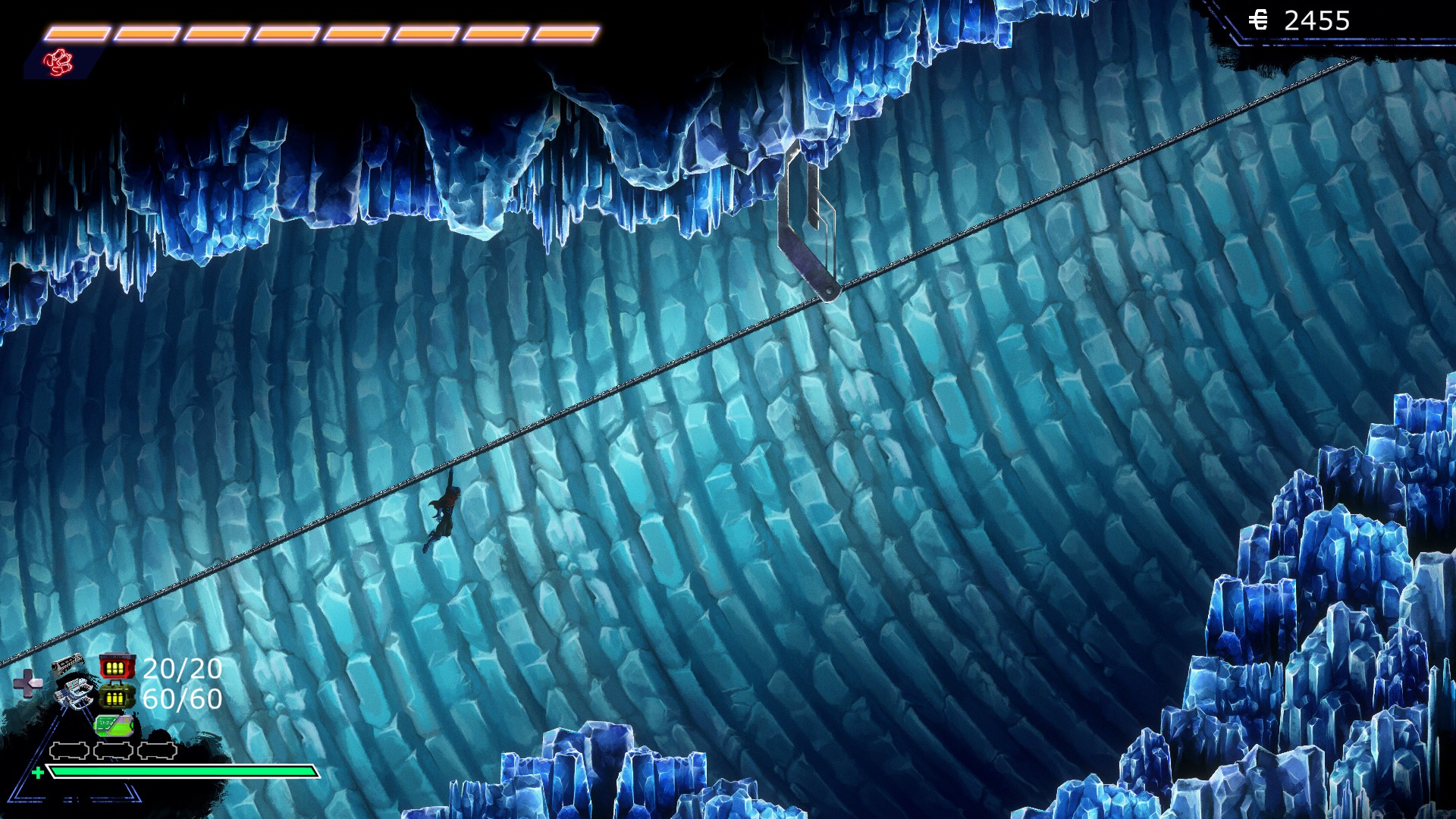
'They Always Run', as the title might imply, follows the journey's of a sci-fi bounty hunter with one of the most generic male hero protagonist names of all time; Aiden. (I don't know what it is about the name Aiden, but it's like the starter name for any fiction writer, for fantasy or Sci-Fi.) Aiden is a suitably bad-ass-coded anti-hero character with his poncho, revolver-esque pistols, triple blades and sight-obscuring face plate- perfect to to fit within the sci-fi wild western universe of frontier bounty hunting justice depicted throughout the game. You can expect to visit various genuinely gorgeous painted-landscape worlds chasing perps across the galaxy in a surprisingly head-strong narrative which... and I'm being very honest as a lover of storytelling myself- totally brushed by me throughout the majority of my playtime. The lore, the universe, the empire, the three-arm mutant species, (of which Aiden is a member) none appealed to me as much as the desire to just play the game.

And that might be because the very basic premise of 'They Always Run' is just so darn approachable and pick-up-and-play. You are privy to a loving animated set of three-handed melee blade attacks that smoothly transition from foe to foe as you cut open woefully unprepared foes between sections of moderately basic platforming. It's neither too stressful nor too patronising to be a wind-down game; and for that alone it's worth the time of anyone who just loves their platformers. But the game does sprinkle in some variety in platforming challenges, which grow in kind with movement options, enemy archetypes, (although you'll reach the four archetype limit within about 3 hours of play) and even an RPG tree that offers frills ontop of the established combat suite. None of it is overly serious or attention arresting, which I think plays a lot to the game's advantage.

As a hunter, Aiden is sent through space outposts dotted with rooms of enemies to slash through, optional bounty targets to scan and collect, (very reminiscent of 'Star Wars: Bounty Hunter') and even the odd 'secret chest' with a collectible slightly off the beaten path. You'll never quite find one of these bases splayed out with the sort of complexity and 'intention of design' from a metroidvania style title, in general the game is more linear, but the game makes up for that slight deficit with some genuinely arresting visual motifs both in the pleasing parry-kill animations which never quite get old to watch and practically every environment. There's so much appropriate detail placed just smartly enough to not clutter the brush-swept canvass, and yet not so little as to make the various biomes and worlds feel too dreamlike and indistinct. There's a strong heart of balance to the entire 'They Always Run' formula.

Your third mutant arm works operates as a utility tool, smashing junctions through walls in a very simple puzzle minigame, or spending bio-energy to smash enemy units for heavy bits of damage. But considering how every enemy is pretty straight-forward as it is, you'll very rarely find yourself coming up short on bioenergy units. Mostly I just like the way the third arm changes up the art of the game, allowing for three-way kill animations or super-dexterous feats where you slide along the floor whilst uppercutting and shooting someone from across the room. The style of what Aiden can do most often overwrites the relatively simplicity of pulling it off. But if you're looking for a rewarding combat system where you feel like you earn every cool finisher- 'They Always Run' will always leave you wanting for something more.

What I was most surprised by, considering the very basic premise of a sci-fi cowboy bounty hunter, was how dedicated this game was to taking it's world and lore seriously. The whole universe recently freed from a tyrannical empire lore is treated very straight-faced and the general prejudice against the three-arm race is supposed to be an emotional touchtone to relate to. It all seems a bit heavy-handed and a little out of place for a game that just really needed to have a loose string of missions related to bounty hunting in order to justify it's own exsistence. Instead we get an honest-to-goodness personal quest for revenge that intertwines with the plights of others that become your crew of confidants against the remnants of the empire who genetically engineered and enslaved the Three-arm people.

But even if I question it's appropriateness, I am a lover of narrative: so I took the time to engage with the story from the moment I realised it wasn't going to be throwaway. (Even if that was a few hours after it already started.) From that lens, I think the key aspects of the world are introduced in too weak of a manner, even a simple introductory scrawl of a couple of lines would have helped set the stage of the world so I know what is important and what isn't. I'll have known not to care about the crime boss you work for during the first mission and only that mission, but to pay more attention when going through the three-arm slum area you pass through in about thirty seconds- but which holds seminal importance to the main narrative later down the line.

The script employs the use of flashback moments throughout the story, and whilst they are placed appropriately for the scenes depicted they just aren't introduced properly- as such I thought the first flashback was me seeing the memories of a corpse I just interacted with rather than my own. Also, some of the flashbacks are literally just a couple of seconds long, containing no purpose within the narrative for further explaining the main character's backstory or expanding upon their former relationships beyond what might be seen in a fine-tooth-comb investigation, and I don't think the overall narrative is strong enough to warrant such an examination. The side character's are decent, as is the general writing style which teeters on angsty but just about manages to keep grounded at the most dangerous wobbles. But I have to admit certain characters like Haze, the surly always sarcastic always belittling member of the group, I found intensely annoying. I know that archetype of character is typical for this style of story, but I've seen it repeated far too often to the point I just can't find the charm in it anymore.

I think the game lacks a real impact behind it's major story beats due to that disconnect between presentation and narrative tone that I just can't get over. Whenever anything important happens I can't conjure up the emotion to respond to it because I haven't been immersed in that way to believe or care about what's going on. I don't even care about the plight of the three-arms all that much, and that might be because I don't even fully understand their backstory. I know they were bred to dig up some kind of mineral, but I don't remember if they ever bothered to explain that mineral's significance to this universe. That would be fine in a game that asks me to explore and interpret it's world, like Hollow Knight does, but for a fairly straightforward narrative that feels like an important omission to the bare basic vertebrae of the plotline.

Which is probably why I was so genuinely shocked when the game then had the gall to end on a twist cliffhanger. Honestly, I didn't really think the story had enough going on in it to warrant a follow-up story, even with the twist reveal at the end which I didn't see coming, but I also did not care enough to be wowed by such a turn of events. The game actually reminded me a little of 'Fallout: The Frontier' in it's final sequences, which is to say; it felt a little overly self indulgent to an unearned degree. Which is a shame to have to say because I otherwise liked the game I was playing and would be open to playing a follow-up provided the gameplay sees some change up and variation so I'm not just playing more of the same. Despite the surprising amount of effort dedicated to it; I wouldn't really return just to see this story picked up.

'They Always Run' is a solid indie platforming action game that impresses and sometimes stuns with it's 2D visuals, but never never quite manages to match that level of dazzle with it's gameplay or narrative. As it is, the game is extremely approachable and easy to pick-up-and-play; which I think is perhaps it's greatest strength as something to while-away spare time on with it's pleasing animations and basic platforming puzzles. But I can see from the tone of the writing and world building that someone in the team was angling for something much more out of this title, maybe just on the writer's table, but they wanted a semi-serious narrative which I don't feel this game managed to carry. As it stands, I did enjoy my time and for the price would simply have to recommend this perfectly solid platforming title for being just a great time to play. When it comes to actually judging the strength of the game next to some of the other modern platformers I've come to love, this one doesn't quite hold up. I think I'd probably award it something of a B- Grade on my scale, shooting above the average on the strength of the quality visuals which elevate the game. Maybe with an increase in scope and money invested, the apparently inevitable sequel can step things up to turn these promising bones to as strong a package as this game's writers want it to be. And on that day I will be happy to rave about it's success right here!

Saturday, 11 March 2023

Loss

 And losability.

Once upon a time it was said that videos games cannot, fundamentally, stand as pieces of artwork to be considered comparable to other forms because by their very nature, as interactive media, one can succeed or fail at them; whereas you cannot, objectively, fail to experience a piece of art. (I feel like modern art snobbery might have a thing or two to say about that, but's theirs is not the angle I wish to adopt today.) Even at the time when I first heard this, I think the concept sounded like bunk to my little ears, and the years have further solidified my belief that the experience of engaging with a video game is not dependent on the completion of that game. In many ways, video games propel themselves to another level of artistic expression when they go so far as to provide functionality and purpose behind a 'lose state' to further enrich the storytelling. Gamers should, by and large, very much welcome the iron hand of the fail state and all the unique opportunities that it brings. But things aren't that simple, are they?

The first game I personally remember playing which really engaged with it's loss state and turned a real mechanic out of the eventuality of dying is the classic, Dark Souls itself. Now you know how the game works by this point, surely; you gain experience points in the form of 'Souls' for every enemy that you defeat, experience can be spent at save points to level up or improve gear, but if you die between spending those souls then you'll drop every spare XP point on you along with a desiccated body. Those points can be reclaimed, should you find your corpse and interact with it, but should you die again before the recovery then that new body with overwrite the old one and you'll lose those left over souls at the same time. This adds a punishment for failure and death and recontextualizes the player's relationship with XP rewards so that they have to examine what it is they value too much to risk and what they comparatively consider not worth this time of day.

But Dark Souls is not itself an outlier in this style of game design in the slightest, in fact there's an entire genre of game built to cater towards the concept of 'losing' in games. I'm talking about rougelikes, wherein the premise of the game is typically some sort of procedurally generated platformer world with randomly selected tools and equipment dropped in there to pick up and combine. A world which then shifts and changes everytime the player character dies and is sent back to the beginning. Think Rogue Legacy, Enter the Gungeon and Dead Cells. These games shoot you right back to the starting line with each failure, but also build in special persistent unlocks so you never feel the full weight of losing all progress because in some way any of ground has been crossed. In many ways the resilience to stick out the losses is as important as developing the muscle memory of each enemy and the general knowledge of all good item combinations.  The art of these games has as much to teach in that department as Dark Souls does.

And then there are the titles that take their own approach to dying. Such as Death Stranding, wherein the death of the hero doesn't stop any ongoing events because the hero, as a Repatriate, cannot fully die by any known means. (Aside from in one very specific story instance which isn't worth bringing up right now because it would take half a page to explain it.) As the gameplay cycle of Death Stranding revolves around delivering supplies across routes through the land, it makes sense for the punishment of 'temp dying' to be the creation of giant explosion craters which scar up the landscape at the spot where you fell; making future supply runs just that tad more complicated than they would have otherwise been if you'd remembered to pack your faeces grenades properly. Yet again, death is punishment but it isn't the end of play; because that avenue is totally open to the developers creative and intuitive enough to take advantage of it.

Yet all of these systems that I just describe still do, in some way, disincentive the act of failure; which makes sense, does it not? The overall goal of most games is to actually succeed in some fashion, usually to overcome some great difficulty or big evil villain- and as such, we as gamers are typically imbued with this resulting resolution so fully as to be totally adverse to even entertaining the prospect of failure when there is literally any other alternative on the table open for us, even in situations where failure and it's punishing consequences are designed to be a process of the game. But when would such a circumstance be? How about in one of those Role Playing Games that focus on the power of the random dice roll?

XCOM, Baldur's Gate 3 and all games of it's ilk rely on chance rolls for a good deal of it's systems. Whether you're carefully planned and executed strike actually passes the hit-percentage and lands, whether that attempt to roll for a persuade skill-check passes the chance and succeeds, whether you pass that death saving roll and avoid the permanent demise of a cherish team mate- all of those situations come back to the virtual roll of digital dice. And in such games it is fully possible to, should you so decree, save scum. As in, reload a save when you encounter a rolled result you don't like and try it again. In a way, cheating yourself of the consequences of a bad turn of luck when the game itself is pretty much designed to present you with such turns of fate and ask you how to deal with them. Messing up an XCOM ambush you've spent 10 minutes planning is heartbreaking, but it's kind of what the game is about. If you hit every shot all of the time, then you're not really playing a chance-based tactical game at all, are you?

And when we expand the confines of that example to RPG games, the situation becomes even more distasteful. These branching RPG games are built to exacting standards so that every eventuality beyond the death of the protagonist can branch out into it's own reality, whether that be a choice made or a skill check failed. Screwing up a 'persuade' roll doesn't just automatically result in a 'game over', because the roll of the dice is not the test of skill, the consequence of that roll is. By save scumming your way around, making sure you win every roll, you're paving your way past all the effort that narrative designers, level designers and everyone else who gets roped into that process, put into making games like that structurally sound. At that point, why are you even playing a roleplaying game to begin with?

But even as I say and acknowledge all of this readily, I'll be the first to admit that I do, in fact, save scum. When I'm totally screwing up a key mission in XCOM, knowing well that a full team wipe is pretty much a death sentence to an entire campaign in higher difficulties, I'll save scum to the beginning of the level. I probably would save scum even more so if I didn't personally limit myself to one save at the beginning of each XCOM mission. In Baldur's Gate I try to live out the failures of my rolls, but sometimes you'll hit your 5th miss in a row and just lose your ability to be objective- from that point onwards what else can you do but slip on into the autosaves list and play a quick game of 'time god'? It's a bit like cheating fate, and it certainly doesn't feel good after the fact, but I'm just going to be replaying this section in pretty much the same manner anyway; so I'm just saving myself time- right?

Coming to the point of accepting losing is perhaps one of the general lessons of playing games from a philosophical standpoint. Many historical games that have been developed throughout antiquity are themselves based on microcosms of real-world pursuits, battles and war most often, wherein players would compete and win or lose without suffering the irreversible consequence of death. It is a safe space, or a magic box, wherein one can experience outside of their comforts or capabilities, without feeling the scars after the fact. Accepting that philosophy in our stance towards modern day gaming would go a long way to emotionally enriching the gameplay experience- or at least making it up to all those poor level designers out there who spent several weeks planning out every way someone can fail to walk up a set of stairs to an audience of no-one. (Won't somebody think about the fail-state designers?)

Friday, 10 March 2023

Fast times at Square Enix high!

 There's only enough room for one dragon

Forspoken is one of those games that ol' Nostradamus me just knew wasn't going to make it big from the very second I saw it. I took one look at the visuals, saw recycled assets from Final Fantasy XV for the world, and recycled visual flairs from the tech demo 'Angi's Philosophy' in the character design, (although I would only remember that very recently in a flare of realisation) and mentally checked the thing out as a lazily processed title. Of course that was a very uniformed preliminary assumption of what I was seeing, and there's nothing inherently wrong with reusing old ideas, and even old assets, to create something new and interesting. But something about the way that Forspoken looked, to me at least, just wasn't fitting together. I didn't like the vast-stride canyon jumping, the featureless craggy expanses and especially not the static flick-wrist combat. But first impressions are mere illusions to which we attach far too much significance- I'm sure the game would win me over given time.

And yet, it didn't. Most seemed to get along with the idea of Forspoken at first, even somehow the well-worn idea of an Isekai premise, all until Frey opened her annoying mouth and started to speak. Marketing is an oft scrutinized equation in the formula of game creation, and one often tossed aside as pandering trite; but if there's one example to prove the power of bad marketing- it's Forspoken. Totally misunderstanding the tastes and sensibilities of the audience, misidentifying the strength factors of your game and how best to convey it's tone, and chucking context free cringe-dialogue at the unwary viewer with clueless abandon has to be one of the most self-sabotaging marketing routines the modern industry has seen. Unfortunately, unlike the movie studios who tried to cut the original Blade Runner into an action movie for the trailers, Forspoken doesn't have that same level of quiet genius in the supporting package to win over the misled and ticked off.

Not least of all because the game was being sold for an eye-watering $70; a price tag insisted upon by Square Enix as just payment for the sheer quality of the products they develop and put out... a laughable joke if ever there was one. On the flip-side, and though the comparison seems a little worn by now, I want to present Tango Gamework's Hi-Fi Rush. A thematically irreverent rhythm-accompanied smash action game that was announced and released within the same hour. Only possible thanks the to the combined platform of Bethesda and Microsoft fans, as well as the novelty of that sort of release window; but still an idea that would conceptually be marketing suicide. But by what small metrics we can actually track, digital sales figures, it would appear that in their shared launch week Hi-Fi managed to beat out Forspoken. In revenue. Whilst Hi-Fi Rush was half the price of a traditional premium release. That is just... ouch.

All this is to provide the background for the news that has been flying across all the relevant headlines recently; Luminous Productions, the Square Enix based yet apparently legally distinct development entity, has been announced to be shutting down after a mere month of Forspoken's release. Let me remind you all, that this was only their second full game release after Final Fantasy XV and we still don't know how much of a flop the game actually was, or wasn't; without a rough idea of development costs we can only speculate. I mean, it was certainly a critical flop, but sometimes those games make money regardless. Not enough to justify keeping Luminous around as a studio, however; because those developers are going to be split up and reassigned to the far-away studio of Square Enix. A studio which, as I said, is located in the exact same building that Luminous was. So... not a big change there, I guess. Maybe some cut pay checks.

Still, it's a sad legacy to leave behind. Even Final Fantasy XV had it's problems both before and after the launch of that legendary game. Before there was the whole, you know, fifteen year development period hanging over the entire team. A little bit trying when you've been doing nothing but make the same game for your entire career. After the game came out there was trouble realising the full scope of the potential, whereupon the extent of the game and it's world was supposed to unfurl through the DLC which got cut off mid-way through production. Fans have but rumours about the giant swathes of content they missed out on, but people say that Episode Noctis would have combined some of the scrapped elements from Final Fantasy Versus XIII into the XV timeline! What I wouldn't give to have finally see Stella interact with Noctis- god, we missed out!

And then Forspoken comes along with it's underperformance, itself just the latest in a slew of bad release games which Square Enix has run out of scapegoats to blame. First it was the Deus Ex developers for failing to address the climate and wants of their franchise, which cost them their trilogy; then it was all their western studios at large for just being so weird and hard to market, leading Square to drop them off at uncle Embracer's and never come back. Now we have more failures, and the hammer has to finally land on someone responsible. Sure, Luminous has to fold but it just can't be them. Luminous didn't seize control of every low performing title that Square has put out over the last 4 years. At somepoint you have to turn around to the common denominator: Yosuke Matsuda.

That's right, CEO Matsuda is being tossed out of the corporate window with a golden parachute, leaving all of his cringe inducing promises of metaversal NFT future unfulfilled, stinking up the place. Meaning that the era of his tyrannical rule is over and Square Enix can finally move on under the purview of their new supreme leader: Kiryu Kazuma? (Why do I hear 'Receive You' playing?) Wait, I read that wrong... actually that's Takashi Kiryu, a man who looks like a computer render of the one in the RPG who betrays the group in order to run back to his evil master, only for the dark lord to end up crushing him like a bug because even he can't stand to be around the snivelling little worm of a man. Oh, and he's also got history leading an NFT company in his past.

So it's seems we're on the verge of some historic changes across the Square Enix world, whilst also a historic amount of crap staying exactly the same because of the revolving door of clowns we call the corporate elite. Even with Matsuda out the door and Luminous shuttered, don't think this marks the end of confused titles bouncing off walls with mishot marketing campaigns that kill once decent ideas, all because the powers that be are too busy salivating over the exploitative potential of their WEB3 suger daddies. You expect me to fall about praising the bravery of the company to finally give the slightest amount of change a shot? Or to give this new CEO a chance even knowing exactly what he's all about, where's he going to take Square and how the board of directors probably only brought him on board hoping for a 'play as you earn' tainted future? Yeah, that's a negative to all that. Kiryu can bite and receive me.

Thursday, 9 March 2023

Fallout Remastered Vegas

 This wasn't a part of the deal!

Yes, I'm still madly and hopelessly in love with Fallout New Vegas, no I don't believe this irrational and frankly embarrassing obsession will ever truly be free of me and I absolutely have enough fuel to go nutso about the game itself once more. Because with the recent shifting of the gaming world that placed the creators of that masterpiece within the same conglomerate that owes the rights to making sequels, I can't help it if my little monkey brain keeps doing involuntary backflips of excitement. Every little sneeze out of Obsidian is now code in my head slowly unveiling the hexadecimal coordinates whereupon stands a buried box containing a geo-cache treasure hunt to the source of the river Amazon in order to find the prospective release date of a theoretical New Vegas 2 spray painted on the wall of a rainforest cavern. I can't help myself, I'm fully lost to total conspiracy nut mode.

Of course, it doesn't help my gentle sensibilities when Obsidian themselves are haphazardly waving around their intentions and suppositions about the many things they could do if the got the go ahead to make a New Vegas 2. Buzzing with the enthusiasm of a eager developer but unfortunately dripping with the candour of a team that most certainly aren't under any contract to keep a bubbling Fallout game under any sort of wraps. Still, with every slipped message into the internet ether the powers over at Obsidian ignites the dormant New Vegas fanbase like an electric whip across the snout of the slumbering dragon, and we cause enough of a stir with each awakening to remind Microsoft how much money they could be squeezing out of us if they just smooshed Bethesda together with their playpen partner for a little impromptu date. The sooner the better, Phil Harrison; none of us are getting any younger over here!

As such it was obviously going to become the topic of a blog when some off-handed comment thrown off the cuff of a speeding train impressed Obsidian's willingness to create a New Vegas remaster if permitted. Of course, I have some thoughts. Firstly: they're still thinking about us! Ain't Obsidian a bunch of softies... and secondly: Huh? What about New Vegas 2? The deal always was, at least as far as the world was aware, that Obsidian were ready to make one more new Fallout title within their trademark West Coast setting, reminding Bethesda once again about what makes this franchise special. New Vegas 2 was shorthand, such a game would obviously not be set in Vegas but somewhere else up the Golden Coast. Maybe San Francisco. But the point is that we were supposed to be getting excited for a new game, not a pampered up and repacked slug at ol' faithful.

The dark cynic bumbling away at the corners of my soul, prepped to wage his forever war against the optimism and hope to drag me back into that crushing pit of slick, suffocating despair, tells me that this is the product of tempered expectations. This almost sounds like the 'settle scenario' of a studio who vied for the contract to make a full blown Fallout game and were fobbed off, leaving them to seek this much more meagre consolation prize. Of course, I have nothing but my own paranoia to evidence for that, and perhaps such comments are more just the idle thoughts of another direction Obsidian could frame their relationship with modern Fallout; but it's all got me wondering nonetheless. Which means I'm also worrying. There's no reason Microsoft or Bethesda would straight turn down an absolute PR win like a Fallout New Vegas 2 announcement- is there?

Now the obvious question that is brought up with a topic like this is why on earth do we even need a remaster when we have mods. Since time immemorial Fallout New Vegas has boasted graphics enhancement mods and 2k retexture packs and ENB filters and Project Nevada and whatever the modern successor to Project Neveda is these days. The point is, you could totally spruce up New Vegas in a hundred different ways in order to get it looking spic and span for the modern hardware of today. I may be the only person in the history of man that likes the vanilla look and gameplay of New Vegas, but let me tell you I am in the extreme minority. Most New Vegas fans these days are playing builds of the game that look better than anything Obsidian could have dreamed of cooking up back in 2011. The players have already remastered the game.

However a Remaster could be an opportunity for the team to go to some of the weak points of the actual code behind New Vegas and patch up the ship. Improve the application beyond it's paltry RAM limit, improve general stability to reduce crashing frequency, and maybe throw a little foundation across the general visual aesthetic so that players who aren't me won't vomit everytime they load up the vanilla EXE. A Remake could go even further, building the game on an updated engine that could take advantage of the play features of modern Fallout. Sprinting, proper iron sights, snap corner aiming, hotbutton throwables- all the features that make Fallout 4 the best shooter in the franchise. Bringing that quality of gameplay to the quality narrative of New Vegas would be incredible! So incredible, in fact; that some fans are already trying to do that with the 'Fallout 4: New Vegas' mod. (Which I suppose would receive a swift 'cease and desist' if this idea gets the green light.)

In such a world, one where New Vegas is re-released and becomes the new 'most recent' Fallout in the franchise, we would see a vast recontextualization of what it means to be a Fallout fan. Know that the Fallout fandom of 2011 is a mere shadow compared to what it currently is today, and many modern fans have never engaged with any game before 4 to really understand what it is about the Fallout setting which makes it so fruitful and worth revisiting. Everytime Bethesda touch the franchise they focus on the least interesting part of the world most; the wasteland, whereas since Fallout 2, Black Isle Studios (Now Obsidian Game Studios) knew to make Fallout about the post apocalyptic society which has blossomed out of the fires. If you want gritty nuclear survival stories, play Wasteland. If you want quirky and bizarre fun-house mirror branches of post-world 'society' which run the gambit from utterly farcical to horrifyingly despotic and cruel- come to Fallout. With New Vegas thrust once more in the spotlight, I think a whole bevy of relatively recent franchise fans will endure their abrupt 'coming to Jesus' moment for Fallout.

Still, if you asked me what I hope for out of the Obsidian acquisition; it's New Vegas 2. I honestly don't care if Obsidian immediately turn around and go independent again the second after that theoretical game releases, I just need another great Fallout in my life sometime before I die or geopolitics swivel off in a direction that brings up towards an actual Fallout. Fans have been yearning for years, Bethesda (bless their hearts) have their attentions occupied elsewhere (to the stars for now); there really is no better course of action than to bring back the grandfathers for one last shot at the gold. For all the guff and rolled eyes that the professional reviewing industry gave New Vegas on it's launch, I'd like to see some small level of schadenfreude when that very same direction they jeered and mocked rears back around to be the new golden age of western action RPG games. Give us that opportunity, Microsoft; We beg!

Wednesday, 8 March 2023

Baldur's Gate 3 has a release date

 You're serious?

I like to think we've all grown several fold in the number of years it has been since the announcement of Baldur's Gate 3 and now, the year of it's coming release. We're older, more experienced, and perhaps wiser to the state of the CRPG landscape in the wake of it's prolonged revival. I, for one, discovered the majesty of the Classic RPG and all the ways it championed the aspects of the RPG market I felt were being underexplored or forgotten about altogether. Distinct character classes, expanded webs of companions, intricate and branching high fantasy narratives that danced and weaved into one powerful thread. But if there is one draw back of the CRPG, it's their reverence of the golden age. Every CRPG wants to look and play like Baldur's Gate 1 and 2 did; reinvigorating those old emotions. No one has the bravery or resources to take everything that CRPGs do great and transfer that to the scale of a AAA RPG. Or at least, nobody did until Larian signed up for Baldur's Gate 3.

From the beginning I was sold on the direction that Larian was taking the game, although that is probably because I've always been just such a firm believer in the church of the turn-based tactical RPG wherein the gameplay gives the player all the time in the world and a bevy of options so you almost feel drowned for choice. That and the sheer level of intricacy that was going towards the various systems keeping Baldur's Gate 3 running was enough to convince me that this was a team worth putting faith behind. It's not often that I slap down those pre-order bucks and place my faith behind a game; but everytime I do it's because I'm decently certain it's the right choice and the developers deserve every last penny of my support. (And I've yet to hit buyer's remorse yet. four for four, baby!) With Baldur's Gate 3, however, I'll admit to harbouring a few small trepidations. 

Of course I knew going in that Baldur's Gate 3 was an Early Access title, and I had faith Larian were too big to just abandon such a project like so many other developer's who bite off more than they chew might; but I did wonder how much value I was going to get for my money during the prolonged wait for Baldur's Gate 3. Since then I have done an exhaustive playthrough of the Early Access everytime a major update has landed, and everytime my faith in Larian has blossomed. Faith not just that they are capable of successfully translating the tabletop majesty of D&D to game form, (perhaps even more faithfully than Baldur's Gate 1 & 2 could) but faith that this really is the true-blooded branching RPG story that the developer's promised us and that this isn't another Cyberpunk 2077 Bait & Switch. (Although to be fair, even CDPR waited until after the prologue to start going all painfully linear.)

I've remarked on this before but it bares repeating; over no less than six playthroughs I managed to approach the main quest in a different way each and every time; with playable consequence. Even choices that feel like dead ends, such as selling the Tiefling's location out to the haughty Dark Elf lady, leads to a totally missable giant siege of the camp whereupon you can rejoin the side of the Tieflings in order to fend off the full fight of the Almighty's goblin forces. A distinct story path hidden beneath side options but still rewarding for pursing. Just like the path of redemption for Kagha leading to a completely unique encounter, or how off-the-beaten path explorations through the underdark can unveil a huge extra castle puzzle dungeon with robot warriors at the top-most level. In the Early Access alone Baldur's Gate 3 is teeming with content and routes and choices, and come August we're going to be able to climb up every branch of that tree to shake down the fruits therein.

What I've already found to be quite intriguing about this release date announcement trailer is how centrally it features this new character of General Thorm, who seems to menace over the player with grand fantasy villain talk fitting of his role as seemingly the big climatic threat of Act 1; one of the apparent three 'Almighty' who have stalked across the Early Access early game story. This character not only speaks with an aura of gravitas, he has been voiced by none other than J.K. Simmons in order to appropriately convey such a gravitas. I can't help but wonder if this set may be alluding to the fact that this man could very well be a big bad the entire narrative, although revealing such a man this early on would be a surprising leap out of left field. I just can't help but shake this visage of Irenicus whenever I see this new elfin General, and though his story seems better tipped to draw out sympathy and Irenicus' own pitiful descent away from human morality; I know Jon is a favourite of Baldur's Gate fans that Larian will want to pay some reverence to.

However I can't help but shake the feeling that casting this Simmons as a significant antagonist might slightly side step a more immediate antagonistic entity. Like the Illithids! The Mindflayers were the creatures advertised first when it came to the Baldur's Gate reveal, and their visage still adorns the game logo for 3: and yet so far their presence has been mostly as side threats to the concept of this mind dominating 'Almighty' and the mysterious enigma of Shadowheart's box. We've already trailed along a large chunk of act 1 in the early access to the game and I've killed more Mindflayers in Baldur's Gate 2 and 1 (counting the Siege of Dragonspear expansion) then I've even met in Baldur's Gate 3. Personally, I'm going to be a little disappointed if it turns out that the Mindflayers are mere puppets in some boring humanoid's game. Nah, I'm kidding- I'll be hugely disappointed! Let the squid people be their own villains; they're supposed to be telepathic mind-eating masterminds of supervillian level intelligence- don't make them into boring lackeys!

And I must pray last of all, to the utmost heavens over at Larian, that whatever cliffhanger the studio decides to leave the story on (because there's no way in hell that Larian are going to be happy telling a DnD story with a level 12 cap.) actually wraps up the narrative brought in this game. I know they'll be some wider threat of a galactic proportion to rival that of the God of Murder's succession in the original two games, but both Baldur's Gate 1 and 2 knew they had to satisfactorily wrap up their adventure antagonists before moving onto the larger narrative. Though I suspect Larian will want to tell a slightly grander and interconnected storyline, (Amelyysan's character coming out of nowhere really bugged me in 'Throne of Baal') there's nothing worse than being left on a sour end note and having to wait several years for the plot-thread to be picked up for a sequel. Only for the series to be cancelled and Deus Ex to be left waiting for Mankind to undivide itself.

Come this August I and many other RPG fans are going to enter something of a coma, but never you worry about trying to wake us- for we will be deep in Role Playing heaven. As far as I'm concerned, Baldur's Gate 3, beyond the 'Honour Among Thieves' movie, beyond the 'One DND' ruleset, and beyond any other tricky little project that Wizards' have up their grubby sleeves, is the Dungeons and Dragons event centrepiece of this decade. Larian have themselves the weight of DnD's larger reputation on their shoulders, espeically after the whole 'OGL' situation from earlier this year, and provided they deliver the game the company says that it can, they alone can revitalise the community love for one of gaming's longest running franchises. So... no pressure, right?

Tuesday, 7 March 2023

Apparently Hogwart's Legacy is going to be a TV show now!

 Something's wrong, I can feel it...

See now this is what I was talking about! I have been keeping up with the Last of Us as it's ticked along in episodes, I and several million others if those generous viewing figures are anything to go by, and as good as the show is (if slightly rushed in events) I've always found myself disquiet about the precedent it's success will set upon the 'marketplace of ideas' that is modern Hollywood. And yes, I do use 'Hollywood' as a shorthand for all modern day media, even though I know that is factually a bit spotty; if only I cared enough to stop. Because the modern media machine is like a shark swimming around in the deep blue, all it needs is to catch the slightest whiff of chum from half an ocean away and that predator launches all over it's the prey like rats on a carcass. And The Last of Us has been no small success. If numbers are to be trusted, that show has to be one of the biggest hits of this year and last year too. All while being one of the most faithful video game adaptations we've ever had; copycats were an inevitability.

That being said, I do find myself of two minds upon learning that the Hogwarts Legacy team are in talks to produce their own TV show based on the world they constructed. On the one hand that sounds like yet another one of those hair-trigger adaptations shoot out from the barrel directly after the world's honeymoon phase with the game, whilst the bedsheet are still warm. Yes, Hogwarts Legacy has done gangbuster numbers, but that doesn't mean it's the greatest thing since sliced bread! And it's narrative isn't a touch on The Last of Us' story, in the slightest! On the otherhand, I can see the connection in name and setting as more of a case of happenstance, because at the end of the day there's not really any reason why a Hogwarts Legacy TV show would be an adaptation of the game; it would really just be a Harry Potter TV Show.

Surely the Warner Bros team have been thinking of making one for a while now. Ever since it became clear that J.K. Rowling would not step back from writing bad scripts for the Fantastic Beasts movies, it was clear that the Harry Potter franchise needed a new avenue if it wanted to relight itself for the new age. 'The Cursed Child' is rumoured to be getting an adaptation featuring the returned cast from the movies, but considering the general consensus around the actual quality of that story, such a promise sounds more like a threat. (I just hope that an adaptation will give us a full blow animated rendition of the supposed story where Astoria Greengrass jumps back in time to 'do the dirty' with no-nose. I need that insanity visualised.) Further rumours of a general Harry Potter reboot are met with universal retching noises from the supposed target demographic. And after the box office performance of 'Secrets of Dumbledore', or lack thereof, it's clear that the story of Newt Scamander will end as unfinished as it... actually, his story really wrapped itself up at the end of the first movie. He's been pretty much sleeping his way through the rest of the 'Fantastic Beasts' movies anyway.

Hogwarts Legacy in setting presents something of a fresh start and clean break away from all that happened in the 1990's. (The time period of Harry Potter.) The basic ties of familiarity are there, but the 1800's are full of their own concerns, with poachers hunting magical beasts, Goblins waging war against Wizards and Ancient Magic dripping off of every curtain. For the first time since 'Philosophers Stone', a new TV show set in this time would present a totally fresh opportunity for newcomers to jump into the franchise of Harry Potter, which would be the mounting point for newly minted millennial parents to introduce their bratty kids to the world they used to read about in school. (Look at me, I'm talking like a marketing stooge now. These courses are really starting to get the better of how I think, aren't they?)

The actual narrative of Hogwarts Legacy is surprisingly light and doesn't carry all that many personable characters behind it's script when it comes to the protagonist or their school friends, which makes it more than likely that any TV show set in this time would, by share necessity, have to construct it's own guiding narrative. Which suits me just fine because the game I played left more than enough room for any such story to slide on in around the events of that game without causing any ruckus whatsoever. In many ways, the only point of this game was to conjure a world for the Harry Potter mythos that could exist without the glasses kid or his painfully extended lore, and everything else the game delivered was just a bonus ribbon on the package. A TV show could happily exist within that newly minted world, doubling down on it's affirmation by bringing actual characters and complex narratives into the framework, which is the one thing holding back the game from being truly legendary in my eyes. There could actually be a world were both the TV show and this game series exist without treading on each other's shoes at all.

Being put to TV, Hogwarts Legacy could benefit from telling a wider story that covers a wider breadth of the wizarding world. For example, and keeping to the narrative of the game, we could follow a bevy of characters from across the wizarding world that all have conflicting perspectives on the Goblin rebellion, with supporters and dissenters all being given their breadth of humanity and purpose to pack some extra layer of nuance behind the somewhat important movement at the heart of the world's story. Maybe we could have one character be a Goblin who is outspoken about improving the lot of his folk but whom doesn't resort to crude tactics of his more brutish brethren at the beginning of the series. Then we might witnesses as throughout the series that Goblin is subjected to injustice after injustice, a beating here to a protest turning into a massacre there, until by the end of the series his taking to arms against the wizarding kind feels almost just and necessary, at least given his situation. That's the kind of muti-layered characters that can't be built in a fixed-perspective world like the one Hogwarts Legacy presents in it's game form.

Of course, I refer to any future with a Hogwarts TV series as a package deal with an upcoming game sequel, because at this point it's pretty much a done deal that we're getting more Legacy games. Although nothing has been written in the stones as of yet, Hogwarts Legacy made around 850 million within the space of two weeks and the team didn't have any DLC plans ready to capitalize on that flurry of fans. So making a sequel is just basic business sense. Plus, Warner Bros. have been needing a win for the Harry Potter franchise for a while now, so investing into more games in this series seems like a no brainer. Plus, there's plenty of wanting features that the Legacy team are coyly teasing might worm their way into a sequel, proving the idea is definitely buzzing around the studio. (Such as playable Quidditch!) We could feasibly have a climate where the future Hogwarts Legacy 2 releases alongside a future series of this supposed TV show for some of that sweet cross promotional marketing all the kids are raving about these days.

As far as news could go for upcoming video game to TV adaptations; this is by far the worst idea I've ever heard of. In fact, I'm almost happy to welcome any expanded Harry Potter media that doesn't have Ezra Miller in it, because that actor's entire deal just makes my stomach churn. I just hope that whatever happens the key-most rules of adaptation are adhered to- don't try to overwrite the legitimacy of the game's narrative with a new one unless the new narrative is objectively better, don't overwrite the custom character of the game (thus robbing fans of their place in the universe) and don't mention Zootopia porn. Because after Resident Evil, you just never know what these rapid show executives are going to come up with next.

Monday, 6 March 2023

Infamous versus Longevity

 It's what the network wants- so why bother complain?

Yeah, I'm big on mortality this month it would seem. I guess the very concept of living forever has always been an interesting topic broached by science fiction and even fantasy here and there. Ideas and concepts might seem to last forever, legacies can feel longer lasting than the gods, but the truth is that even ideas themselves will one-day burn up into nothing once the cosmos finally go quiet. All things die. People, nations, ideas and gods. Death stalks everyone and everything, wolfish and grinning beneath it's red-eyed hood. You can choose to fight against death and be dragged down in a flurry of sweat, spit and snot; or dispense with the adversarial accoutrements and greet the end as a friend, departing from this life as equals. So, now that I've managed to make a reference to Puss in Boots and Harry Potter within one paragraph, how do you think I'm going to get around to the Infamous series?

Infamous is the action adventure franchise that put Sucker Punch Productions on the map as a talented 'exclusives creator' for Sony. Well... actually I guess that was more 'Sly Cooper', now wasn't it... Or maybe 'Ghost of Tsushima?" You know what, Sucker Punch Productions are just a supremely talented studio that by the graces of some distant and archaic deity have never really produced a total dud of a game- and yet somehow I've managed to miss most all of their library. Even when I owned a Playstation, I was more of a 'Ratchet And Clank' sort of guy; and when Infamous was doing the rounds for it's chaotic and flashy gameplay, I was trying to get into it's low-rent copy-cat 'Prototype'. (And 'Ghost' has yet to port to PC, much to my constant and perpetual chagrin.) But I've always been interested in their games. Enough to keep an eye on everything they've been up to from afar.

In fact, I've watched out for Sucker Punch so much that I absorbed the entirety of the marketing for Infamous Second Son back when it was the gorgeous system launch title for the Playstation 4. Before Horizon was the 'in-thing', Second Sun was the game that your girlfriend told you not to worry about. It was a looker and then some, boasting life-like character models, eye-shrivelling neon glares and densely backed dystopian city streets so realistic you could just taste the stench of oppression! And the story was alright too. Yeah, I remember watching a couple of full playthroughs of both the full game and the DLC, from which I retained nothing but nightmare style flashes of forgettable characters who popped up here and there before dissolving into smudge. And I kind of remember Delsin (the hero) being excessively annoying and hard to like for most of the run time. So maybe that game's beauty was mostly skin-deep; but I still kind-of remember it. Almost.

What I didn't know at the time, and I couldn't have known considering my very 'other side of the wall' relationship with this franchise; was that the rather strong Infamous community received Infamous Second Son with a mixture of confusion and slight betrayal. Those who like Infamous did so for more than just it's eye-popping and gratifying gameplay and systems, I later came to learn, they actually liked it's characters and story beats and themes and, most of all, it's ending. That's right, Infamous was one of the few franchises that actually had a conclusion to it's stories. And that conclusion came... before the release of Second Son. Oh... yeah, that's going to be something of a tricky issue to navigate I would imagine. But let's take a look at this from a laymen's perspective and see if we can figure out what the community took umbridge with when it came to Second Son.

Spoilers for the Infamous stories, of course; but the basic synopsis goes thusly. There's some sort of recessive gene bubbling around certain random people across humanity that, when activated, gives people super powers. Super powers makes people dangerous, thus kicks off the core struggle with the protagonist (one of these powered folk) going up against forces trying to stop him, other power users going out of control and everything inbetween. It's basically a CW show set-up where by the end of the season the big-bad looks like a cheap model who refuses to wear a shirt in any of his scenes because it 'devalues his brand'. At the end of Infamous 2, in order to resolve all the story issues in one fell swoop, a McGuffin death wave is released killing everyone currently alive in the world with that special gene, activated or not, killing off the entire cast and sub-characters and ending the franchise. And then there's Second Son.

Rather humorously there is no effort devoted in the slightest to explain how Delsin and that new wave of power users survived that extinction wave, despite them definitely being alive and around when it happened. Sucker Punch didn't even stick in some throw away text-scrawl about how the 'gene evolved' or some other such backhanded rewrite, which seems to contrast with a team that appeared to somewhat care about the franchise when they were making it for the PS3. From an outsider's perspective Second Son just seems like it's own 'new generation' iteration but for Infamous fans it was largely a spit-in the face to a finale that wrapped up the entire line of stories in a neat little bow. And there's actually no sensible explanation to why Second Son would exist beyond the most cynical- because Sony needed an impressive-looking system launch title and Sucker Punch had a franchise they could pull from.

For those that loved the originals, all the problems with Second Son- it's insincere protagonist, lacklustre villains and nonsensical 'continuation'- are all emblematic of the very soul of 'selling out'. All those fans see is a franchise exhumed and necromancy-ed back to a life it happily departed, and not really to a high enough standard to justify it's own existence. Now I'm sure that at least someone at Sucker Punch had an idea for what they could do with the Infamous franchise in the future, but nothing about Second Son appeared to have that level of care and love which fans fell in love with. Which isn't to say the game was bad, it just wasn't anything special. And as someone who once absorbed everything about the game with jealous abandon and currently can't even remember half of the major plot beats... yeah, I can see their point.

The moral should be rather clear out of all this. Not every story can just be picked up and continued without a whisper of thought put into justifying why. In fact, the best stories shouldn't be, because their end is just as important as how they started and where they progressed to. Why has no one sat down and just continued the story of Lord of Rings; telling us what the next generation of Hobbits got up to? Because that would be an insult to the quality of the stories themselves and such a writer would be rightly lambasted for assuming the gall to do so. Stories, like their tellers, have to reach their end. And those stories can drag themselves out, grow stale and boring and fizzle away once the time comes that no one wants to hear them anymore, or they can bow out with dignity whilst the stage lights are still shining on them. Dignity or longevity; you can't ever have both.

Sunday, 5 March 2023

Rovio and mortality

Here we go again... 

I swear I'm not looking for there stories, they're coming to me! I can almost turn these 'Mortality' stories into a mini-series covering the inescapable inevitability of death and the soul cracking chaos that descends upon the unprepared in the face of that eventuality. Although in actuality, today's story is a bit of a different look on that same concept; this time we're looking at a publisher who is actively playing up the terror of mortality in order to profit and generally enrich themselves. Because there's nothing more frightening than the sensation of knowing something you once loved will one day no longer be there. Part of the deceit of the Internet is that it is 'forever', which runs true all the way until a Yugoloth-cultist cuts one of the underwater cables and the magic box in our rooms go "bye bye". (I assume that's what the premise of GTFO is about. A desperate suicide mission to restore the world's internet access.)

The developers of today's topic would be none other than Rovio Entertainment- and I'm seeing a lot of blank stares... They're the guys who made Angry Birds; you know them. Now you may not know this, but Angry Birds is a franchise of games that is still alive to this very day, believe it or not! That's right, the crappy app game you used to kill time with during break times at School is getting new entries even now. (I figured that god-awful movie would have finally made the world good and done with the mauve menace and his menagerie of malcontents.) In fact the latest game in the franchise is 2022's 'Angry Birds Journey' which features 3d Renders being slingshotted about in a more service-style game that is easier to monetise than the base Angry Birds package. It's as mindless as you'd expect and after all these years making the same sort of game you'd have figured that these developers would be out of fresh ideas by now. But the truth is, these probably aren't the same developers and they are out of ideas anyway.

Because rather than ride the same course that game developers do the industry over, and expect the merits of your new and recently released game to lure old fans back into their wallets; Rovio have decided to tug on that string that gamer's are most afraid of- the mortality of their software. Angry Birds 1, the original from all the way back in 2009, has been sentenced for the chopping block to be pulled from app stores entirely. Firstly the game will be renamed to 'Red's First Flight', to obscure it from search results, then when the dust is good and settled Rovio are going to lead it out behind the KFC and have that piece of history converted into heavily processed wings. Now to be fair, the game they're killing off is actually a faithful remake of the original game because the original and every Angry Birds franchise game from 2014 and before were delisted and removed back in 2019 for no publicly apparent reason. But the team released the remake they are now killing of because they were impressed on, by the internet, the historical significance of the game that literally made all of their careers!

I'm not sure why I take this so personally, but there's something deeply insidious about callously casting away your own heritage twice like that. Picture if the Rockstar develoeprs turned around and delisted every GTA game from the 3D era so that they could sell us a- wait, that's a bad example. What if my beloved hero game Marvel's Ultimate Alliance was killed from stores just as the new game released, conveniently funnelling traffic towa- wait, that's an even worse example. Okay, let me think about this a bit harder. What if Nintendo- actually there's no point even going down that train, is there... Wow, I guess this breed of cold and callous disregard for 'gaming history' has itself a bit of precedent, doesn't it? And all because George Lucas refused to offer up the unaltered original cuts of Star Wars to the American National Film Registry. (I can't prove that had anything to do with how the game's Industry treats it's past, but I'm going imply it does anyway.)

It would be utterly pretentious of me to sit here and make wild assumptions as to why the Rovio team chose this cause of action, particularly when they quite literally put out an exhaustive statement detailing their reasoning without any compunction of how it would reflect back on them. So what were the issues taken into account? Well, the team looked at their figures, realised that some people were still playing the original Angry Birds remake (which, by the way, released two months after Angry Birds Journey, so that isn't so crazy of a possibility) and then concluded that the old game had some form of sales impact on their currently supported title. The team was shook into action by the competition within their own library, so decided to shut down the choice of the consumer in order to funnel them towards the more profitable, easier to exploit, avenue of 'Angry Birds Journey'.

This is about as blatant and no-holds-barred as you can feasibly get when it comes to public relations; telling the populace that it is very much their own preferential habits that formed the companies problem, and by manipulating their access to the possibility of choice, Rovio can be venerated. The less exploitable app was just too popular to exist within this modern mobile gaming world. Now obviously I think we all just assume that this is the way these companies operate and that these are the sorts of issues that they take into account, but how often do you hear proof of those immoral dedications baying from the horses own chops? And the conversation here doesn't just touch on wider issues of game preservation, although that conversation is absolutely there to be had; but on intentional manipulation of software availability by a company that seem to very much not have the interests of it's consumer base to heart.

Not that I think anyone is going to be shedding any tears over the happenings of Angry Birds games, but what about that proposed New Vegas Remaster I covered recently? A revisit to the core systems that made the classic New Vegas, buffing them up for the modern age, probably making that remaster totally incompatible to the thousands of old school New Vegas mods in the process. What if Bethesda then move to pull the original New Vegas from all digital store fronts, thus forcing people to pick up the new game within which will most likely exist the companies newest paid-for mods iteration which they're thinking of reinstating later this year. Think I'm being alarmist? I literally just repackaged the exact real-world situation that happened with Skyrim Special Edition. You can't buy the original edition of Skyrim anymore, all you have is the version with the Creation Club attached on top of the package.

I've said it before but until there's action done it needs to be repeated, the relationship between consumers and gaming software needs to be addressed with legislation. If we continue to persist in a system where game disruptors are fully within their rights to withdraw access from paid-for products, this entire industry we're playing within will continue to teeter on the brink, beholden to the whims of whatever unrepentant faceless 'Corpo' is holding the cattle prod. Nothing lives for ever, to be sure, but you'd at least wish for something of a natural life span for the games that we play. Can we at least wait until hardware makes those old games incompatible before pulling them from sales? Is that asking for a bit too much? Or are we all happy moving towards a theoretical future were everygame that is no longer generating active profits can be forcibly plucked out of player's hands by the whim of the publisher? Because that's not a environment I want to flourish within.