Most recent blog

Final Fantasy XIII Review

Thursday, 6 February 2020

What the what?

Change is always good. Unless it's bad.

I honestly had something all lined up to write about today. It would have been something simple and laid back with no unnecessary stress, but then something profound happened. Something that will undoubtedly have wide sweeping consequences across one of, if not the, most influential game companies in the world thus could potentially shifting the landscape of game development. And yet, I'll bet that it's a topic that will get looked over by a lot of folk just because of who it is involved. I am of course talking about Dan Houser's departure from Rockstar.

Now, this news is so fresh that I only just finished reading the article 20 minutes before starting to write this, (Which, contrary to all the evidence you may find in this blog, is not the time that I usually like to let stories marinate) but this was far to juicy for me to pass up. One one hand, Dan is a writer who's work I respect a great deal; he's capable of penning cutting insights and crafting engrossing characters to a standard that I just plain never will be able to, and I see his style reflected in a lot of games I play everyday. On the otherhand, Rockstar is perhaps the most well known game company around the world and a literal rockstar of the industry; any news that has the potential to shake up their very foundation is something worth paying attention to. So my fluff blog will have to be postponed... again... >sigh<...

Now, you might meet this news with the immediate reaction of "So? I don't even know who this guy is." and that is one of the reasons why I'm so fascinated by this story. You see, Sam and his brother Dan are almost notoriously private considering their incredible eminence in the gaming market and that is reflected perfectly in their Wiki pages which are almost bare. Rockstar themselves are some of the most secretive developers in the world, (Although I get the sense that's more a product of their specific creative process rather than a conscious effort) and I'm 70-80% sure that they spend their years between releases securing sacrifices for their demonic rituals. (How else can you explain the amount of success they've had so many years straight without a single serious flop?) Digging around the Internet there is only so much you can find about these two, but there's enough to get a decent idea of who they are and what makes them so important.

Dan and Sam are often hailed as 'the founders of Rockstar' which is absolutely true, however that doesn't mean they founded it's predecessor DMA Design too. As much as it's fun to speculate how it was that they developers of 'Lemmings' turned to games about hard crime and redeeming the irredeemable, the truth is that Sam and Dan joined DMA, learned a lot and used that as a launching off point for Rockstar. (Or at least that's how things turned out as far as I can tell, information is sparse.) The tone of Rockstar games apparently comes from the siblings' love for gangster movies and their morose Tarantino-brand pessimism comes from years of living under a direct flight path. (I can only assume.)

For years the pair ran the show at Rockstar with Sam credited as 'CEO' most often and Dan getting the 'Producer' credit and/or 'lead writer'. (But I'd imagine they both had their hand in shaping the company over the years.) Although given his specific credit, I'd have to imagine that Dan is the specific fellow to thank for the distinct tone of Rockstar games that has been both lauded and criticized throughout the years. At times Rockstar's stories have been labelled bigoted or mean spirited (I'd argue that the latter is usually more true then the former) and othertimes critics have found themselves a tad grated by the onslaught of pessimism. (Which is something that I definitely noticed in Max Payne 3.) But for the most part Dan's talents are wildly recognized and praised for their ability to cut through the barrier between human and game to touch the player every now and then. (Red Dead Redemption 1 and 2 were especially strong in that department.)

Although we have very little in the way of 'first hand accounts', obviously, we do know that Dan Houser took his job seriously and I can only imagine that he sought to strive the team to top themselves with every release. Personally I heard a glimmer of that in a throw away anecdote by Benjamin Byron Davis in one Q&A where he hinted at how serious the boss was that the scene he wrote be performed exactly as he envisioned it. Does that mean the man is the kind of Kubrik-like perfectionist who'll retake a scene over and over until everything is just right? Judging from the cutscenes in 'Grand Theft Auto: London' I can assume not, but you never know; maybe Dan wanted all the dialogue to sound like it was being spoken by a kidnapped Canadian held at gunpoint and taught the dual talents of acting and accent-mimicry by a 2 page-long instructional leaflet.

But all that talent is no longer at the disposal of Rockstar anymore for Dan has departed the company and, in typical Rockstar fashion, hasn't offered a reason why to anyone. In recent years when we see a significant departure like this it comes in the wake of turbulent times thus sparking rumors of a struggling company. (The customary canned 'PR speak' that basically translates to: "Everything is fine, fellow human." doesn't tend to help matters much either.) It's just like when Casey Hudson left Bioware after the lukewarm reception to Mass Effect 3 (Still sold well, though) and the studio went to the toilet almost immediately afterwards. (With emphasis on 'Almost'. People tend to forget that 'Dragon Age: Inquisiton' came out after that.) But Rockstar are just settling down from one huge hit, still raking in the dough from their hit before that, and reportedly are starting production on what is sure to be their next big hit; so Dan's departure is probably just a holiday for several consecutive jobs well done. (Can't say the guy doesn't deserve it.)

The important question here, at the end of the day, is whether or not this will change the dynamic over at Rockstar. Sam Houser still runs as CEO (at least for today. Who knows, he could be planning on following his brother out of the door next week) but will his provedly strong direction be enough to keep things 'buisness-as-usual' when such an important part of the studios' soul has up and vanished. Of course, there are the still the entire rest of the writing staff who I'm sure are talented enough to ensure the entire narrative reputation of Rockstar doesn't completely fall to crap in the next few years, (And hopefully none of them are responsible for writing the 'Online' story sections for GTA and Red Dead) but without Dan there's a very real possibility that we could be seeing real change heading for Rockstar, and I'm not sure how I feel about it. Until we have a game on our laps to see for ourselves, I'll stay hopeful and patiently wait to see what everyone's favourite wonder-kids conjure up next. (Maybe they'll need two goat sacrifices in order to make extra sure that their next game is up to snuff.)

Wednesday, 5 February 2020

Warframe Empyrean

I hope you're all Ninjas...

If there is one game that people love to cite whenever an argument comes up that "Free-to-play games can't be good" or "F2P's have to be monetized to hell and back in order to fund a good game." It would have to be Warframe. Launched all the way back in 2013, Warframe had sustained itself on the lofty model of "Ninjas play free." (You see the joke is that all the playable characters in the game are, in fact, Ninjas... I didn't find it funny either.) To this end, the MMO-slasher-hybrid game has undergone a great deal of renovations and retooling over the years with an important balance struck between what's best for the game and what's best for the community. Consequently, they are often held up there with the same regard as 'CD Projekt Red' when it comes to taking community feedback, and that is quite the storied company to have.

Now, personally I've never actually been a huge fan of Warframe, which isn't to say that I've never played the game. I have, in fact, given the robot-ninja-simulator a try all the way back when it first launched on Xbox One. (I had precious few game so a F2P seemed like a good pick.) Unfortunately, I didn't particularly like the player or enemy design, the first big villain was incredibly forgettable and all the environments felt very same-y to me. Regardless of all that, I kept up with the game all the way until I hit the kind of roadblock that knocks all the wind out of you, and thus discouraged me from continuing. For me it was a section in which I had to get a pet in order to progress the story, but in order to obtain said pet I had to grind away at a single mission on the off-chance that the quest rewards would give me an egg. I can't recall how many times I tried that mission over and over, but it was more than 3 days worth of effort. In the end I just couldn't stomach it anymore and turned the game off, never looking back.

Now whilst that may seem like a rather scathing story to relate to the title, it does end in some good news. For, you see, Digital Extremes are actually known for their community interaction, and it's a testament to their effectiveness that, not long after I stopped playing the game, they identified and resolved that specific issue to make the game's progression more seamless. Now, because of all the other things that I mentioned, this wasn't enough to bring me back to the game, I'm just not the right person for this experience, but it certainly was encouraging for others out there who were more invested. Too often you'll get games with much more glaring issues that simply never get fixed because the team in charge is either understaffed or too distracted to act and make a positive change. Take a look at titles like 'Mass Effect: Andromeda' which, to this day, has a gamebreaking bug on one of the worlds that can sporadically delete all your items, thus corrupting that save file. Or, for a closer comparison, take a look a 'Fallout 76' which is so abandoned by the community managers that the current meta, (Actully, the only meta since launch) literally relies on exploiting one 'ill-thought out' legendary item affix to boost damage outputs to such a ridiculous high that, consequently, one-shots everything. (No, that's not 'min-maxing'. That's just making the game unfun.)

Those that choose to invest their time and, should they choose, their money with Digital Extremes, often find that they feel respected and are offered surprising value for all that they partake in. Which makes it all the more impressive, and depressing for the rest of the industry, to remember the fact that Warframe is an entirely indie title. Through the merit of skill, morality and positive word-of-mouth, this title has managed to balloon into a large and healthy ecosystem that often nabs spots at trade shows right along all of those million-dollar microtransaction hellholes. Showcasing that no one has to sacrifice their morals in order to compete in today's gaming market. (If only the rest of the industry were comprised by the like who care for such lessons.)

Of course, as a 'Live-service' game, Warframe is a title that must be supported with regular content drops in order to keep the game alive; and that was exactly the reason for their surfacing at the VGAs last December. (And last year's E3.) For this year Warframe's huge expansion is titled 'Empyrean' and even I have to admit that I am incredibly impressed with that is has to offer. (Maybe even enough to give the game another chance before I delete it again in frustration because I don't really have the friends to take advantage of this new feature.)

As one can see from the trailer, Imperium's key new addition to the Warframe playstyle is the ability to design and fly huge spaceships in realtime and engage in combat and exploration in a vacuumous space. Now, all that is well and good on it's own, but where Warframe goes that extra step beyond is in the way that the player is not confined to their space ship during such exploration bouts. At the E3 walkthrough last year we all got to see exactly what that means in action. Essentially, teams of players could take part in adventures wherein one player commands the flying base of operations whilst the others can depart from the ship, mid flight, and go and scour at abandoned space stations or battle small threats on the ground. This kind of seamless connected-play has positively huge implication going forward on how it can expand, and I'm honestly amazed how Digital Extremes could even pull this off in a multiplayer environment.

This brings me back to the days of 'Assassin's Creed: Black Flag' whereupon one of the most impressive features of that game was the way in which dynamic boat battles could happen anywhere in the sea with the player fully able to disembark from the captains wheel at anytime and board the enemy. This proved to be a huge feat of engineering, requiring for the vertices and solid surfaces to be constantly maintained by the engine because these platforms were technically still in motion. And that doesn't even take into account the sheer number of calculation that the engine had to run in order to calculate the specific animation choices and variations to account for when the dumb-ass player decided to launch themselves from the 'Crow's Nest' onto the deck of a moving frigate. It's also impressive, when you consider that this sort of simultaneous space/ground exploration is the exact kind of thing that games like 'Star Citizen' have been teasing since year dot, and 'Cloud Imperium Games' still seem years away from realizing that particular aspect.

There are, of course, a bunch of story trailers that tease off the narrative with melodramatic visuals, but I don't really care about any of that. The takeaway here is that Warframe is pushing what people can do with this game forward in substantial ways, even seven years after launch. Digital Extremes are honestly an inspiration for the industry in the ways that they can keep reimagining their games without breaking the bank and bleeding their customers dry to cover the bill. (Seriously, how did Destiny cost 1 billion to make and have less to do in it than Warframe?) If you're like me and sometimes struggle from the cloud of pessimism that seems to distort the things that you love, just take a peek over to whatever these guys are doing and remember that someone out there still cares enough to try.

Tuesday, 4 February 2020

Marvel Ultimate Alliance 3: at the VGAs

What did it cost?

Wow, it has been a long time since I've had a chance to to talk about my appreciation of marvel and love for Ultimate Alliance. Just to catch everyone up, Marvel Ultimate Alliance was my go-to game back when I owned a PSP and it's one of those titles that I can boast about beating more than 10 times in my time with it. (When you're young you have precious little to do, okay. Don't you judge me!) Of course, nowadays I unfortunatly cannot relive any of that childhood glee due to a cadre of legal troubles that means all active storefronts are forbidden from selling the game. (Which really sucks.) Lucky for me then, that the folks over at Team Ninja came together to put together a brand new Marvel game just in time to reap the benefits of the omniscient MCU.

Now, full disclosure, I haven't actually got the chance to play MUA. In stark contrast to my younger years, I have a lot less free time on my hands and all of that is typically getting split between newer games. (Okay, I just realized how that argument holds literally no water given that my two main games right now are Stellaris and 'Dragon Age: Origins', but I stand by my entirely false words.) I have, however, had the chance to take a look at some of the new things that MUA has done to appeal to modern marvel audiences and that's worth some investigating of it's own. I find it interesting to judge all of the changes in direction, policy and approach; for it paints a picture of the direction of the gaming industry as a unit.

Firstly you must understand, the last Ultimate Alliance Game (number 2) launched all the way back in 2009. Back then there were a few more Marvel games floating around, but they were more aimed at the 'comic/game nerd' culture intersection, because the MCU hadn't even really begun yet. (Yeah, Iron Man had come out but no one really believed that little 'post-credits' scene would actually lead to anything, let alone the Hollywood crushing force that it did.) It made sense then, for the MUA team at the time, who were made of three different studios, to focus the game towards events more familiar to fans at the time. Whilst the first game had done it's own independent story which bordered on the fun, fantastical and epic and did it just fine, Activision wanted more of a sure-fire success story for their next game so they focused the storyline on the most talked-about comic series of that time; Civil War. (Not to be confused with the movie, those two stories did end up at roughly the same place but they took largely different trajectories.)

The result was... slightly better than the Civil War movie. (But that is barely saying anything at all.) The basic premise had to be largely altered in order to avoid anything that would be too controversial, (The comics events were kicked off by a Supervillian going nuclear next to a kindergarten. That wouldn't have translated too well with the video games ratings board.) and the slant of "Choose your side" was implemented in order to force some 'replayability' into the game because that was the 'in thing' in the late 2000's. (Which is dumb when you think about how the entire premise of a super hero game wherein you form your own team is literally dripping with replay-value anyway, why mess that up?) It should be no surprise then, that MUA 2 didn't really live up to her name sake and the franchise would be dropped like a rock.

Now in terms of 'monetisation' the Marvel Ultimate Alliance brand was surprisingly ahead of the curve. (Although I'm torn wherever or not I mean that in a bad way or a terrible way.) Both games were built around the premise of providing players with a stable full of their favourite heroes (and villains in the sequel) in order to allow players to mix and choose at their leisure to create their dream team. (Spiderman, Deadpool and Wolverine for me, with an extra slot for whomever I felt like completely carrying that day.) However, they both took advantage of platform and store exclusives that would lock off certain heroes behind the player's ability to jump through inane, sometimes costly, hoops. MUA 2 even featured some DLC heroes, back before small-scale DLC was all over the place. (They were true trail-blazers...)

As evidenced by the VGA trailer for MUA that we saw back in December, that is one aspect of MUAs development that hasn't changed. 'Marvel Ultimate Alliance: The Black Order' has begun a series worth of 'DLC characters' that appear to be trying to tap into the same culture of the latest 'Smash Bros' DLC train. "Every character completely revolutionizes the game!" Although in Smash's case that is a little true as that game is online; MUA, on the otherhand, is trying to sell character packs for twice what they're honestly worth. (Guess once you get into bed with Nintendo that premium pricing addiction just starts to rub off on you.)

Team Ninja also shifted their approach when it came to writing MUA, which makes a lot of sense considering how, for the past 5 years, the Marvel Comic universe has been sporadic at best. Kevin Fiege and his movie franchise is the one true god of the Marvel cannon right now, and that's why it made sense for the team to pivot their story to match the movies and bring fans into contention with Thanos. And I think it was effective, to a degree. I mentioned at the time how I was more excited about fighting Thanos in MUA than signing up to Square Enix's confusing Avengers game which still hasn't been properly revealed, and a lot of pundits seemed to agree. (It's just a shame that the Black Order wasn't a better title.)

I'm not sure how I feel about the direction that Activision have pointed the Marvel Ultimate Alliance franchise, but I understand why they did it. The easiest way to make your game feel alive, without making an always-online title that requires constant supervision and updates, is to sprinkle feed the community with content bites every now and then. It is a bit more concerning that Geoff Keighley decided to dedicate one the VGA ad slots to assisting that cycle instead of giving it to one of the hundreds of titles that haven't got a look-in at any trade show yet. ('Oddworld: Soulstorm' anyone?) But I suppose the guy has to keep the lights on somehow. Here's to hoping for something more tangible out of Activision's DLC team in the near future. (Maybe then I'll actully go ahead and turn the game on.)

Monday, 3 February 2020

Another Final Fantasy 7 Trailer? You guys are too much!

But it's so Pretty!

"But you literally wrote about a FF7 trailer a couple weeks back." Yeah, I know but I don't care. I'm in a real bad mood right now and I need something to geek out over, and this cool new trailer for a video game which I don't know when i'll get my hands on (as I don't own a PlayStation) is literally the only thing I have going for me right now. Besides, in my last blog on this subject I did make a few factual errors as well as a specific prediction that this trailer seems to have proven wrong, so I'm honor bound to dive into this and correct my folly. Before I do, however, I will mention that, due to how deep this trailer goes, I'll likely be touching on events throughout the entire game (Because this Remake will only consist of the first 20 or so hours of the original product) so take that into account if you hate spoilers. Then again, maybe I'll be completely wrong with my coverage as this trailer has proved that the team aren't afraid of changing elements of the story to suit a better narrative. (Which is something I'm literally ecstatic for.)

Firstly, this new trailer kicks off with kid Cloud and kid Tifa in their 'hometown' discussing Cloud's imminent departure. This is the moment just before Cloud makes that classic 'promise' which Tifa attempts to twist his arm about all those years later and this entire scene is, at least in the original, a flashback moment that happens whilst Cloud is staying in the Gainsborough household. The narrative tool of flashbacks isn't something I ever expected the team to walk back on, so I'm not surprised to see them used here. In the original they helped seed the relationship between Tifa and Cloud but, much more importantly, they laid the groundworks for Cloud and his idolization of Sephiroth. Which is a key element of their initial dueling dynamic and works as a great starting point for Cloud on his journey to saving Midgar (Also, did I write 'Midgard' in my last blog? I feel like I did.)

This leads into a scene that I honestly didn't expect, of Cloud and the team confronted by Sephiroth in front of, what looks like, a vat containing Genova. Now, I could be misremembering the original game, but I don't remember this scene playing out with the entire crew like it is, which would imply that this is a new addition. Of course, there is the scene where Tifa and Cloud confront Sephiroth, but that was supposed to be a flashback and I don't remember that happening until Act 2. (Again, it's been a good number of years since I played through the original.) I do like this change, however, as it introduces the main rival early on and reinforces the dramatic tension between the two of them. It also makes for "A touching reunion."

I positively loved the next few scenes, as we see a brief cut through all of the hugely memorable supporting cast from this game such as Scarlett (perfectly in character with her henchman foot-stool) and Don Corneo, the creep who infamously tries to pimp off your party. Who are little more than children. (Huh, Final Fantasy 7 is a lot darker than I originally thought.) The thing which I loved most of all, however, was the fact that we got to see the scene in the Honeybee Inn where Cloud is forcibly crossdressed! I was almost positive that they were going to cut that out or tone it down, but instead they have hammed it up to such I degree that I feel like the Yakuza developers have to be taking their hats off to these guys. It makes me hopeful that the team know precisely how important the weird and humorous elements of the original are in order to outset the comparatively po-faced main narrative. These guys get it!

Next comes a little bit of a correction. I previously stated that we had heard the voices of all the main cast that would be appearing in the game as Cait Sif, Vincent, Yuffie (my fav), and Red XIII didn't show up in the Midgar. Obviously I was completely mistaken as Red XIII obviously shows up in Midgar (can't believe I forgot that) and we do technically meet Cait Sif, if you're picking up what I'm putting down. Also, I totally forget that Cid is one of the main cast, probably because I never used him in my party. (The guy's a mechanic, why would that make him a good fighter?) Anyways, we get to hear Red and, just like I expected, he sounds exactly like he should. Everyone in this title just sounds perfect and that is astounding considering the source material was entirely written. (Yes, I know Advent Children exists, but I've never seen it so I don't care.) Especially that one moment wherein we hear Aerith teasing Cloud; I felt like I actually remembered hearing that dialogue years ago before realizing that I only ever heard it in my mind. Truly on point voice work so far. (I do wonder how they'll make Vincent not sound like a pretentious arse, though.)

Then we get to see gameplay and hear the battle music and I'm surprised to say that I'm actually less thrilled about this part of the trailer. It's not that the gameplay looks bad at all, in fact it all looks exceptionally fun and I'm just eager to get my hands on it, but as a huge fan I'm more interested in seeing my favourite scenes reimagined. It was pretty cool to see the Moogle summon (which I used way past it's effectiveness threshold in my initial playthrough) but I was more curious about the Leviathan summon. Correct me if I'm wrong (which I'm not, I just looked up a picture to compare) but that looks like the exact same model that was used for The Hydraean in Final Fantasy 15, which paints a cool connective thread between the series. Even if the stories and worlds are completely distinct from one another, the creatures look the same. (Does that mean this game's Bahamut is going to look even a slimmer as cool as Final Fantasy 15's? Guess we'll have to wait and see.)

Surprisingly, this trailer actually goes so far as to cover all the events in Midgar, even showing a brief glance of the team's escape from the city as a whole sector is destroyed. So basically they've just shown you what is going to be the end of the first game in their trailer, I know that a lot of people have played the original but there will be entirely new audience coming to this game, so perhaps they should play their cards a little closer to their chests in the future. What, are they going to show us the entirety of One-Winged Angel during the trailer for the third game? (I'm assuming these games are going to be trilogy.) Or maybe this is hinting that this game will actually extend slightly past the events of Midgar and into the next few areas. But honestly the crumbling of Midgar is such an amazing cliffhanger that I can't imagine the team screwing that up with some needless extra scenes.

The only that is still worth mentioning is the fact that the battle music is a lot more versatile than even I thought, and I love that tune. It makes for a solid 'swashbuckling adventure' theme that I feel like won't get too grating in prolonged bouts. Oh, and there's an odd moment of the team fighting Genova which I'm almost certain never happened in the original. I mean, I think they have a run-in before meeting Red, but I don't remember a full-blown fight. Finally, I would like to offer my predictions of one major change that I suspect is coming our way. Fans of Final Fantasy 7 will know what I mean when I say that I, whilst watching this trailer and seeing all my Midgar friends bought to life again, was struck with both love and heartache. I adore the chance to meet everyone again, but also lament because I know where that relationship is going to go. Or rather, how it will go for one character in particular. (No, not Cait Sif. I hope that little furry bastard stays dead this time.) That scene is the cloud hanging over everyone and it must have struck the developers minds at some point. Now, it would be nigh-on sacrilege for them to mess with it, to offer a way out, the entire emotional crux of the story rests on it, but I'm starting to think that they may throw a little twist in there. I have no 'inside evidence' to support this assumption, merely my gut, but I feel they could be prepping us for a curve ball with all these subtle changes.

What do I mean? Well 'The Twist', as I'll call it to avoid spoiling a game that's literally as old as I am, is very dependant on one thing; the player becoming invested in the characters. Now Japanese RPGs in particular are absolutely great at this, and Final Fantasy literally created the archetype that most of those games follow, but that doesn't mean it'll hit everyone the same way. What I'm trying to say is, wouldn't it be more impactful if 'The Twist' were to occur on whatever character that the player feels most attached to in order to be more effective? The original game even has a moment, just before 'The Twist', where you are given a choice that could influence such a moment. I have no idea how that might play out, and it would probably be stupid if the scene in question doesn't go the way we all expect, but I think it's suitable food for thought.

Well that's enough playing vague, I think, time to wrap up. All I really have to say to conclude this blog is "For the love of god, Square, please bring this to PC!" I cannot get over how excited I am for this title and every day I exist without knowing if this will come to a platform I can work with is actively killing me. It's like how Atlus have been playing coy about whether or not 'Persona 5' will ever come to PC, but have hinted that 'Persona 6' may make it. I don't care about 'Persona 6', it's 5 which made me fall in love with it's weird advertising, quirky characters and impeccable music. I have no doubt that future 'Final Fantasy's will shirk the outdated premise of 'exclucivity', but this is the one that I need in my bloodstream for no other reason than I want to know what it feels like to be excited again. Please, Square, give as something to look forward to, 2020's been exceptionally crappy so far.

Sunday, 2 February 2020

The Fall of Assassin's Creed.

From the height of pride.

Last week I sat down with the intention to pen a review of 'Assassin's Creed: Origins'. That plan existed until I realized that there was a lot of history in this franchise that I had to cover first, so somehow this turned into a franchise retrospective. (No one ever accused me of being too organized, I guess.) With that new direction I went over all the things that past-Ubisoft did to turn their Prince of Persia replacement series into one of the biggest franchises in gaming, and now I want to convey how they squandered all of that with a vain desire to pump out as many titles as humanly possible. With that said, there is a huge spoiler warning that those who care should pay attention to. We're about to cover every game until 'Origins' and show the ways how they all, in some way, failed to push the franchise forward.

After what was arguably the single best game in the franchise, Brotherhood, Ubisoft were eager to capitalize on their success by rushing to a sequel that would once again thrust everyone's favourite, Ezio Auditore da Firenze, into the limelight once more. At the time it was exciting to imagine following our hero on one last adventure, but in hindsight I can see how much of a bad decision this really was. By focusing on Ezio for the third game in a row, Ubisoft cemented that character as a stable of the franchise which is a bad idea for a series that was constructed to be an anthology-like affair. How could any preceding character go on to live up to the legacy of Ezio? I'd argue that none have since then, to be honest, and the blame rests on Ubisoft's shoulders for setting the bar that ridiculously high.

In terms of story, 'Assassin's Creed: Revelations' was not a direct sequel like 'Brotherhood' was. Indeed, Brotherhood had pretty much completely wrapped up Ezio's journey and 'Revelations' felt like a tacked-on tale about Ezio on the hunt to discover the secret of the man who had shaped the 'modern' Assassin order; Altaïr Ibn-LaʼAhad. Now, despite all my criticism to this game I will admit this was a great way to unite all the franchise fans. Linking the first two protagonists of the series together is always a huge draw and works to make everything feel a lot more intentional than it probably was. Ezio's journey does, however, seem in sore lack of a definitive purpose. In AC2, Ezio lost his family and, in searching for vengeance, found an entirely new one. In Brotherhood, Ezio matured into a mentor for his new family. And in Revelations, he goes soul searching like a kid on his gapyear. It just doesn't quite fit, does it?

His journey brings him to Constantinople (Not Istanbul) in search of... you know, I honestly can't remember. Give me a sec to... Right, right! So he discovers this library under Maysaf that is sealed with Precursor tech somehow. ('Precursor', by-the-by, is what this series started to call the Martians because it sounds less stupid.) Ezio then goes on a journey to find the keys to open Altaïr's library, out of curiosity I guess, and winds up in the middle of some Templar plot to seize control of the city. (You know- standard Assassin's Creed fair.) The kicker is that every library key also doubles as a memory recorder, (Which makes actually no sense) meaning that whenever the player discovers one they are thrust into the memories of Altaïr after the events of the first game to discover what his life was like post the credits screen. (Because that was something we really needed to know.)

From a narrative perspective the big problem with this game is the fact that we really don't see anything new out of our protagonists. Ezio wonders about the place playing mentor to the local Assassin's Guild and lusting after this Florentine immigrant who literally looks young enough to be his daughter. (And don't get me started on the fact that he travelled to another country and stumbled upon the only woman there who is not only from his home country but literally his hometown. What are the actual chances?) And Altaïr seems to completely lose his mojo and becomes a mirror of boring-mentor-Ezio. I suppose fans might find some closure from seeing Ezio finally settling down with someone, although most always expected him to end up with Rosa or, I dunno, someone we actually knew and/or cared about!

There is another huge problem with the entire modern Assassin's Creed franchise that this game originated, and that would be the lazy modern-day storyline. Previous titles showed us how the journey of our rock, Desmond Miles, would mirror that of his murderous ancestors, giving us a sense of progression in the story even when we switched through ancient plot lines and ancient characters. In this game, Ubisoft threw Desmond into a coma after he was forced to murder Lucy and treated the whole game as a 'let's talk about the past' story. Apparently, the Assassin's decided to throw Desmond into an Animus in order to stable his mind (You know, the same machine which can turn your brain into jelly if you stay in it for too long. Seems great for a recovering coma patient, right?) In that dreamy haze, we finally meet Subject 16 (or his consciousness) who has seemingly been trapped here since his corporeal form lost it's mind. (Okay... the story's starting to lose me again.)

Now as far as 'backstory episodes' go, Revelations has to be one of the laziest that I've ever experienced. In order to unravel his past, (Which Desmond has no reason to be doing, by the way, he already knows all this stuff!) the player must traverse through first person puzzle-platforming in a low-effort block world whilst Troy Baker narrates Desmond's story for the audience. (Couldn't you have just given us a text wall?) From here we learn that Desmond grew up on a farm of Assassins and was being trained by their leader, his father William Miles, before he rebelled and ran away. He became a bartender, then got picked up by Abstergo. (See how long that took to summarize? Why did the Ubisoft team think they could extend that to cover an entire game?) And the worst part about all of this? You have to buy the DLC in order to unlock another few puzzle levels to explain what the heck happened with Lucy. Turns out she was a double-agent, kinda maybe. (And the Martians knew that? And cared for some reason? My interest level in this story is still slipping...)

There is one cute moment at the end wherein, after Ezio finally gets all the keys, kills the badguy and gets the girl, he enters the Library only to find Altaïr's skeletal corpse holding his Apple of Eden. (I'm not sure if this is the first time that we are made aware of the fact that there are multiple Apples, but there it is.) Ezio then, seemingly having lost his fragile grip on sanity, begins talking to the camera. (Oh god, not this again...) He assumes that everything he experienced is still be watched by 'Desmond' and presumes that he's making more sense of it all than Ezio can. This leads him to wishing Desmond good luck and hoping that Dezzy-boy finds the peace of mind that Ezio finally has. (Wouldn't hold my breath on that one, Ezio.) and with that the game comes to a close. Oh wait no, he wakes up from his coma, realizes that his dad is there, says something vague and stupid like "I know what we have to do." And then the game ends.

This was the first time when cracks were beginning to show for Assassin' Creed, as many came away from that game thinking. "Did I like that? I think I did, but I'm not sure." All the gameplay additions felt gimmicky (Like the awful 'tower defence' minigame) and the story was just boring from start to finish. But things looked up for the future; not only was Assassin's Creed 3 going to follow a whole new character and time-period, it would be evolving the game engine into something more robust. Cautious optimism was the name of the game here, as fans dared themselves to hope that this would be the start of a whole new era for Assassin's Creed.

At first, Ubisoft seemed to be getting things right. The modern storyline started with Desmond, now in the real world once again, travelling into a cave somewhere in North America in search of a grand Precursor vault that held the secret to saving the Earth from the sunflare through the use of Martian technology. (Huh, it sounds dumb when I write it like that.) Although, I'm not entirely sure how they transported a comatose man from some catacombs in Italy to North America without hassle whilst the biggest company in the world, who is essentially the Illuminati, was searching for them. (How did they get past customs?) But at this point it was clear that the story had hit that lamentable moment where the writers just don't care anymore. Things didn't have to make sense, just be somewhat coherent. (I'll let you be the judge of how well that turned out.)
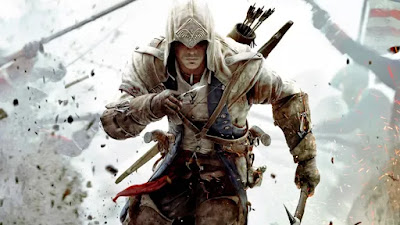
To their credit, I will say that Assassin Creed 3's story did tell half of it's tale incredibly well. Taking place throughout the events of the American war for independence, players were offered the chance to play both sides of the historical conflict as well as the fantastical fictional one. We started off as Haytham Kenway, grandmaster of the American Templars, before being thrust in the shoes of his bastard son, the half native-American, Ratonhnhaké:ton. (Once more, glad this is a written blog.) This allowed us to finally learn just what the Templars were about and actually sympathize with their members and their plans, which made it all the more cool to go up against them as Ratonkn- screw it, Connor. (As he is known for most of the game.) This really is highlighted in the post murder ghost-chat scenes. (Which is a concept that is never actually explained in the franchise. Throw it on the pile.) In AC3, each Templar has a role they pursue and believe in fully, and they lament Connor for being more harmful for the land than good. Each time you off someone, you are hit with a healthy dump of shaming until you're not entirely sure if you're still the good guy, which allows for Connor and his father to meet and play off each other in a really cool way.

Unfortunately, the other half of the story followed the journey of Connor Kenway from childhood to adulthood, and he was easily the least likeable part of the game. As opposed to the charismatic lovable charm of Ezio, Connor was serious and mostly humorless. This would have been fine if he wasn't also grumpy, ill-tempered and even a bit pig-headed at times. And it's a little bit of a problem when your key character is thoroughly unlikeable and you prefer it when you played his villain father in the prologue. There were some attempts to soften him up, by making him the landlord of a fledgling community in which he knew everyone and helped them with their issues. But those missions were, inexplicably, all optional, meaning that a lot of fans only saw the arsehole Connor and ended up thinking "Man, I miss Ezio." (Which is why you have to be careful not to set the bar so high, Ubisoft.)

The Gameplay was the most fun part of it all, transforming the free running to feel more fluid and free, although the world design suffered as a result. New York and Boston in their colonial forms were very bland locales and the 'Frontier' which connected the lands felt overlarge and underpacked. Whilst Brotherhood and Revelations had managed to marry their freerunnning and world design to a point where their platformer gleamed shades of Tomb Raider/Uncharted in it, Assassin's Creed 3 lost all of that in favour of more flashy moments. That being said, the combat felt like a decent improvement and there were the bones of a stealth mechanic to this game. (Finally.) If only they had completely left out all of the annoying 'evaesdropping missions'.

Connor's story follows his uncovering of 'The grand temple' and his gathering of the keys to open it. (Haven't we seen this one already?) And Desmond's story showed us the evolution of our plucky bartender into an actual field agent. Some of the biggest set-pieces in the story revolved around Desmond's missions to secure the Temple keys and it was at this point that folk started to get hope for the future of this franchise. Even if the past-protagonist was feeling a bit lame, the modern day protagonist would start to steal the show as things became more involved. Desmond's tale reached it's zenith once his Father, William Miles, is kidnapped by Warren Vidic and Dezzy is forced to storm the holding facility in which he was once kept in order to get his dad back. We get to see Desmond bring along his Apple (the one he killed Lucy for) and twist the minds of hundreds of guards into shooting themselves. (Which would be somewhat horrific if this series felt half as serious as it takes itself.) Desmond gets into a stand-off with Vidic, makes Warren off himself and rescues his dad once and for all.

That was the moment when it became clear that even if Connor sucked, Desmond would supplant him to become the rock of the series. It made sense, afterall Desmond was the man who Ezio gave his blessing to, so who else could carry that cool legacy? All that was left was for Desmond to activate the grand temple which generated a huge forcefield over the Earth that soaked up all the cosmic radiation from the sunflare. (Ugh, I hate this story thread.) Only... something strange happened. Because as soon as the planet was saved, Desmond fell down dead. Wait. Then who are we supposed to follow in the next game? There would be a next game, right? Of course, Ubisoft assured us, we'd just be going a new direction with things. And that was the start of the end.

Next came 'Assassin's Creed: Liberation'. It's terrible. What do you mean you want more of a review? Urgh, okay... Liberation starts the new thread of the modern day storyline wherein Abstergo have founded a new division of their company called 'Abstergo Entertainment' which adapts the memories of Assassin's into video games that can be played by the public. (How is this story thread even dumber than the Martians?) Aveline de Grandpré is the 'star' of this game and she... is just the absolute worst. Whereas Conner was annoying, Aveline is a cardboard cutout throughout the entire story with no flaws, quirks, charm or residual personality whatsoever. The game also brushed by all the parts of her story that could be interesting or bring us closer to her core motivations like, oh I dunno, the process of her becoming an Assassin! That's right! Aveline is the first Assassin who wasn't born into this world and the game simply skips through her finding out about the world of Templars and magical Pieces of Eden. (Writing is hard, I suppose.)

For this game the player is framed as a nameless, faceless consumer of Abstergo Entertainment who bought their copy of 'Liberation' and has it hacked into by some Assassin's. Which makes no sense considering the game was made for home consoles, (Despite the real-life Liberation originally being exclusive to handhelds) so there is no online capabilities for the Assassin's to get in through. (But what did we say about this series and making sense?) The Assassin's explain that, whilst Aveline's story is a real one, Abstergo have altered the events to hide the truth from the tale. Through their help, the player is then tasked with unravelling these events whilst enduring the most frustrating storyline that the Assassin's Creed team have ever put together. (I wish I could get into details but I just cannot bear to right now.) At the end we find out the shocking truth... that Abstergo are hiding the existence of a secret shadow cabal called 'The Templars' which they themselves are likely part of! Kinda already knew that one, Ubisoft, but thanks for wasting 10 hours of my life re-revealing that to me. I appreciate it.

Then was 'Assassin's Creed 4: Black Flag', which was the last time that Ubisoft got close to recapturing the greatness that was 'Brotherhood.' This was game built on the back of the naval encounters that were a small sub-section of AC3's content, and they built it into a gimmick that spanned the entire game. Players would take control of Edward Kenway, Welsh sailor turned pirate and, incidentally, Haytham Kenway's father. Edward was a roguish thief with a heart of gold and ambitious dreams of a free world. (Oh my god! A character with ambitions? Are Ubisoft feeling okay?) The main selling point was, of course, the ship combat and wanton piracy which would take up the majority of player's time, but the story wasn't so bad either.

Edward ends up getting shipwrecked on an island and stumbles into the clothes of a nobody that the audience can identify as an Assassin. Some light graverobbing later, he discovers that the man was carrying a package to the governor of Cuba for a nice payday. Never one to miss out on an opportunity, Edward deigns to deliver the message himself whilst coming across a ship of his own and befriending some historically appropriate pirates along the way. (Just like in any good Assassin's Creed game.) Once there, we discover that this Assassin was really a defector who sold out his compatiots' secret bases to the Templars, but Edward doesn't know any of this and just plays along.

Throughout the course of 'Black Flag' we get to meet a slew of colourful characters, including Mary Read, Anne Bonny and Edward Thatch (Blackbeard), and begin to discover just where Edward fits in with all of them. We get to become part of his struggle for liberation from the thumb of the colonies and governors and even start to gain some sympathy for the thieves of the age. It's very similar to a tale about Cowboys, like RDR 2. They're criminals who lie, cheat and steal to get what they need, but they don't know any other way of life and are desperately just trying to stay afloat amidst turbulent times that threaten to drown them. As the narrative moves onwards and pirates start dying, we start to see more and more how Edward is a beacon for a dying age, and soon it becomes clear that he has to jump ship or go down with all his friends. There's one scene that I love where Edward is struck by a second of clarity at his lowest moment and remarks "When I turn around, and look at the course I've run... there's not a man or woman that I love left standing beside me."

Of course, there has to be one thing that lets it all down (This is a Ubisoft game, afterall) and for 'Black Flag' it was the modern day sections. Now with Desmond gone, there was this big question about who would be the next protagonist that would provide the connective tissue to untie these anthology games once more; and Ubisoft answered: "No one, ya idiots!" Yep, this game starred another faceless no-body, although this one worked for Abstergo Entertainment under the Chief Creative officer, Melanie Lemay, who is decidedly too cheerful at every waking moment.You are tasked with digging through some rando's genetic memory to prep it for sanitation before the editing team got to it. (Will the fun never stop?)

Along the way your communications get hijacked by a mysterious guy from the tech department who is mean and makes you do weird tasks around the office by blackmailing you. These include hacking into terminals, trespassing and delivering packages to the delivery girl in the lobby who is- oh no, it's Rebbecca and Shaun again! Is this my hell? At the end of the game it is revealed that... oh god, there's so much to go through... bear with me. So, the guy who's blackmailing you just happens to be a dead-ringer for a pirate who betrays Edward called Bartholomew Roberts. That is because this man is actually the long-dead ancient lover of the Martian Juno, an evil Martian Scientist who sought to survive the solar flare by transferring her mind into a machine and leaving it there until she got freed, which is what Desmond did at the end of Assassin's Creed 3. However, she couldn't bring her lover along, so she came up with another solution. As the designers of the human race, (Oh, did I mention that the Martian's created the human race with their pieces of Eden? That's a thing) Juno knew how to code the genetic makeup for her man so that he would be reborn again and again throughout history until the day where she was freed... so they could be together? (I'm guessing at that last part.) This guy was the latest rebirth in that chain and was working to connect Juno into Abstergo's servers so that she could start her conquest of the human world, which is something she know wants to do for whatever reason. (Oh, and he was also working with the Assassin's on the side which really speaks poorly of that organization's ability to perform background checks on thier secret operatives.) You still with me? Cause I'm not even with me at this point. This franchises narrative started off so goddamn intriguing and now it feels like it's jumped the freakin' solar system. 

Finally we come to 'Assassin's Creed: Unit-', oh wait, there was 'Assassin's Creed: Rogue'! That game was released at the same time as 'Black Flag' under the knowledge that Black Flag would be too demanding to the processing power to effectively run on the lower gen, meaning that they made 'Rogue' to cater to the lower gen whilst 'Black Flag' would appeal to next gen. Although, I suppose the porting job wasn't as hard as they originally thought, because I played 'Black Flag' on 360 originally, so they managed it. 'Rogue' was still there, however, and it used 'Black Flag's ship mechanics and bought them to the cold Atlantic sea. 'Rogue's story was bleak, dumb and told the story of an Assassin, Shay Cormac, going rogue and joining the Templars because of a misunderstanding that could have been cleared up over a coffee. Also, the modern day game developer ends up joining the Templars at the end for literally no reason as he/she is well aware how evil these guys are at this point and honestly should have quit after all the weird crap that happened in 'Black Flag'. This game also introduced the new big bad of the franchise, Otso Berg, who uses the data that the player collects throughout this game to transmit a chilling message across the Assassin's online information channels (Which he knows about, for some reason) about how William Miles, their current leader, is dead. Of course, it literally takes a few messages to confirm that William is not dead and that Otso is just trolling, but he got to disorganize the Assassin's for the space of 20 seconds so... victory to the Templars? (Seriously, who's writing this garbage at this point? And what even bigger idiot is paying attention to it all and trying to make it all somewhat coherent on his blog?)

Now it's time for 'Assassin's Creed: Unity', and oh boy what a dumpster fire that was. Unity marked yet another jump forward in the game engine and a jump forward in the storyline away from the Kenway family and to a french man; 'Arno Dorian'. (Although, Haytham Kenway's protégé, Shay Cormac, does murder Charles Dorian at the end of 'Rogue', which is the event that kicks of 'Unity', so there is some connection there.) Predictably, this game took place during the french revolution and would follow the events of one of history's largest class revolts ever, something that Ubisoft were very serious about portraying given that they are, at heart, a french company.

To this end Ubisoft debuted a mind-blowing E3 showcase that was full to the brim of incredible graphics, bustling crowds and dynamic gameplay opportunities. Who could forget the moment when the player, upon observing a bubbling crowd outside of a aristocrat's house, fired a pistol into the air to ignite the crowd, Boston massacre style? Or how about when Ubisoft slyly revealed that the gameplay was cooperative, with 3 other Arno clones helping him pick apart the mansion guards and close in on the target in that hyper-organized fashion that we never see out of actual multiplayer matches.

All this excitement built to a fever pitch which the final game did not satisfy for many key reasons, although mostly because the thing was broken. Most ports could barely run those huge crowds from the demo without chugging to a snail's pace, crowds would never actively riot regardless of what the player did and glitches and bugs sprung up everywhere surrounding this game. Models wouldn't load properly, players would glitch through floors and key items would magically stop working for no reason whatsoever. The exciting multiplayer aspect was nigh-on unplayable, and even when it was the action was mostly limited to a selection of unrelated missions that could largely be completed without any help. Also, Ubisoft thought it was smart to add microtransactions into their game for buying weapons and armour pieces; because the game barely runs so they might as well charge you for more of it.

In terms of story, the game actually disappointed yet again, once more the player was put in control of a faceless Abstergo Entertainment consumer who's game is hacked by Assassins. (Do they need a better filing system at Ubisoft? They keep recycling the same crappy scripts.) The player is then recruited in a hunt for the body of a man that they are calling 'The Sage'. This being the title that is given to the human reincarnations of Juno's lover. (Glad we're pursing this stupid plotthread...) This is intercut with little recorded scenes of things that the actual Assassin's are doing, including one scene where Otso Berg shoots Shaun Hastings. (Too bad he didn't kill the annoying pri-)

As for Arno's journey, this one really bugs me because I actually saw the potential. The game starts with Arno witnessing his father being murdered (by Shay) and consequently being taken in by his father's friend, François de la Serre, becoming an adoptive member of his family. Fast forward to adulthood and Arno is a budding swordsman who is sleeping with Élise de la Serre, who is his sister. Wait, what? Okay, so she's his adoptive sister, but that's still kinda supremely creepy. Anyway, through some contrivances Arno finds out that his deceased father was an Assassin and ends up joining the order. From here he finds out that the Assassin's and Templars of the age are currently in a truce (which makes no sense) and that Élise is a member of the Templars. Do you see the potential there? A story of two lovers caught on opposite sides of a generations long war, twisted between their feelings for each other and warring philosophies, likely ending with one having to take the life of the other? Yeah, none of that happens.

Instead, Élise and Arno just kinda team up as they navigate the French revolution, make friends with various famous people (Yeah, they meet Napoleon) and uncover a plot that threatens to shatter this fragile truth. Honestly, there's a lot of this story that I plain don't remember, so if there's anymore to this that I'm missing out, I'm sorry but it doesn't matter right now. At the end of it all, Arno and Élise track down the Sage, who is trying to screw with everything for some reason, and have a really bad boss fight with him down in the Paris catacombs whilst he wields a new piece of Eden, (Finally!) The Sword of Eden. Events transpire, things go awry and Élise gets killed by shockwave (literally the most pathetic on-screen way to die) and Arno finishes the Sage. The final events of the game show Arno hiding the Sage's remains among the bones in the catacombs, somewhere where modern day Abstergo will never find them. (Basically meaning that the entire problem that this game poised itself upon had solved itself before the game ever began. Wonderful.)

That was probably the peak of Assassin's Creed and after that a lot of the hype from this franchise seemed to die off. The game's were getting more and more repetitive, sometimes the bugs were nigh-on game breaking and the overarching plot was circling around itself, going nowhere. The next game, Syndicate, was okay to some degree, but failed to move the franchise forward out of it's rut and actually dropped the ball bigtime in terms of combat. (Why remove most of the weapon categories? That was literally the only thing giving the combat any remote depth.) I will say that I liked the industrial London setting and thought Evie Frye was cool, but Jacob Frye was a trainwreck and the final boss fight was honestly one of the worst that I've ever seen in gaming excluding those that are literally just quick time events.

Syndicate didn't sell too well and people began to wonder if the magic of Assassin's Creed was finally starting to run out. Watch Dogs was proving to be a more positively received franchise and Ubisoft refused to mix those two brands out of some odd pride that seems prohibitive. (Those franchises wink at each other all the time, let them consummate already!) Instead, Ubisoft decided to go back to the drawing board and give themselves a full year off to envision the next Assassin's Creed game, one that would set the franchise back on track and reboot the modern story thread. And that is the game that I will be reviewing next Sunday (As soon as I'm done reminding myself everything that happened. It's a long one.)

Saturday, 1 February 2020

Here comes the Blizzard of our miscontent

Living long enough to become the villain...

Now that's a bit more like it. After coming across a whole generation of remakes and remasters that threatened to change my mind on the prospect of revisiting past projects, there's finally one to break that dangerous illusion before it set. On one hand, it's incredibly lazy and speaks to a certain lack of creativity on the part of the imaginers who spearhead these projects, but on the otherhand if you can take something great and make it even better, then why wouldn't you? (Heck, if this kept up I might have even forced myself to give those new Disney movies a shot.) Thankfully, one burning turd in the pile has come crashing at our feet to remind us all that good remakes are the exception, not the rule, and that far too often their conception is drawn by corporate greed and likely a little active disdain for an audience always asking for the envelope to be pushed.

So if you've spent anytime around the internet gaming community forums in the past week, you'd have been made aware of the fact that Blizzard is trending in the news once again, and it hasn't even been 6 months since the whole 'Chinese toadies' debacle. Do you remember during the Blizzcon right after that whole mess, when Blizzard Entertainment's President, J. Allen Brack, descended from his ivory tower to let everyone know an important message; "We're sorry!". J, (Who's first name I literally cannot find after a 3 minute google search) relayed how Blizzard had let the community and themselves down, but it would be okay because they were committing to making things right from here on in. "We will do better going forward," the man promised with all the sincerity of the Monkey and the Buzzard "But our actions are going to matter more than any words". Why, how very true Bracky-boy, you can make all the crocodile tears that you want but until we see a marked improvement from your office and the way you do business, ain't no one sane going to be cozying up to you guys anytime soon. That was a self imposed test that Blizzard ultimately failed with their very next game release, the remake of 'Warcraft 3: Reign of Choas': 'Warcraft 3: Reforged'.

For the uninitiated, Warcraft 3 is the last real-time strategy title out of the Warcraft franchise and, incidentally, one of the most influential video games ever made. This title defined RTS for many games going forward, established the popularity of a brand that would then go on to found the biggest MMO of all time: 'World of Warcraft, and built the archetype for a dedicated & creative modding community. Skyrim may boast the biggest modding community of all time, (or at least it did at one point, not sure now) but 'Warcraft 3' likely had the most ambitious. 'Reign of Choas' was a bastion for custom games that completely rewrote the rules of play, total conversion mods that were send-ups to franchises like DBZ and loving attempts touch-ups of the UI interface. (Which I'm told was garbage. I never played the game so I'll just have to take their word for it.) In fact, one such custom game for Warcraft proved so popular that is spawned a little spin-off title called 'Defence of the Ancients 2'. That's right, 'DOTA 2' and by transitive property, 'League of Legends' and the entire MOBA genre, own their entire existence to 'Warcraft 3: Reforged' and it's passionate community of minds. (So you can blame old-school Blizzard next time you see that same god-damn LOL advert by Nevercake. "Take that, rich guy, go buy an island somewhere and afford stuff; I'm trying to play League here with my many friends, who exist!")

It was with some fanfare then, that Blizzard announced back in 2018 how they planned to completely remake Warcraft 3 from the groundup in 'Warcraft 3: Reforged'. (And it was only 'some' fanfare, considering that was the same year that they announced 'Diablo: Immortal'. That particular travesty seemed to suck a lot of the air out of the room.) This was heralded with a long list of promises that was sure to set fan's hearts a-racing; there would be a remodeled UI, various narrative tweaks to bring the storyline in line with WoW's lore and, most exciting of all, brand new cinematic cutscenes for the various campaigns. These cutscenes were the star of their trailer, showcasing a decently rendered back and forth between pre-Lich Arthas and pre-dead Uther. Whilst this animation wasn't anywhere as good as Blizzard's irregular expansion announcement vids, (Which makes sense. Those probably take a couple of years to put together each.) it was still a grand step-up from the original game and had fans pumped for what other improvements the remake might have. Promise after promise leaked from Blizzard's chalice and the thirsty masses drank it up, never even tasting the healthy heap of arsenic mixed in.

But in the words of every adulterer ever; Promises are made to be broken, and so one could have guessed that Blizzard would break theirs, However, I don't think anyone could have imagined the extent to which this would reach. It started innocently enough, with the team sending corrections to news outlets that were calling this a 'remake'. Whilst that label was accurate to some degree, this title would have more in common with a 'remaster' with updated models, features and content, but the same basic beloved experience behind it all. Fair enough, it was good of them to clear it up. Then came a straight up walk-back. This one was, again, quietly announced by Blizzard to the necessary news outlets, and was concerning the narrative tweaks that fans were dubious about. They wouldn't be going through with it, just bringing everyone the same great story as before. It was around about this time that they began detailing how they wanted this game to feel like the original as much as possible because that was already such a strong foundation. Strong words, team. Speechcraft 100.

So some folk who didn't go the distance of setting up a Google alert for this title might be a little disappointed when the release date came, not everything was as promised. But again. Blizzard's incompetence overshadowed even the most pessimistic predictions. Once the game launched it became clear, not much love and attention had really gone towards this title. The biggest issue, off the bat, was the gutting of the online features that made the original title so enduring. There were no profiles, clans, competitive play or even custom games at launch due to a brand new online infrastructure that was established for this title. (A seemingly incomplete infrastructure.) Although, even folk who prefer the single player may have found themselves disappointed. The UI was unchanged, the updated visuals are practically unnoticeable unless you zoom into the character models (which no one does in an RTS) and do you remember those cinematic cutscenes? You know, the ones that Blizzard sold this concept on the back off? Those ones that are still up on their YouTube channel and which are linked on their official website promoting this game? Gone. Completely no-existent in this title.

There are a bevy of bugs and other missing features that afflict this title, but the only other big change in this game was Blizzard's approach to custom content. Firstly, they strictly laid out their rules for using custom assets on their map creator, which prohibits some of the best overhauls for the game from being ported to the new title, and they specifically changed their privacy notice to future-proof their game. Eagle eyed readers noted how Blizzard's new rules meant that anything created within their game would be the sole property of Blizzard, and fans had to waive away their moral rights in order to get access to these tools. That means that Blizzard could take ownership of anything cool built using their engine and they wouldn't be obligated to pay the original maker so much as a credit. (Way to treat the community that made your game so big, guys! what's the encore? You going to go around kicking over strollers?) All of this is done, rather transparently, to avoid another situation like DOTA 2 arising, which cost Blizzard millions, perhaps even billions, in potential revenue. (Just nipping all creativity right in the bud, hey guys?) 

And the icing ontop of all of this? The updated online infrastructure which rips away so many features, eliminates custom games (for now, at least) and enforces draconic copyright measures, has been implemented across the board. Meaning that all these systems aren't just present on 'Warcraft 3: Reforged', but on the original 'Warcraft 3' as well. All those 18 years worth of custom community content that kept this title alive, gone overnight, sacrificed to the Blizzard corporate puppet with Activision playing with the stings, in a theatre showing exclusively to the Chinese government. Blizzard haven't just ruined the legacy of one of their classic games, but the classic game itself. (Even EA couldn't manage that with Battlefront 2.)

So Warcraft fans were sold a lie, kicked in the nuts and left to fester, what's their next course of action? Well, get a refund of course! There's only the lingering problem that might make that difficult; and that would be Blizzard's particularly unfriendly refund policy. (Yep, the hole gets deeper.) In Blizzard's eyes, the second someone opens their software the company is completely relieved of all refund-responsibilities and will not cede to negotiations on that matter. This was something that was heavily put to the test in the wake of Reforged's release, as folk battled against Blizzard's systems to get their money back. Things got so messed up, that people on the official Blizzard forums were giving fellow consumers guides on how to force a refund out of Blizzard. Although these samaritans were then promptly banned for their troubles. (Because Blizzard are bringing their pneumatic digger for this hole.)

And that's where things currently are with Blizzard's latest disaster. Fans have review bombed this title's Metacritic to a 0.7 consumer score as of the writing of this blog. (which is only bottomed by 'Day One: Gary's incident'.) The bastions of consumer friendliness that once was has been transformed by Frostmourne and now stand as a lifeless shell of their former selves. (Get it? I replaced 'Activision' with Frostmourne- making it into a Warcraft 3 reference... well, I thought it was funny.) J. Allen Brack has straight up proved that his promises don't mean jack and now it's up to the audience to decided if enough-is-enough or if they have to wait for the next disaster to hit their wallets before they do something. Do they need to wait until Blizzard resell Overwatch to us and call it a new game? Or until Diablo 4 launches as a predictable buggy mess? When will the final shoe drop off this hydra-esque monstrosity and what exactly are the consumers ready to do about it? I guess this coming month will tell.